


























Views
Downloads

Classifying and Calculating Angles | Essential Grade 8 Math
Paste this activity's link or code into your existing LMS (Google Classroom, Canvas, Teams, Schoology, Moodle, etc.).
Students can open and work on the activity right away, with no student login required.
You'll still be able to track student progress and results from your teacher account.
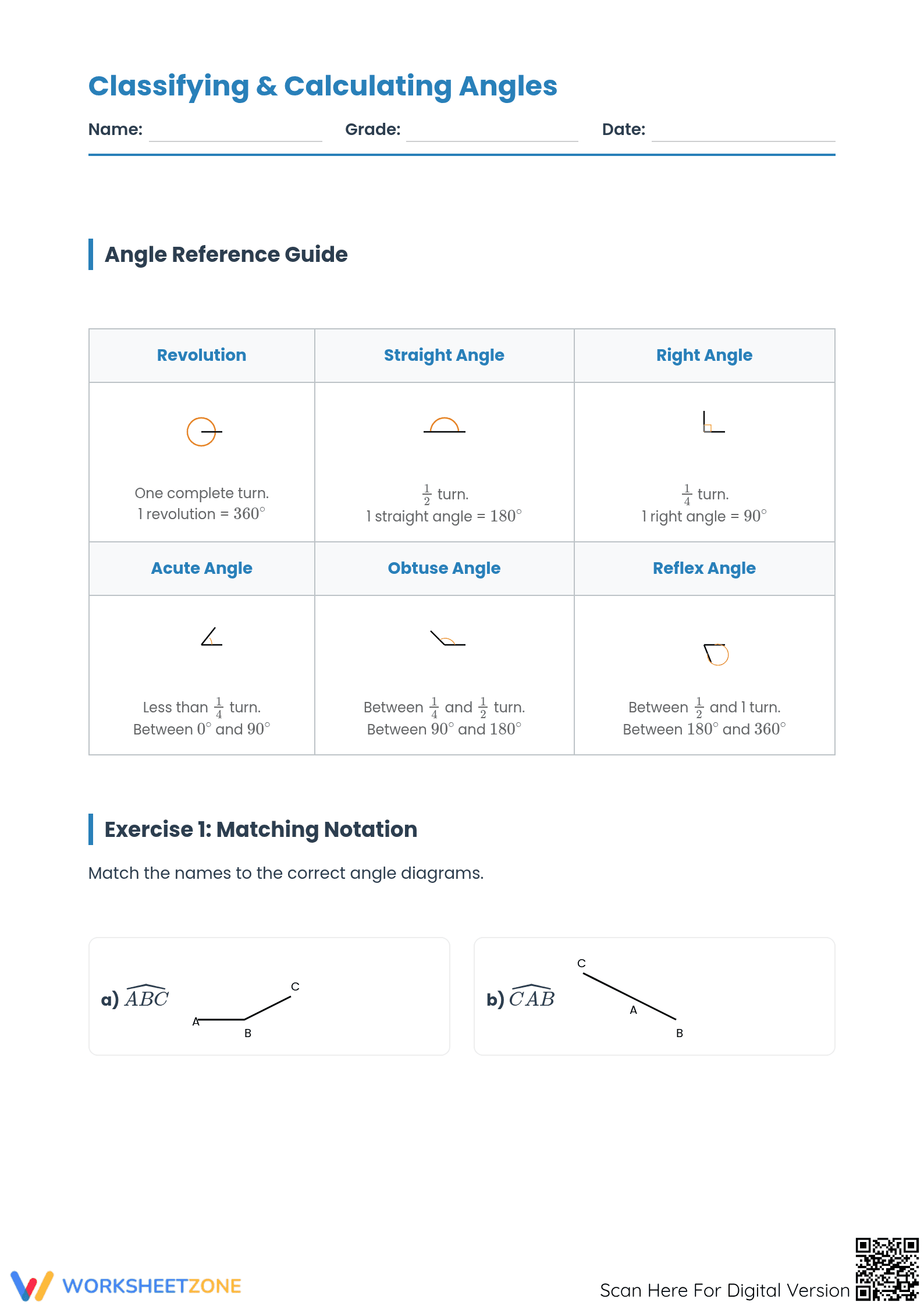
This Grade 8 math worksheet provides a comprehensive approach to identifying and calculating angles. Students first review fundamental geometric definitions before applying their knowledge to notation matching and multi-step angle calculations. By the end of these exercises, learners will demonstrate mastery in distinguishing between acute, obtuse, reflex, and straight angles while accurately naming them using standard geometric notation.
At a Glance
- Grade: 8 · Subject: Math
- Standard:
CCSS.MATH.CONTENT.8.G.A.5— Use informal arguments to establish facts about angle sums and relationships.- Skill Focus: Angle classification and notation
- Format: 2 pages · 6 problems · Answer key included · PDF
- Best For: Independent practice or quick review
- Time: 15–20 minutes
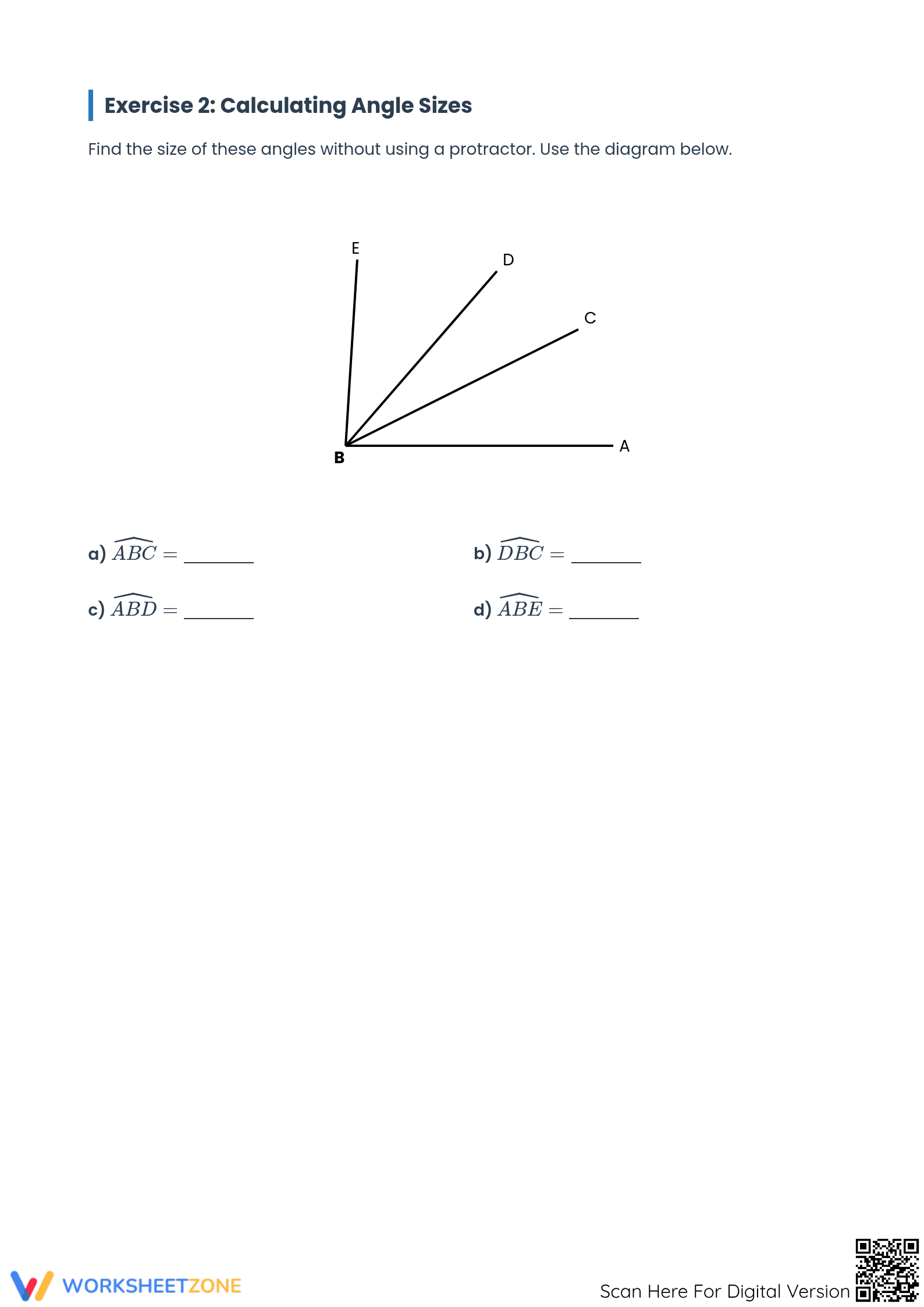
The resource features a two-page layout designed for clarity. Page one contains a visual Angle Reference Guide that defines six key angle types—from acute to revolution—using both degrees and fractional turns. This is followed by notation matching exercises. Page two challenges students to calculate specific angle sizes within a complex diagram without the use of a protractor, encouraging logical deduction and the application of geometric properties.
This worksheet is designed for a zero-prep workflow. Teachers can print the two-page PDF in under 30 seconds. Distribution takes less than a minute, and because the reference guide is built directly into the first page, students can begin working immediately without additional instruction. Reviewing the 6 tasks using the provided answer key takes approximately 2 minutes during whole-class feedback, making it an ideal choice for busy classroom schedules.
Primary alignment is to CCSS.MATH.CONTENT.8.G.A.5, which focuses on establishing facts about angles and their relationships. The worksheet also supports foundational geometry standards by reinforcing the identification of right, acute, and obtuse angles in two-dimensional figures. Both standard codes can be copied directly into lesson plans, IEP goals, or district curriculum mapping tools to ensure instructional compliance.
Use this as a formative assessment after a lesson on geometric properties. It works exceptionally well as a bell-ringer to gauge prior knowledge before moving into more complex proofs. Teachers should observe students during Exercise 2 to see if they are correctly identifying adjacent angles and using the vertex notation properly. Expected completion time ranges from 15 to 20 minutes depending on student familiarity with geometric notation.
This resource is ideal for Grade 8 and 9 students who need to solidify their understanding of geometric terminology. It is particularly helpful for visual learners who benefit from the included reference guide. Pair this worksheet with a protractor-based activity or an interactive geometry software session to provide a well-rounded instructional experience that bridges the gap between visual identification and mathematical calculation.
According to the RAND AIRS 2024 report, high-quality instructional materials that integrate visual scaffolds—like the reference guide found in this worksheet—significantly improve student retention of mathematical vocabulary. By explicitly linking fractional turns to degree measurements, this resource addresses common misconceptions in middle school geometry. The inclusion of standard notation matching ensures that students are prepared for the rigorous demands of high school geometry and standardized testing. Research from EdReports 2024 emphasizes that zero-prep materials allow educators to focus more on individual student interventions rather than administrative setup. This worksheet meets those criteria by providing a self-contained learning cycle that moves from reference to application. The standard CCSS.MATH.CONTENT.8.G.A.5 is central to developing the spatial reasoning skills necessary for success in advanced STEM fields and vocational technical pathways.


