


























Views
Downloads

Letter G Tracing Worksheet — Printable Kindergarten ELA
Paste this activity's link or code into your existing LMS (Google Classroom, Canvas, Teams, Schoology, Moodle, etc.).
Students can open and work on the activity right away, with no student login required.
You'll still be able to track student progress and results from your teacher account.
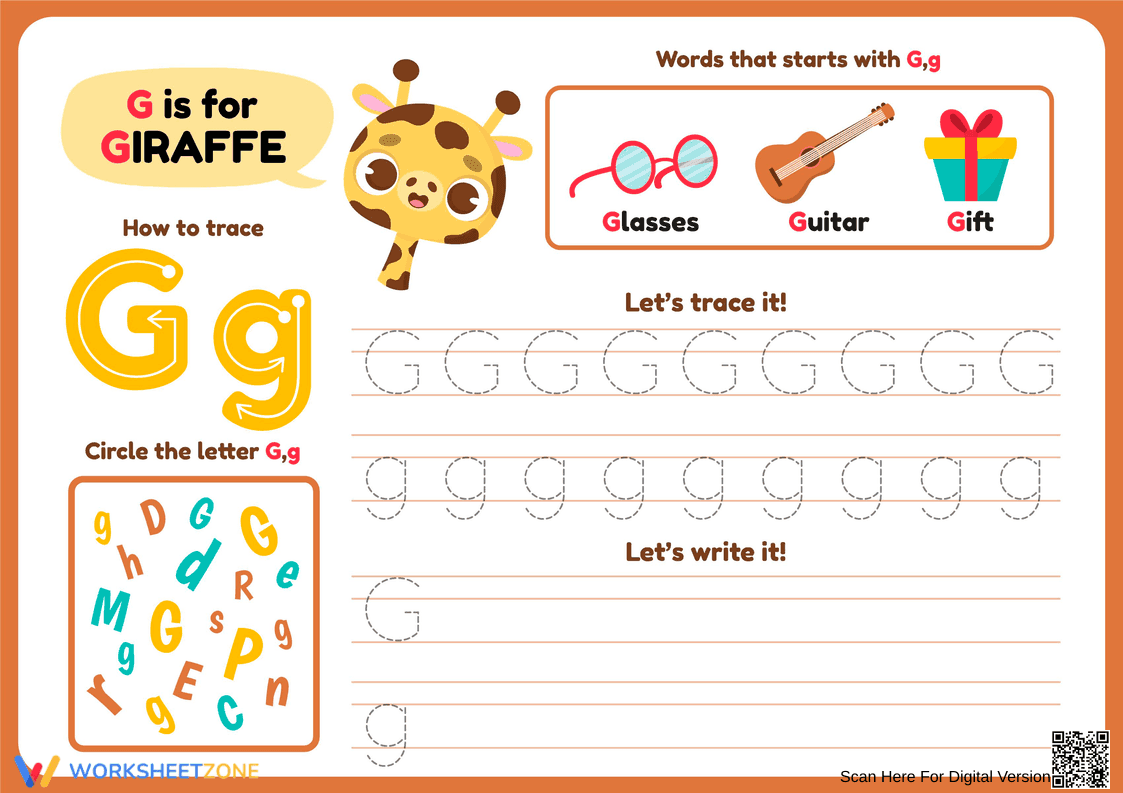
This printable Kindergarten handwriting worksheet helps early learners master the letter G through targeted tracing and identification exercises. By combining directional arrows, guided tracing lines, and independent writing space, students develop fine motor control and letter recognition skills essential for foundational literacy.
At a Glance
- Grade: Kindergarten · Subject: ELA
- Standard:
CCSS.ELA-LITERACY.L.K.1.A— Print many upper- and lowercase letters.- Skill Focus: Letter G tracing and identification
- Format: 1 page · 4 tasks · No answer key needed · PDF
- Best For: Morning work or literacy centers
- Time: 10–15 minutes
This single-page resource features four activity zones to build letter familiarity. It begins with a visual guide showing stroke order for uppercase and lowercase G, alongside vocabulary words like giraffe and guitar. Students then complete a letter-hunt to circle the target letter. Finally, the page provides dotted tracing practice and blank primary lines for independent writing.
Zero-Prep Workflow
Follow these three simple steps for immediate classroom implementation:
- Print (1 minute): Generate the PDF and print a class set.
- Distribute (1 minute): Hand out the sheets during morning arrival or transition times. The intuitive layout means students know exactly what to do.
- Review (3 minutes): Quickly scan completed pages to check for proper stroke direction and line adherence.
With a total teacher prep time of under two minutes, this worksheet is an ideal addition to any emergency sub plan or last-minute center rotation.
Standards Alignment
This handwriting practice page is directly aligned to CCSS.ELA-LITERACY.L.K.1.A, which requires students to print many upper- and lowercase letters. By isolating the letter G and providing explicit stroke models before moving to independent practice, the activity ensures students build the muscle memory required for fluent writing. Both standard codes can be copied directly into lesson plans, IEP goals, or district curriculum mapping tools.
How to Use It
Deploy this worksheet during morning work or as an independent station during literacy rotations. While students work, teachers can conduct quick formative assessments by observing pencil grip and verifying letters start from the top. Most students will complete the page within a 10 to 15-minute timeframe.
Who It's For
This resource is optimized for Kindergarten students and first graders who need targeted handwriting intervention. The clear visual boundaries and step-by-step scaffolding make it highly accessible for occupational therapy sessions or students developing fine motor strength. Pair this worksheet with a tactile activity, such as tracing the letter G in sand, to reinforce motor pathways.
Mastering foundational handwriting skills like those aligned to CCSS.ELA-LITERACY.L.K.1.A (Print many upper- and lowercase letters) is a critical step in early literacy development. According to a comprehensive EdReports 2024 analysis, explicit instruction in letter formation significantly reduces the cognitive load required for transcription, allowing young writers to eventually focus on content and expression. When students practice tracing and identifying specific characters, such as the letter G, they build essential orthographic mapping skills. This direct practice bridges the gap between visual recognition and motor execution. Providing structured, repetitive practice with clear directional models ensures that students do not develop ingrained, inefficient writing habits. Early intervention through targeted worksheets helps solidify these pathways, setting a strong foundation for future reading and writing fluency.


