


























Views
Downloads




Aligned Rhetorical Choices Worksheet | Grade 11 English III
Paste this activity's link or code into your existing LMS (Google Classroom, Canvas, Teams, Schoology, Moodle, etc.).
Students can open and work on the activity right away, with no student login required.
You'll still be able to track student progress and results from your teacher account.
This worksheet teaches Grade 11 students to trace a speaker's style choices back to the rhetorical situation and explain how each choice builds power and persuasiveness. Using one fictional town-meeting speech, students move from a modeled annotation to independent written analysis of exigence, audience, purpose, and constraints.
At a Glance
- Grade: 11 · Subject: English III
- Standard:
RI.11-12.6— Analyze how a speaker's style and content make a speech persuasive- Skill Focus: Linking style choices to exigence, audience, purpose, and constraints
- Format: 6 pages · 10 problems · Answer key included · PDF
- Best For: Rhetorical analysis practice with speeches
- Time: 40–55 minutes
What's Inside
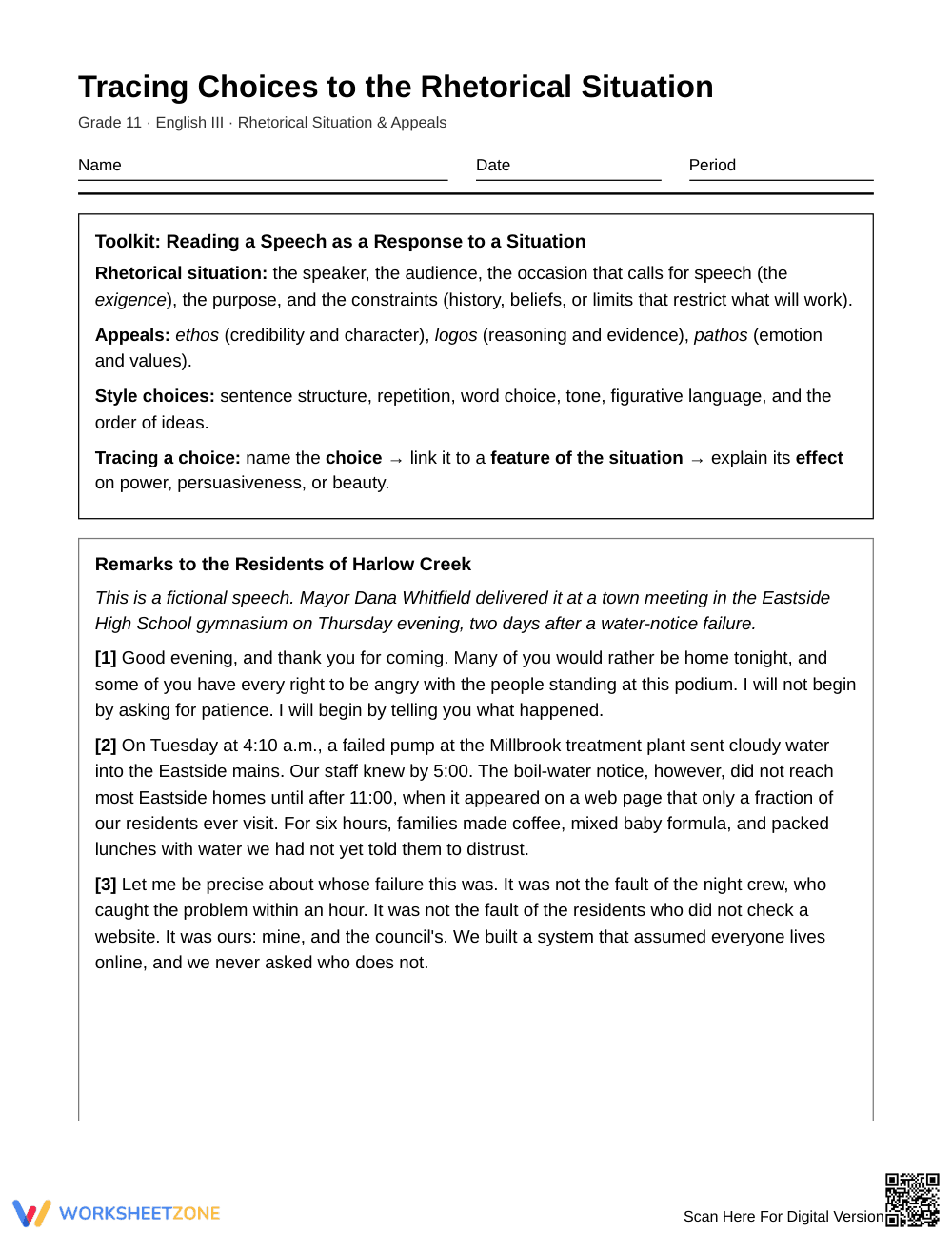
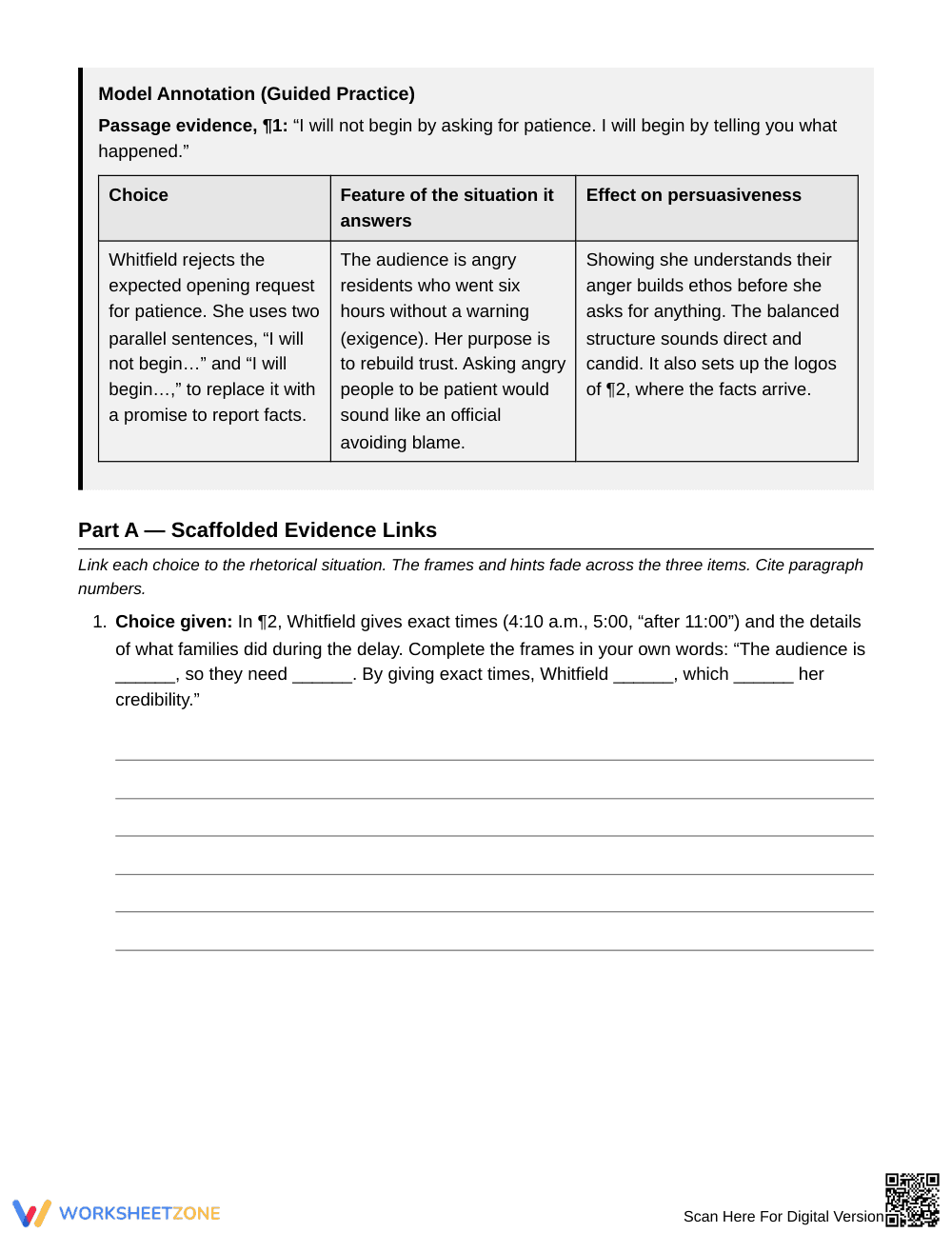
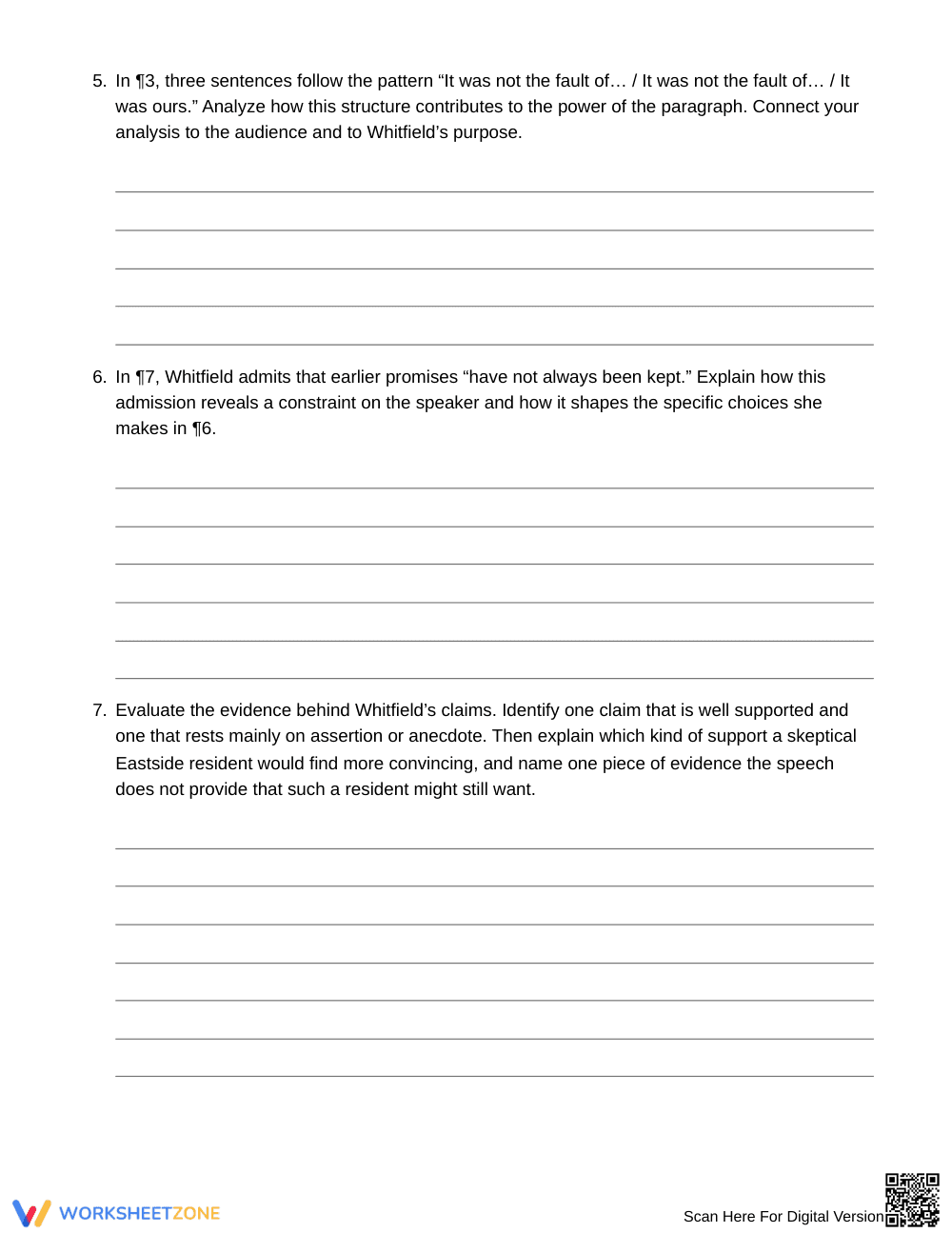
The 6-page PDF opens with a toolkit defining rhetorical situation, appeals, and style choices, then presents an 8-paragraph fictional speech by a mayor addressing a water-notice failure. A model annotation precedes three scaffolded evidence links, five written analyses, and two multiple-choice interpretation checks. A 3-page answer key is included.
Skill Progression
- Guided practice: one model annotation plus 3 Part A items with sentence frames that fade across the set.
- Supported practice: 2 Part C multiple-choice checks, each requiring a quoted phrase and a brief explanation.
- Independent practice: 5 Part B analyses written in complete sentences with paragraph citations.
The sequence follows gradual release: I Do, We Do, You Do.
Standards Alignment
RI.11-12.6: Determine an author's point of view or purpose in a text in which the rhetoric is particularly effective, analyzing how style and content contribute to the power, persuasiveness, or beauty of the text. Students practice this by naming a choice, linking it to the situation, and explaining its effect. This standard code can be copied directly into lesson plans, IEP goals, or district curriculum mapping tools.
How to Use It
- After direct instruction on appeals: assign the model and Part A as a guided in-class check.
- During a unit assessment window: assign Parts B and C independently.
Formative tip: watch whether students name a choice without linking it to the situation. That gap shows where to reteach. Expect 40–55 minutes, or split the work across two class periods.
Who It's For
Built for Grade 11 English III students who can identify appeals but need practice explaining why a choice fits a context. Sentence frames in Part A support emerging analysts, while the evidence-evaluation task in Part B stretches advanced readers. Pair it with an anchor chart on ethos, logos, and pathos or a mini-lesson on exigence and constraints.
RI.11-12.6 asks Grade 11 students to analyze how a speaker's style and content contribute to the power, persuasiveness, or beauty of a text. This worksheet teaches that skill as a three-step move: name the choice, link it to a feature of the rhetorical situation, and explain its effect. Students apply the move to a fictional mayor's speech after a water-notice failure, working through 10 tasks across 6 pages, with a 3-page answer key for quick feedback. Fisher & Frey (2014) describe gradual release of responsibility, moving from modeling to guided to independent work, as a reliable structure for building complex skills, and this worksheet follows that sequence with a model annotation, fading sentence frames, and extended written analysis. The result is evidence of whether students can connect rhetorical choices to audience, purpose, exigence, and constraints rather than only labeling devices.


