


























Views
Downloads
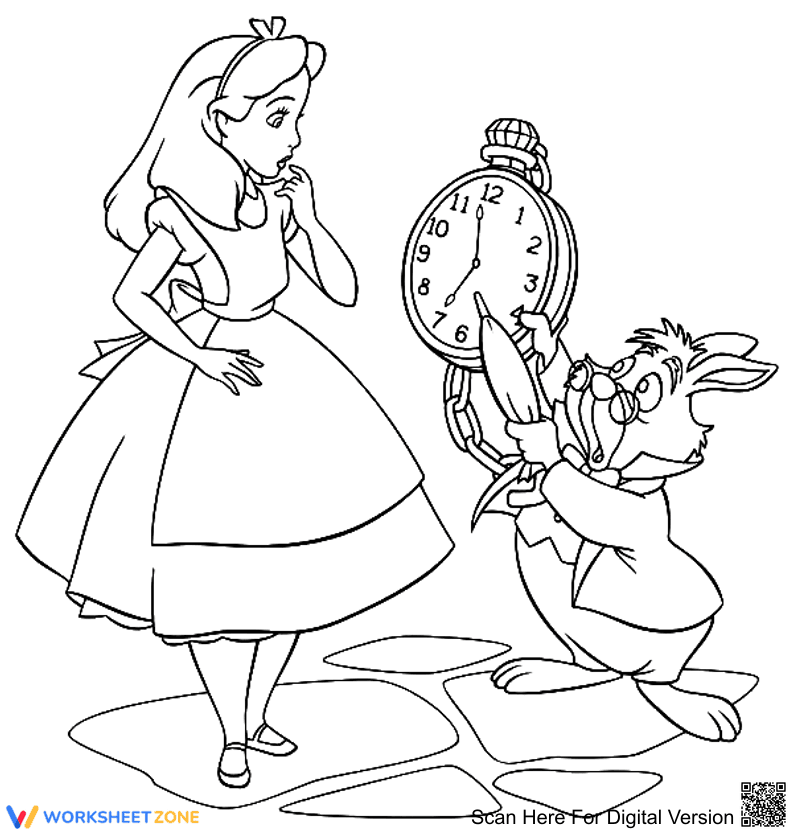

Alice and White Rabbit Coloring Page | Essential Printable
Paste this activity's link or code into your existing LMS (Google Classroom, Canvas, Teams, Schoology, Moodle, etc.).
Students can open and work on the activity right away, with no student login required.
You'll still be able to track student progress and results from your teacher account.
This Alice and White Rabbit printable coloring page provides a creative outlet for students to develop fine motor control while engaging with classic literary characters. By focusing on the intricate details of the White Rabbit's watch and Alice's dress, learners improve hand-eye coordination and artistic expression. It is a perfect supplement for early literacy units.
At a Glance
- Grade: Kindergarten · Subject: Arts & Crafts
- Standard:
CCSS.ELA-LITERACY.SL.K.5— Add drawings or other visual displays to descriptions to provide additional detail- Skill Focus: Fine motor development
- Format: 1 page · 1 task · Answer key N/A · PDF
- Best For: Early finishers and literacy centers
- Time: 15–20 minutes
Inside this resource, you will find a high-quality, single-page PDF featuring a detailed line-art illustration of Alice encountering the White Rabbit. The image includes the iconic pocket watch, providing various small areas for precision coloring. This 1-page layout is designed for immediate use without any complex assembly or teacher instructions, making it an efficient addition to any classroom toolkit.
The zero-prep workflow for this worksheet is designed for maximum efficiency. First, print the single-page PDF (30 seconds). Second, distribute the sheets to students during a transition or as part of a literacy center (30 seconds). Third, review the completed work to observe fine motor progress or use the finished pages for a classroom display (1 minute). Total teacher prep time is under 2 minutes, making it an ideal sub plan filler.
This activity aligns with `CCSS.ELA-LITERACY.SL.K.5`, which encourages students to add visual displays to descriptions to provide additional detail. While primarily an artistic task, it supports the standard by allowing students to visualize and detail a scene from a known text. This standard code can be copied directly into lesson plans, IEP goals, or district curriculum mapping tools.
Use this worksheet as a hook before reading a simplified version of Alice in Wonderland to build character familiarity. Alternatively, assign it as a formative assessment observation tool to check for pencil grip and spatial awareness during independent work time. Expect students to spend between 15 and 20 minutes completing the detailed illustration, allowing for a focused instructional block.
This resource is ideal for Preschool through Grade 2 students, particularly those needing extra practice with grip strength and color boundaries. It pairs naturally with a read-aloud of Lewis Carroll's classic or an anchor chart describing character traits. It serves as an excellent quiet-time activity for early finishers or as a calming transition after recess.
According to the RAND AIRS 2024 report, integrating visual arts into early literacy instruction significantly improves student engagement and retention of narrative elements. This Alice and White Rabbit worksheet addresses the CCSS.ELA-LITERACY.SL.K.5 standard by facilitating the connection between visual representation and character description. Research from Fisher & Frey (2014) suggests that fine motor activities like coloring are foundational for writing readiness, as they strengthen the intrinsic muscles of the hand required for letter formation. By providing a structured yet creative task, this worksheet allows educators to monitor developmental milestones in a low-stakes environment. The inclusion of 1 detailed scene ensures that students remain focused on the task for a sustained period, promoting cognitive endurance. This resource serves as a bridge between creative play and formal academic standards, ensuring that even simple coloring tasks contribute to the broader goal of literacy and motor mastery.


