


























Views
Downloads
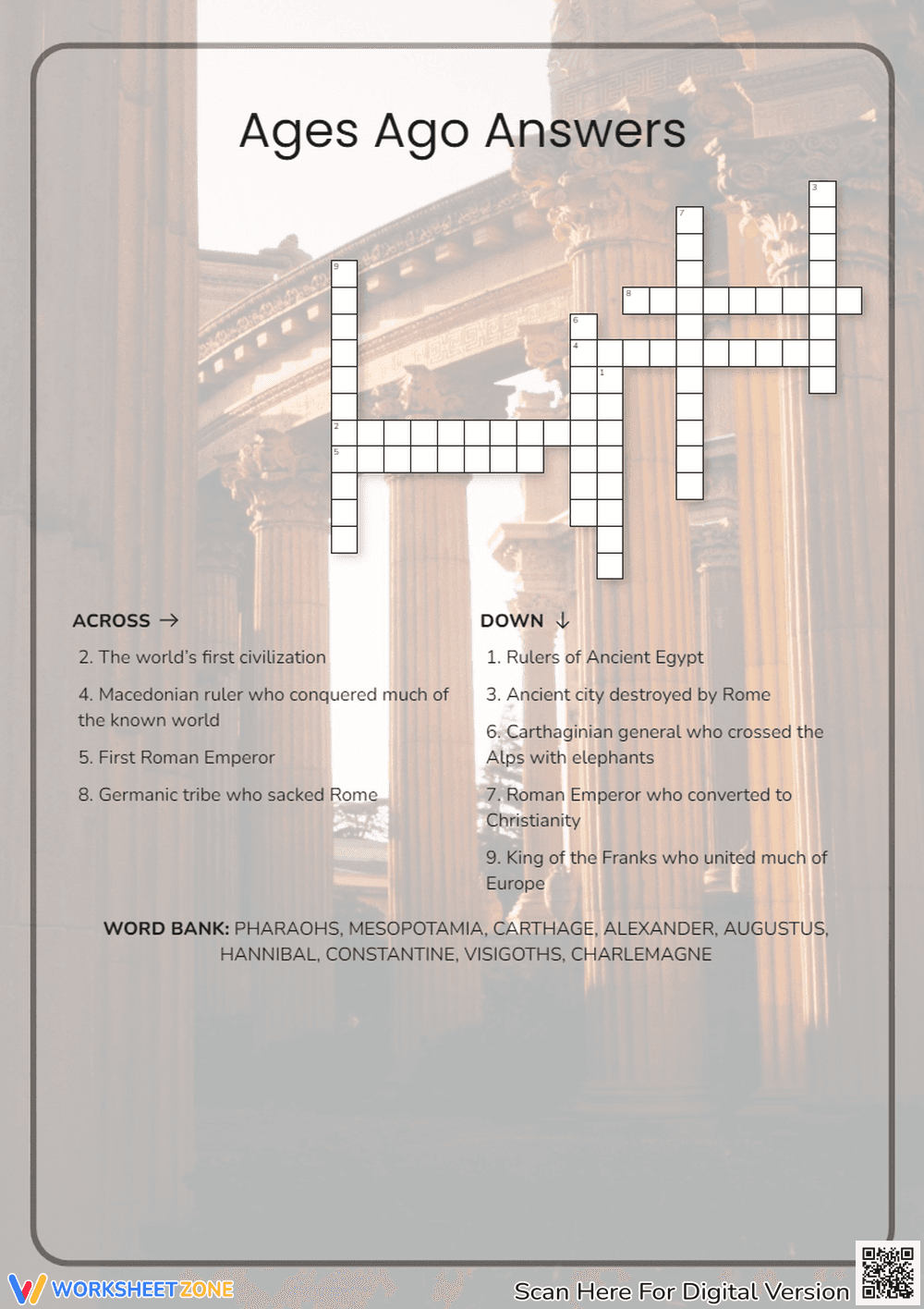

Printable Ancient History Crossword | Grade 4
Paste this activity's link or code into your existing LMS (Google Classroom, Canvas, Teams, Schoology, Moodle, etc.).
Students can open and work on the activity right away, with no student login required.
You'll still be able to track student progress and results from your teacher account.
This Grade 4 ancient history crossword puzzle helps students master domain-specific vocabulary related to early civilizations and historical figures. By matching descriptive clues to key terms like Mesopotamia and Charlemagne, learners reinforce their understanding of historical contexts while practicing reading comprehension and spelling in an engaging format.
At a Glance
- Grade: 4 · Subject: Social Studies
- Standard:
CCSS.ELA-LITERACY.RI.4.4— Determine the meaning of domain-specific words- Skill Focus: Ancient History Vocabulary
- Format: 1 page · 9 problems · Answer key included · PDF
- Best For: Independent practice or review
- Time: 15–20 minutes
This single-page resource features a classic crossword puzzle layout with nine distinct clues covering major historical eras, from Ancient Egypt to the Roman Empire. To support student success, a complete word bank is provided at the bottom of the page, containing all necessary terms such as Pharaohs, Augustus, and Visigoths. A full answer key is included to make grading fast and accurate.
Designed for immediate classroom implementation, this worksheet requires minimal teacher preparation:
- Print (1 minute): Download the PDF and print a class set. The clear design ensures excellent readability.
- Distribute (1 minute): Hand out the puzzle during social studies blocks. The included word bank means students can begin immediately.
- Review (3 minutes): Use the provided answer key to quickly check student work.
With under two minutes of total teacher prep time, this activity is highly suitable for emergency sub plans.
This activity aligns with CCSS.ELA-LITERACY.RI.4.4: Determine the meaning of general academic and domain-specific words or phrases in a text relevant to a grade 4 topic or subject area. It also supports general historical knowledge acquisition by familiarizing students with foundational figures and empires. Both standard codes can be copied directly into lesson plans, IEP goals, or district curriculum mapping tools.
Teachers can utilize this crossword puzzle as a formative assessment after completing a unit on ancient civilizations to gauge vocabulary retention. Alternatively, it serves as an excellent introductory activity; students can use textbooks or digital devices to research the clues and discover the terms before formal instruction begins. While students work, teachers can observe which historical clues require more time to decode, indicating areas for future review. Most students will complete this task within 15 to 20 minutes.
This resource is primarily designed for fourth-grade students studying ancient history, though it is also appropriate for second and third graders needing enrichment. The inclusion of a word bank provides built-in differentiation, supporting English Language Learners and students who struggle with spelling recall. It pairs perfectly with introductory reading passages about the Roman Empire or early Mesopotamian civilizations.
Integrating domain-specific vocabulary practice through structured activities like this crossword puzzle directly supports CCSS.ELA-LITERACY.RI.4.4, requiring students to determine the meaning of domain-specific words. According to Fisher & Frey (2014), explicit vocabulary instruction combined with repeated exposure in varied contexts significantly improves reading comprehension and content retention in the social sciences. When students actively engage with historical terms—such as identifying the Carthaginian general who crossed the Alps or the first Roman Emperor—they build a stronger cognitive framework for understanding complex historical narratives. This targeted practice ensures learners move beyond rote memorization, developing the academic language necessary for advanced historical analysis. By utilizing a familiar puzzle format with built-in scaffolds, educators can effectively lower the affective filter, encouraging sustained attention and deeper cognitive processing during independent work periods.


