




























Views
Downloads
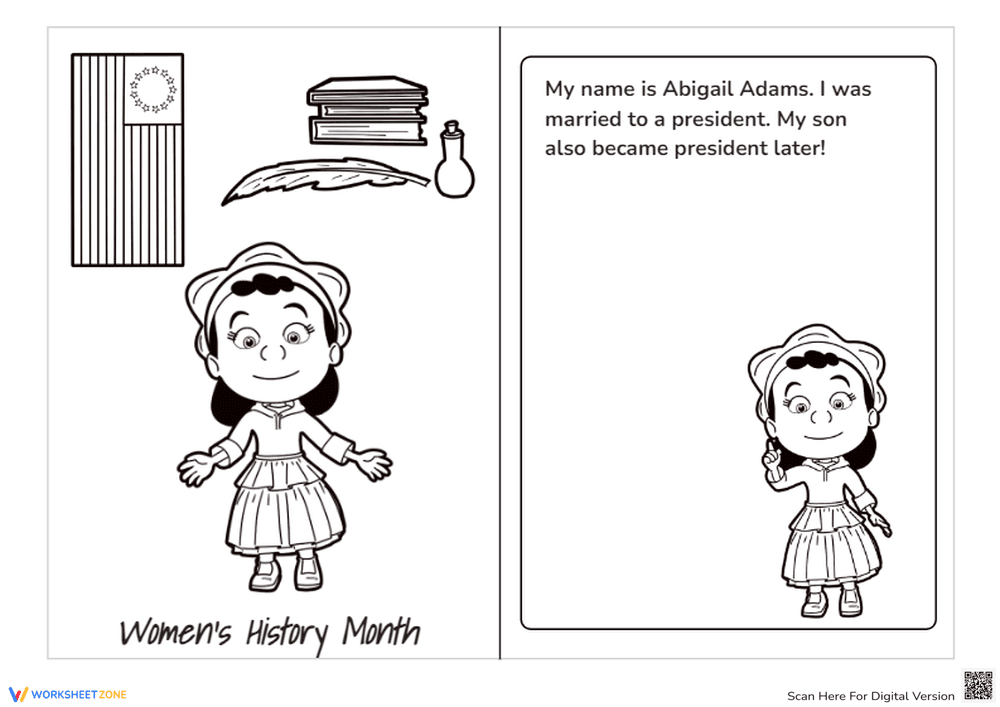

Abigail Adams Greeting Card | Essential Grade 1-3 History

Paste this activity's link or code into your existing LMS (Google Classroom, Canvas, Teams, Schoology, Moodle, etc.).
Students can open and work on the activity right away, with no student login required.
You'll still be able to track student progress and results from your teacher account.
This Abigail Adams greeting card worksheet provides a creative way for students to engage with American history during Women's History Month. By combining a coloring activity with biographical facts, students learn about the unique role Adams played as both a wife and mother to U.S. Presidents. This printable resource ensures students retain historical information while developing fine motor skills through a hands-on craft.
At a Glance
- Grade: 1-3 · Subject: Social Studies
- Standard:
CCSS.ELA-LITERACY.RI.2.3— Describe the connection between a series of historical events or individuals- Skill Focus: Abigail Adams & Women's History
- Format: 1 page · 1 craft task · No answer key needed · PDF
- Best For: Women's History Month classroom activity
- Time: 15–20 minutes
The worksheet features a high-quality illustration of Abigail Adams alongside iconic symbols of the 18th century, including a quill pen, inkwell, and the early American flag. A dedicated text box provides a first-person introduction to her historical significance, while the foldable card format allows for personalization. This 1-page PDF is designed for easy printing and immediate use without additional assembly instructions.
The zero-prep workflow for this activity is designed for maximum efficiency in a busy classroom. First, print the single-page PDF (30 seconds). Second, distribute the sheets to students along with coloring supplies (1 minute). Third, review the historical facts about Abigail Adams as a class while students work (5 minutes). Total teacher preparation time is under 2 minutes, making this an ideal resource for sub plans or last-minute holiday celebrations.
This resource is primarily aligned with `CCSS.ELA-LITERACY.RI.2.3`, which focuses on describing the connection between historical individuals. By identifying Abigail Adams' relationships to two presidents, students practice informational text comprehension. Additionally, it supports state-level social studies standards regarding significant women in American history. Both standard codes can be copied directly into lesson plans, IEP goals, or district curriculum mapping tools.
Use this worksheet as a formative assessment after a read-aloud about the American Revolution to see if students can identify Abigail Adams. It also works well as a morning work activity during March to introduce Women's History Month themes. Expect students to spend 15 to 20 minutes coloring and discussing the facts presented on the card before taking it home to share with family.
This activity is tailored for students in grades 1, 2, and 3 who are beginning to explore biography and civic history. It is particularly effective for visual learners and students who benefit from kinesthetic activities. Pair this card with a picture book about the Adams family or a digital timeline of the Revolutionary War for a complete instructional unit that bridges social studies and literacy.
Abigail Adams represents a pivotal figure in American history, serving as a bridge between the Revolutionary era and the early Republic. According to the RAND AIRS 2024 report on elementary social studies, integrating creative arts with historical biography increases student engagement and retention of key facts. By identifying Adams as both a First Lady and a mother to a president, students begin to understand the complex social networks of early American leadership. This worksheet aligns with CCSS.ELA-LITERACY.RI.2.3 by asking students to connect individuals and historical events through a tangible medium. Research from Fisher & Frey (2014) suggests that multimodal learning—combining text, visual coloring, and physical construction—supports literacy development in early childhood. This resource provides a low-stakes entry point for discussing the contributions of women in history, ensuring that foundational historical knowledge is accessible to diverse learners in grades 1 through 3.


