


























Views
Plays
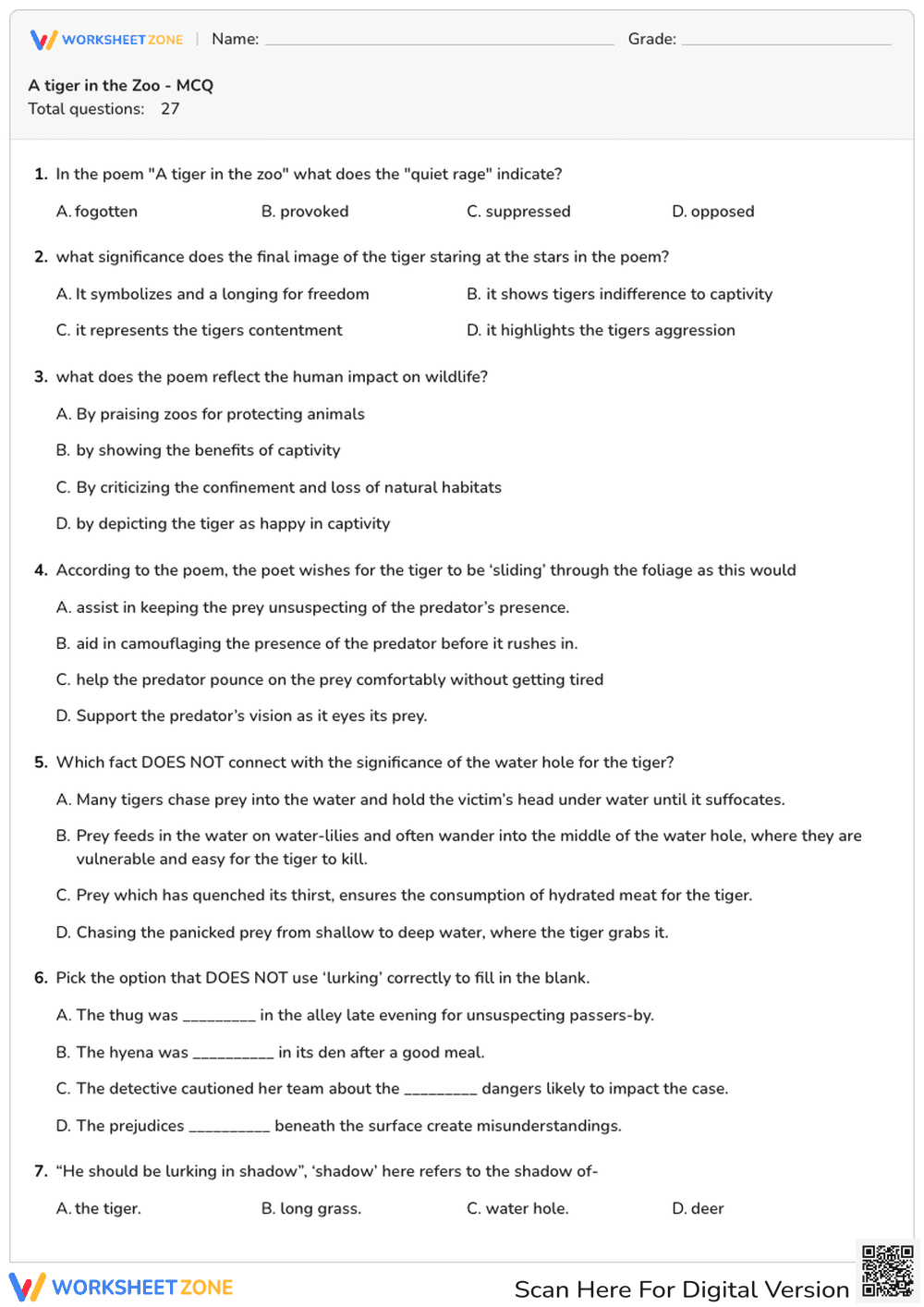
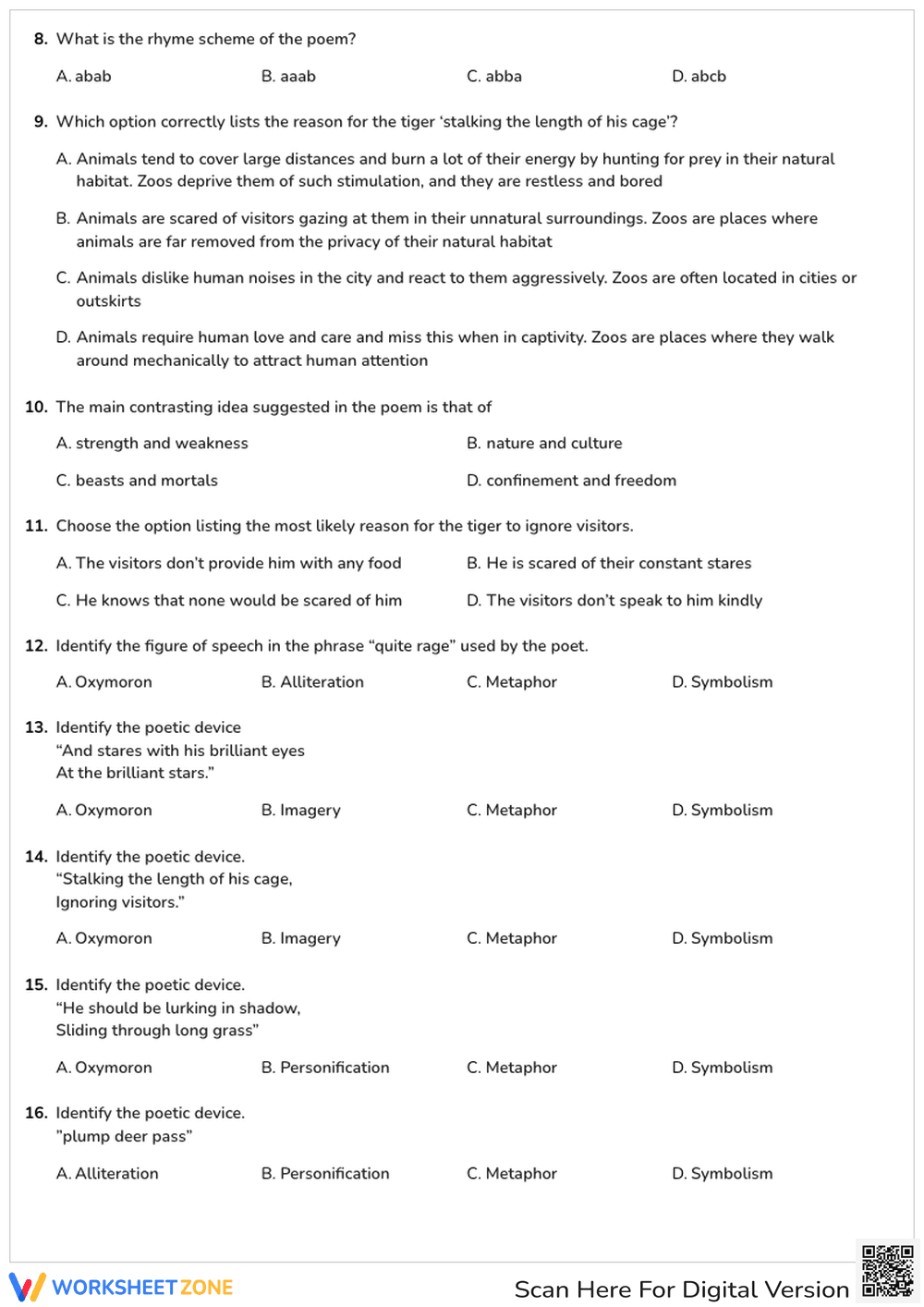
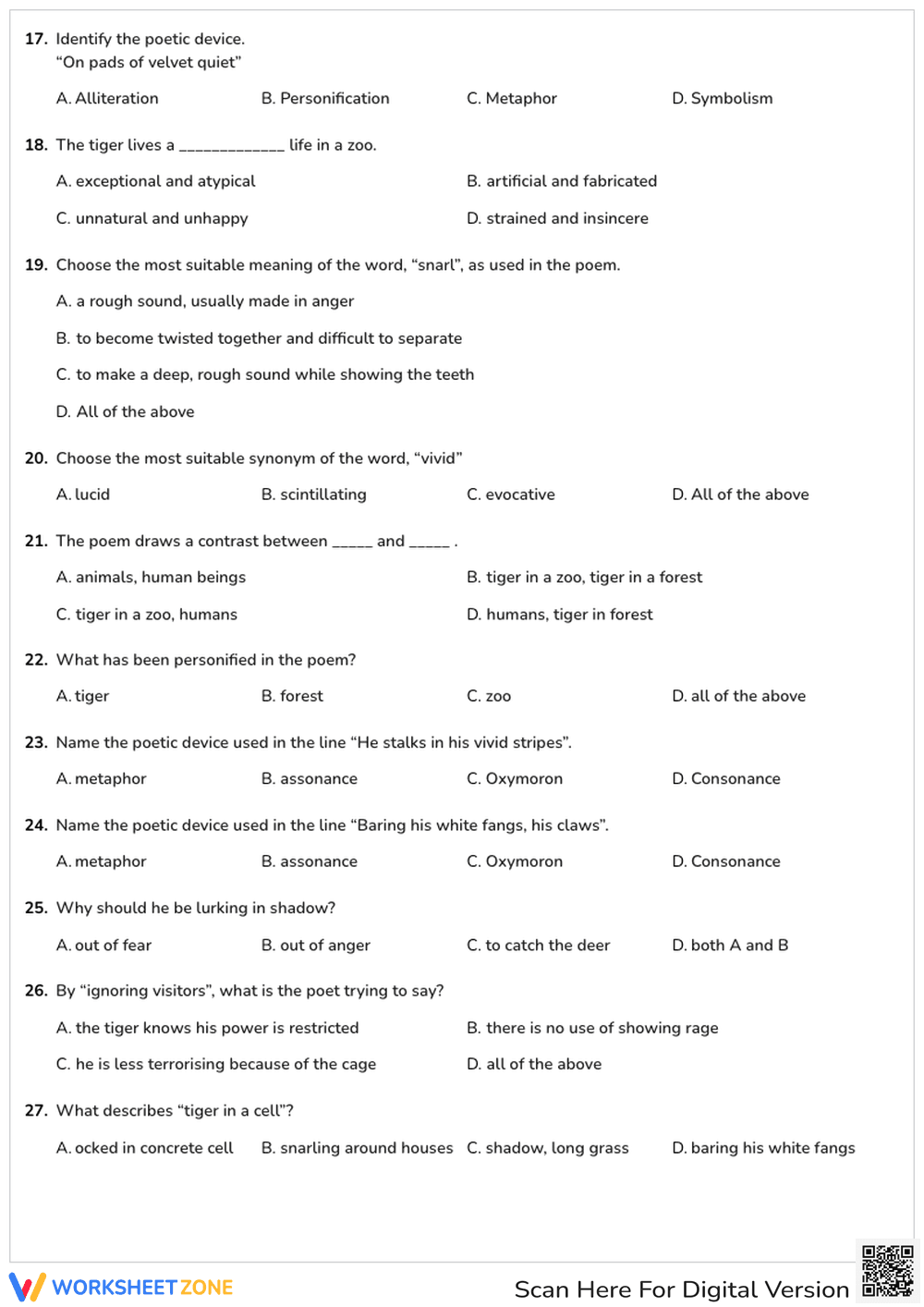

Essential Grade 10 Poetry Quiz: A Tiger in the Zoo
Paste this activity's link or code into your existing LMS (Google Classroom, Canvas, Teams, Schoology, Moodle, etc.).
Students can open and work on the activity right away, with no student login required.
You'll still be able to track student progress and results from your teacher account.
This Grade 10 poetry analysis worksheet provides a comprehensive assessment of Leslie Norris's poem, "A Tiger in the Zoo." Students engage with the text through 27 rigorous multiple-choice questions designed to evaluate their understanding of imagery, tone, and the central conflict between captivity and the wild. This resource ensures students can identify complex literary techniques while interpreting the poet's deeper message.
At a Glance
- Grade: 10 · Subject: ELA
- Standard:
CCSS.ELA-LITERACY.RL.9-10.4— Determine the meaning of words and phrases, including figurative and connotative meanings- Skill Focus: Poetry Analysis & Poetic Devices
- Format: 3 pages · 27 problems · Answer key included · PDF
- Best For: Summative assessment or reading check
- Time: 25–35 minutes
What's Inside
This three-page PDF contains a structured 27-question multiple-choice quiz. The assessment covers a wide range of analytical skills, including identifying rhyme schemes, interpreting oxymorons like "quiet rage," and analyzing personification. The layout is clean and professional, featuring clear question stems and four distinct options for every item. A full answer key is provided to facilitate rapid grading and immediate student feedback.
Zero-Prep Workflow
- Print: Generate class sets in less than 60 seconds using any standard black-and-white printer.
- Distribute: Hand out the three-page packets at the start of the period; no additional context or teacher lecture is required for students familiar with the poem.
- Review: Use the included answer key to grade an entire class set in under 10 minutes, or use the questions for a whole-group digital review session.
Standards Alignment
The primary focus is `CCSS.ELA-LITERACY.RL.9-10.4`: "Determine the meaning of words and phrases as they are used in the text, including figurative and connotative meanings; analyze the cumulative impact of specific word choices on meaning and tone." Additionally, it supports RL.9-10.2 by requiring students to identify the main contrasting ideas and themes. Both standard codes can be copied directly into lesson plans, IEP goals, or district curriculum mapping tools.
How to Use It
This worksheet is ideal as a post-reading summative assessment after a unit on contemporary poetry. It can also serve as a high-quality bell ringer or a sub plan activity. For formative assessment, observe which students struggle with the poetic device identification (Questions 12-17) versus thematic comprehension. Expect most Grade 10 students to complete the full 27-question set within a 30-minute window.
Who It's For
While designed for Grade 10 ELA classrooms, this resource is highly effective for advanced Grade 8 or Grade 9 students exploring figurative language. It is an excellent pairing for an anchor chart on poetic devices or as a follow-up to a direct instruction lesson on Leslie Norris. The multiple-choice format provides necessary structure for students who require clear parameters during testing.
According to research by Fisher & Frey (2014), the use of targeted multiple-choice assessments in poetry instruction allows educators to isolate specific misconceptions regarding figurative language before moving into complex essay writing. This worksheet addresses `CCSS.ELA-LITERACY.RL.9-10.4` by forcing students to distinguish between similar poetic devices such as alliteration, consonance, and assonance within the specific context of "A Tiger in the Zoo." By evaluating 27 distinct data points, teachers can accurately measure student mastery of literary analysis and vocabulary acquisition. The inclusion of questions regarding the "quiet rage" oxymoron and the "vivid stripes" imagery ensures that students are not merely reading for surface-level plot but are instead engaging with the author's craft. This systematic approach to poetry evaluation is a proven method for preparing students for high-stakes standardized testing and college-level literary criticism.


