


























Views
Downloads
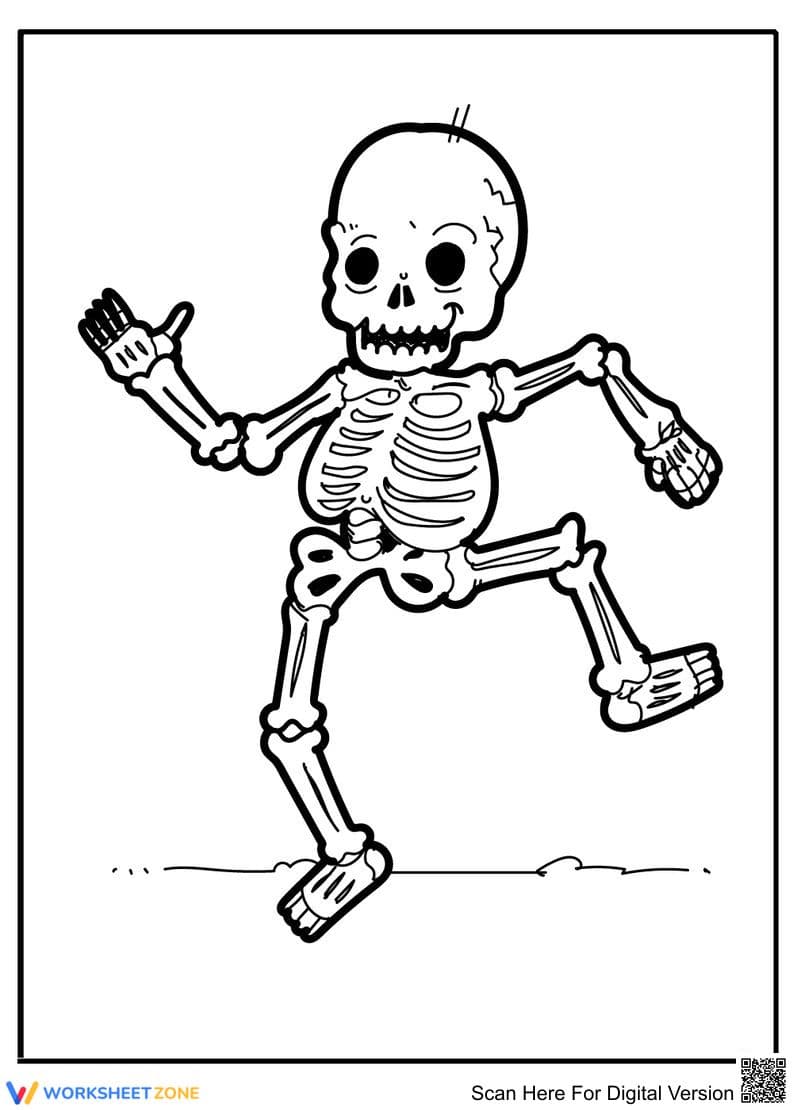

Printable Skeleton Coloring Page | Grade K-2 Science
Paste this activity's link or code into your existing LMS (Google Classroom, Canvas, Teams, Schoology, Moodle, etc.).
Students can open and work on the activity right away, with no student login required.
You'll still be able to track student progress and results from your teacher account.
This Grade K skeleton coloring worksheet provides a creative way for students to explore human anatomy while developing essential fine motor control. By engaging with this friendly, dynamic character, learners practice grip strength and spatial awareness. It serves as an ideal introductory activity for science units on the human body or seasonal October themes.
At a Glance
- Grade: Kindergarten · Subject: Science & Arts
- Standard:
K-LS1-1— Use observations to describe patterns of what plants and animals need to survive- Skill Focus: Fine motor skills and anatomy
- Format: 1 page · 1 task · Answer key not required · PDF
- Best For: Early finisher activity or science hook
- Time: 15–20 minutes
The resource consists of a single high-quality PDF page featuring a large, clear illustration of a skeleton in motion. The bold outlines are specifically designed to help younger students stay within the lines, supporting hand-eye coordination. There are no complex instructions, making it accessible for independent work or centers.
This worksheet is designed for immediate classroom implementation with a total prep time of under 2 minutes. First, print the single-page PDF for your class. Second, distribute the sheets along with crayons, markers, or colored pencils. Third, review the finished work to observe student pencil grip and color selection. It is a perfect grab-and-go resource for substitute folders.
The primary alignment is `K-LS1-1`, where students use observations to describe patterns in living things. While a skeleton is a biological structure, this page allows for the observation of bone placement and joint movement. Both standard codes can be copied directly into lesson plans, IEP goals, or district curriculum mapping tools.
Use this worksheet during the Engage phase of a science lesson about the human body to spark curiosity about what is under our skin. Alternatively, assign it as a calming morning work activity to settle students as they arrive. Expect students to spend 15 to 20 minutes completing the coloring task, providing a window for formative observation of their fine motor development.
This resource is tailored for Preschool through Grade 2 students, particularly those working on foundational motor skills. It is also beneficial for Occupational Therapy (OT) sessions. Pair this with a labeled anatomical chart or a read-aloud book about bones to deepen the educational impact.
According to the RAND AIRS 2024 report, integrating creative arts into core subjects like science significantly improves engagement and retention in early childhood education. This skeleton coloring worksheet addresses the K-LS1-1 standard by providing a visual representation of biological structures, allowing students to observe and internalize the concept of the skeletal system. Research from Fisher & Frey (2014) emphasizes that visual scaffolds and fine motor activities are critical for cognitive development in learners aged 4 to 7. By providing a low-stakes, high-interest task, educators can bridge the gap between abstract scientific concepts and concrete physical expression. This 1-page printable is a reliable tool for teachers seeking to supplement their curriculum with high-quality, standards-aligned visual aids that require zero preparation time while meeting developmental milestones in both art and science.


