


























Views
Downloads

Printable 1st Grade Word Search: Phonics & Spelling
Paste this activity's link or code into your existing LMS (Google Classroom, Canvas, Teams, Schoology, Moodle, etc.).
Students can open and work on the activity right away, with no student login required.
You'll still be able to track student progress and results from your teacher account.
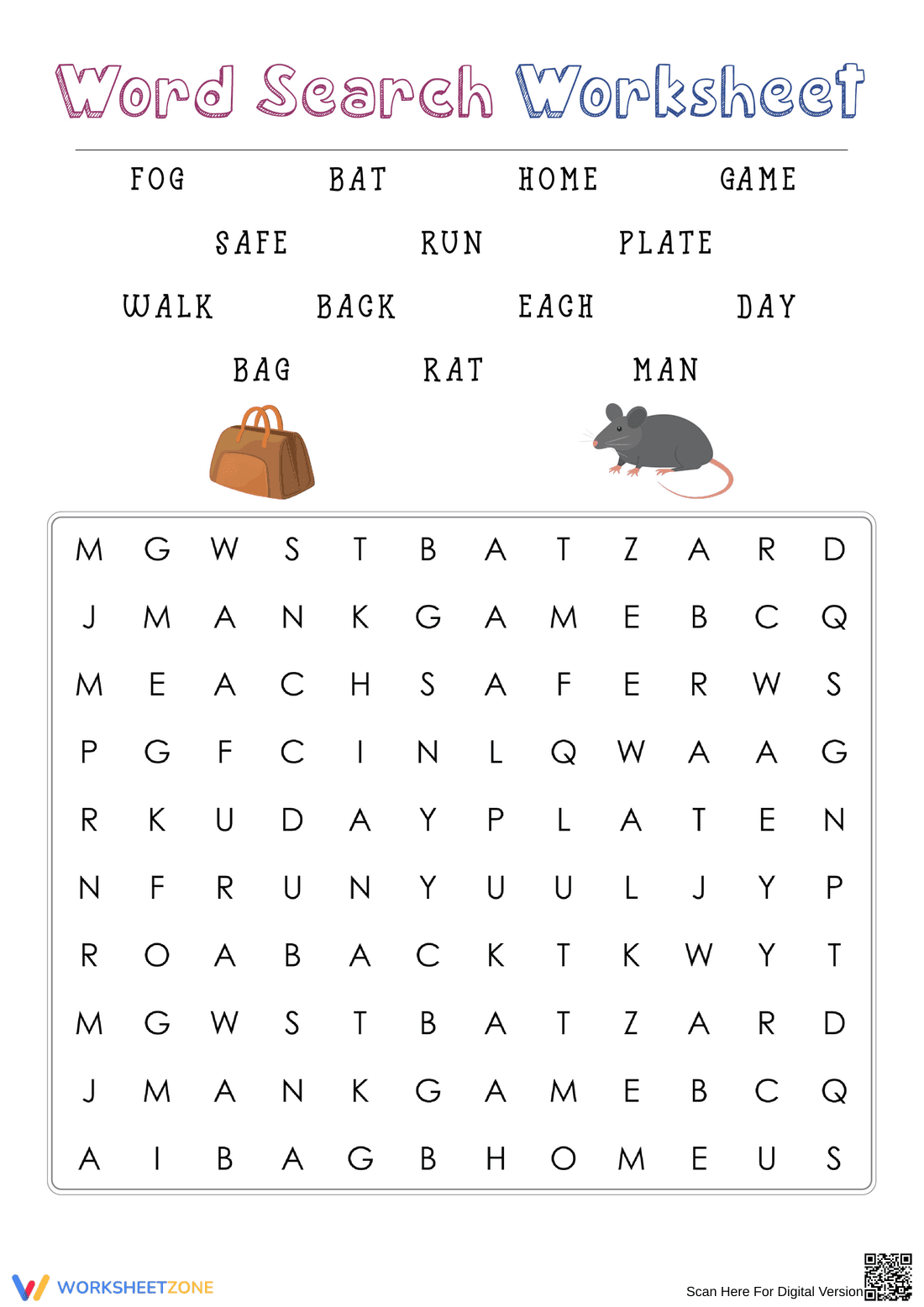
This printable first-grade word search worksheet helps young learners build essential word recognition and spelling skills. Students search for fourteen high-frequency words hidden within the grid, reinforcing letter-sound correspondences and visual tracking. By identifying these common vocabulary terms, children strengthen their reading foundational skills and improve spelling confidence.
At a Glance
- Grade: Grade 1 · Subject: English Language Arts (ELA)
- Standard:
CCSS.ELA-LITERACY.RF.1.3— Decode regularly spelled one-syllable words during reading practice- Skill Focus: Word recognition and spelling
- Format: 1 page · 14 problems · Answer key not included · PDF document
- Best For: Morning work, independent practice, and early finishers
- Time: 15–20 minutes
- Prep: Zero prep required
This single-page activity features a clear letter grid containing fourteen hidden vocabulary words, including "fog," "bat," "home," and "safe." The worksheet includes two simple illustrations of a bag and a rat to provide visual cues for early readers. The clean layout and large print size ensure that young students can easily read, track, and circle the words without feeling overwhelmed.
This resource offers a zero-prep workflow. First, print the single-page PDF in under one minute. Second, distribute the sheets to students in thirty seconds. Finally, review the completed word searches in under two minutes by reading the found words aloud. This layout requires less than two minutes of total teacher preparation, making it ideal for emergency sub plans.
This activity aligns directly with `CCSS.ELA-LITERACY.RF.1.3`, which requires students to know and apply grade-level phonics and word analysis skills in decoding words. It also supports `CCSS.ELA-LITERACY.L.1.2.E` by encouraging students to spell untaught words phonetically, drawing on phonemic awareness and spelling conventions. Both standard codes can be copied directly into lesson plans, IEP goals, or district curriculum mapping tools.
Use this worksheet as a warm-up activity at the start of your ELA block to activate prior knowledge. Alternatively, assign it as an independent center activity during small-group rotations. During the activity, observe how students scan the grid to assess their visual tracking skills. Most first-grade students will complete the puzzle in fifteen to twenty minutes.
This worksheet is designed for first-grade students, but it also serves as a review for second graders or an extension for advanced kindergarteners. Teachers can differentiate by highlighting the first letter of each hidden word for students needing support. Pair this puzzle with a decodable reader or a phonics anchor chart to reinforce the target vocabulary.
This vocabulary worksheet supports early literacy development by targeting word recognition skills aligned with `CCSS.ELA-LITERACY.RF.1.3`. According to research from Fisher & Frey (2014) on the gradual release of responsibility, structured independent practice activities like word searches help consolidate phonics instruction by encouraging students to actively scan and identify letter patterns. This cognitive processing reinforces orthographic mapping, which is critical for orthographic learning and automatic word recognition. By searching for the fourteen target words, students practice letter-sound correspondences in a self-directed format. This independent practice builds the stamina required for fluent reading and accurate spelling. The clear visual layout minimizes cognitive load, allowing young learners to focus entirely on letter sequences and word boundaries. Educators can confidently integrate this resource into daily reading routines to support foundational literacy goals and track student progress in word recognition.


