


























Views
Downloads
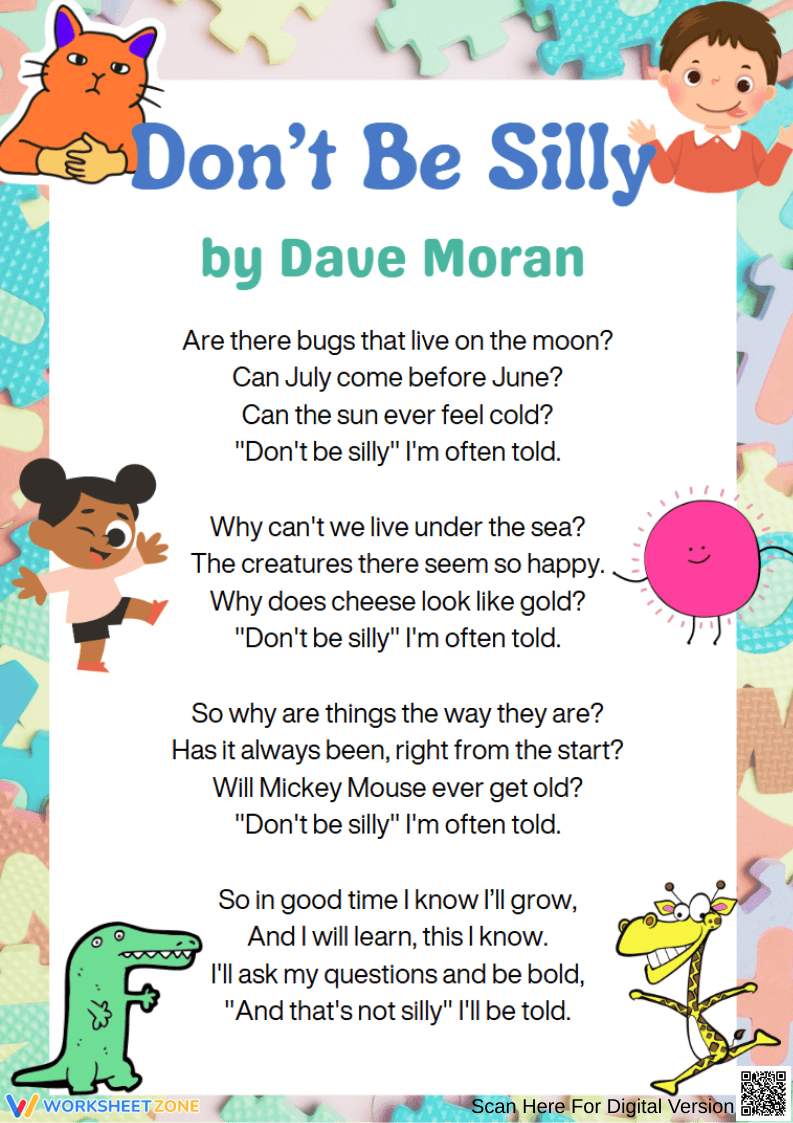

Printable Fun Poem Worksheet | Grade 2–4 ELA
Paste this activity's link or code into your existing LMS (Google Classroom, Canvas, Teams, Schoology, Moodle, etc.).
Students can open and work on the activity right away, with no student login required.
You'll still be able to track student progress and results from your teacher account.
This printable poetry worksheet builds Grade 2–4 students' ability to read a playful poem, interpret figurative language, and respond in writing — turning a single page into a complete reading-and-writing experience anchored to CCSS.ELA-LITERACY.RL.3.4.
At a Glance
- Grade: 2–4 · Subject: ELA / Poetry
- Standard:
CCSS.ELA-LITERACY.RL.3.4— Determine meaning of words and phrases in a poem, including figurative language- Skill Focus: Poetry comprehension and creative written response
- Format: 1 page · 6 problems · Answer key included · PDF
- Best For: Independent practice or literacy center work
- Time: 20–30 minutes
The worksheet presents the original poem "Don't Be Silly" followed by 6 structured tasks: vocabulary-in-context questions, a comprehension check, a figurative-language identification item, a short written-response prompt, and a creative-extension writing line. An answer key covers all objective items and provides a model response for the open-ended prompt, so grading takes under two minutes.
Skill Progression
- Guided practice (problems 1–2): Students re-read targeted stanzas with line references provided, reducing cognitive load while building close-reading habits.
- Supported practice (problems 3–4): Sentence-frame scaffolds guide students through identifying figurative language and explaining word meaning in context — bridging decoding and interpretation.
- Independent practice (problems 5–6): Students write an original response and a creative extension line with no scaffold, demonstrating transfer of the skill.
This gradual-release sequence mirrors the I Do / We Do / You Do model, allowing teachers to use the worksheet across a single lesson arc or across two shorter sessions.
Standards Alignment
Primary standard: CCSS.ELA-LITERACY.RL.3.4 — Determine the meaning of words and phrases as they are used in a text, distinguishing literal from nonliteral language. Supporting standard CCSS.ELA-LITERACY.W.3.3 applies to the creative-writing extension (narrative writing using descriptive detail). Both standard codes can be copied directly into lesson plans, IEP goals, or district curriculum mapping tools.
How to Use It
Use before direct instruction as a diagnostic: scan student responses to problems 1–2 to gauge baseline fluency with figurative language before teaching. Use after a read-aloud lesson as independent practice; target completion time is 20–25 minutes. Formative-assessment tip: collect problem 5 written responses only — a quick sort into three piles (literal retell / partial interpretation / full figurative understanding) gives an immediate class snapshot without full grading.
Who It's For
Designed for Grades 2–4 classrooms, this worksheet suits on-grade readers working through poetry units and below-grade readers in Grade 4 who need accessible, high-interest text. The playful, curious tone of the poem sustains engagement for reluctant readers. Pair with a figurative-language anchor chart or a teacher-led shared reading of a second short poem to extend the lesson naturally.
Poetry comprehension is a measurable, standards-trackable skill. CCSS.ELA-LITERACY.RL.3.4 requires students to determine meaning of words and phrases in literary text, including figurative language — a skill directly assessed on state ELA tests. NAEP data show that fewer than 40% of Grade 4 students perform at or above proficient in reading, with figurative and inferential language cited as a primary gap area. Fisher & Frey (2014) identify structured gradual-release tasks — guided, supported, then independent — as the highest-leverage instructional pattern for closing that gap. This worksheet operationalizes that pattern in a single printable page: six sequenced tasks move students from scaffolded close reading to independent creative writing, giving teachers observable evidence of RL.3.4 mastery without additional materials or prep time.


