


























Views
Downloads

Printable Compound Words Worksheet | Grade 2 ELA Aligned
Paste this activity's link or code into your existing LMS (Google Classroom, Canvas, Teams, Schoology, Moodle, etc.).
Students can open and work on the activity right away, with no student login required.
You'll still be able to track student progress and results from your teacher account.
Mastering compound words is a foundational step in building morphological awareness and vocabulary depth. This comprehensive Grade 2 English Language Arts worksheet provides structured practice to help students recognize, assemble, and deconstruct common compound words. By the end of these activities, learners will confidently predict meanings by analyzing root word combinations.
At a Glance
- Grade: 2 · Subject: ELA
- Standard:
L.2.4.D— Use knowledge of individual word meanings to predict compound word meanings- Skill Focus: Morphological Analysis & Compound Word Formation
- Format: 3 pages · 20 problems · Answer key included · PDF
- Best For: Independent practice or literacy centers
- Time: 20–30 minutes
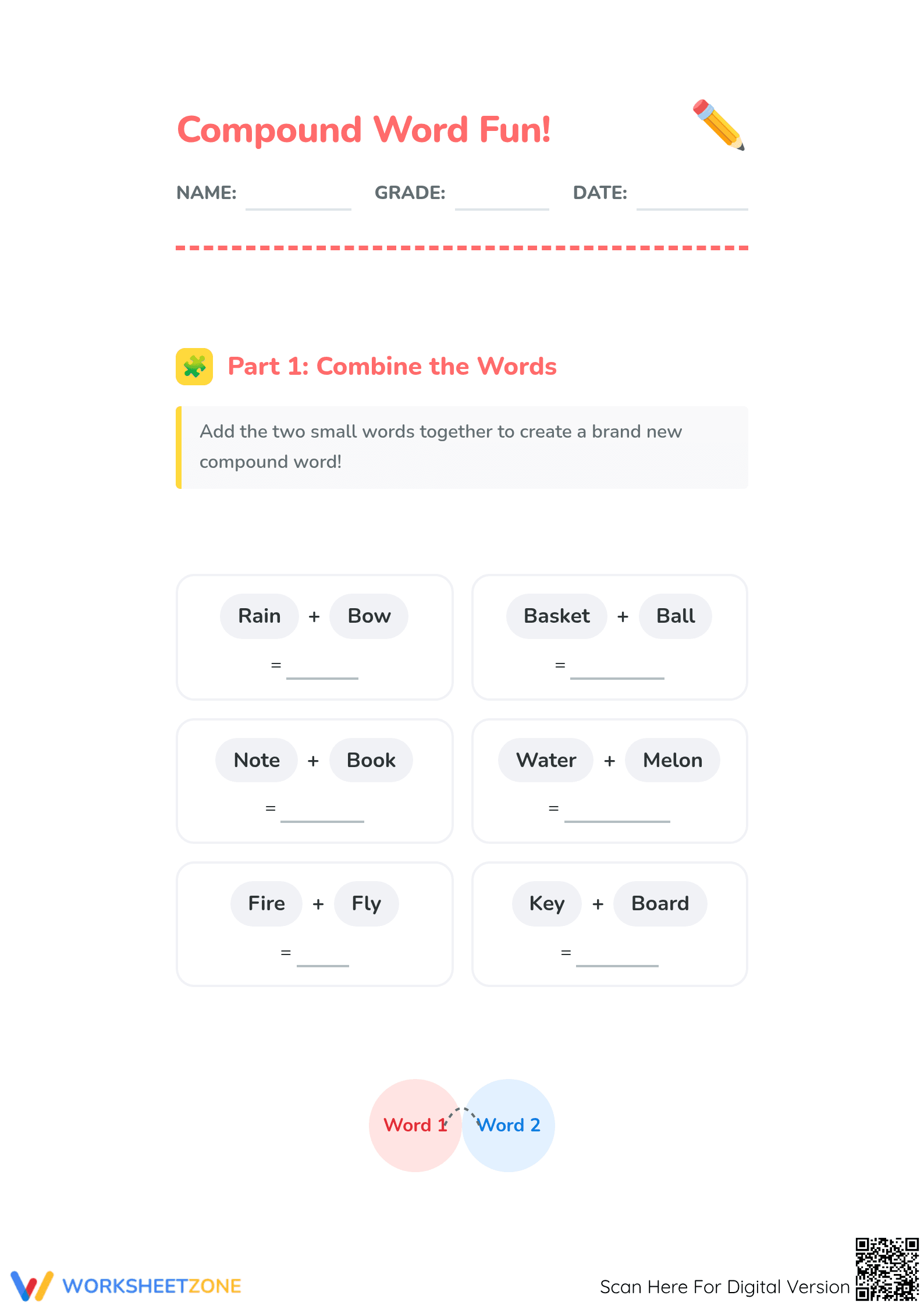
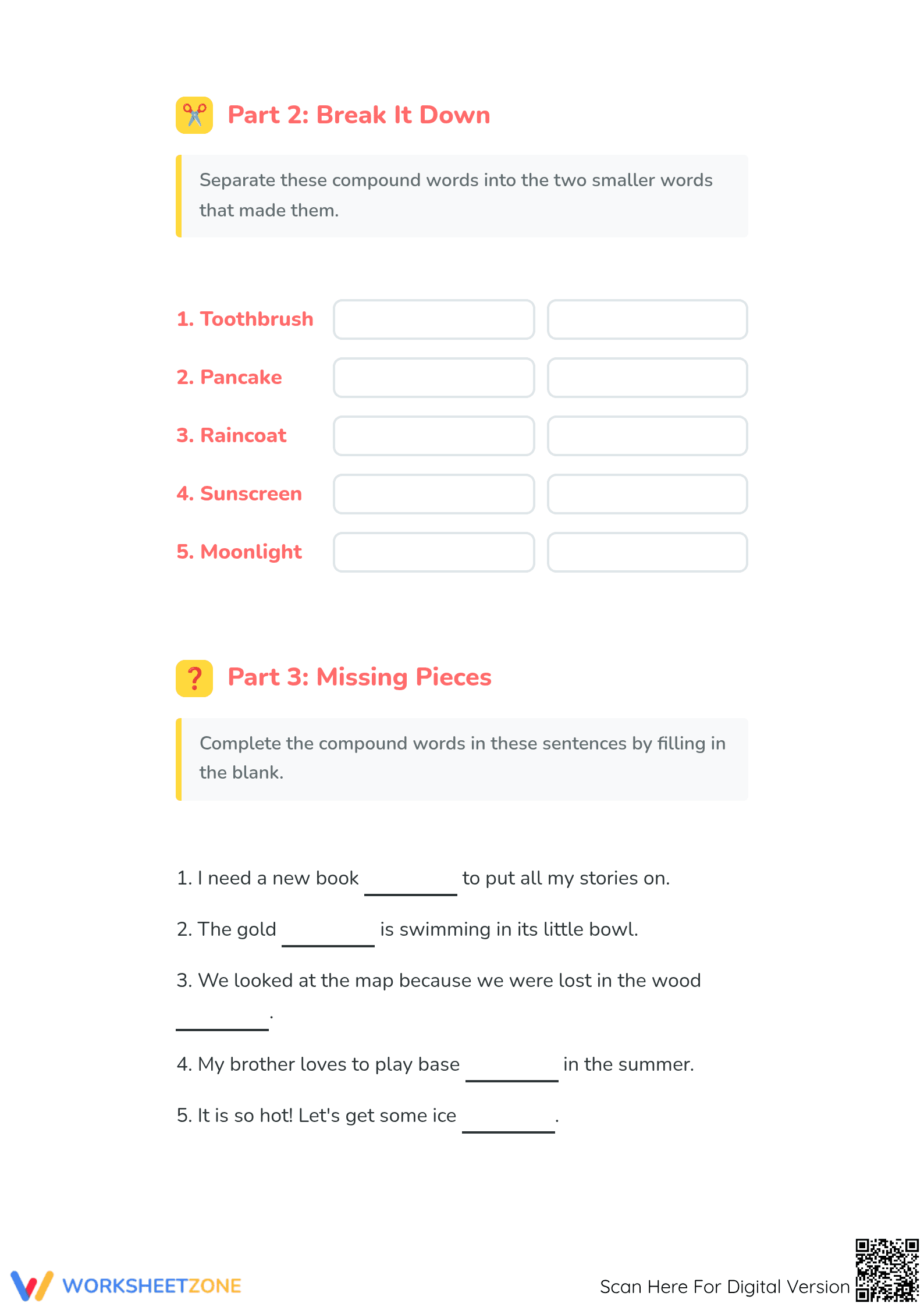
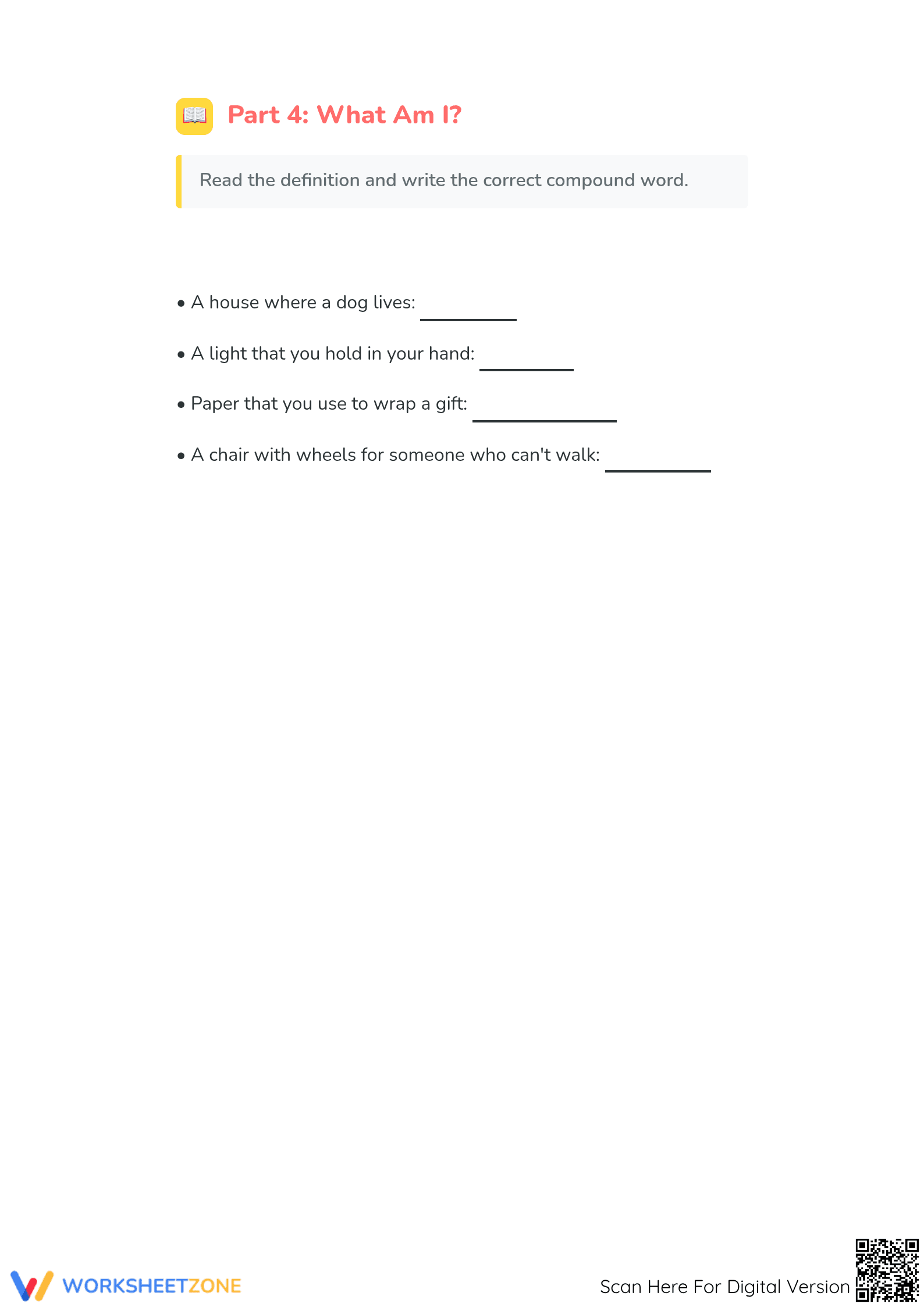
This printable packet contains three high-quality pages featuring four distinct parts. It starts with visual equations for word synthesis, moves to analytic decomposition of existing words, incorporates sentence-level application for contextual clues, and concludes with critical thinking definitions. A full answer key is provided for immediate feedback and easy grading.
Skill Progression
- Guided Practice: Six synthesis tasks use a simple addition format to introduce the concept of word building, allowing students to visualize how two meanings merge into one brand-new term.
- Supported Practice: Ten tasks across sentence completion and word breaking require students to reverse the process and apply logic within specific contexts, bridging the gap to reading fluency.
- Independent Practice: Four definition riddles demand that students synthesize meanings into specific vocabulary terms, demonstrating a deep internal understanding of compound structures.
This sequence follows a scaffolded model designed to move students from basic recognition to independent mastery.
Standards Alignment
This resource is aligned to CCSS.ELA-LITERACY.L.2.4.D. Students demonstrate mastery by using their knowledge of individual root words to predict and verify the meaning of the resulting compound word. This alignment ensures that the material supports district-level curriculum goals and can be cited directly in lesson plans, IEP goals, or state-mandated progress monitoring tools for elementary literacy.
How to Use It
Use this worksheet as an assessment following a direct instruction lesson on word parts. Alternatively, place it in a literacy center to provide meaningful independent work during small-group rotations. Teachers should observe the sentence completion section specifically to ensure students are using context clues correctly to choose the appropriate compound word, which is a vital indicator of comprehension readiness.
Who It's For
This resource is ideal for Grade 2 students but serves as an excellent challenge for first graders or a necessary review for third graders. It supports diverse learners through clear visual layouts and repetitive structures. Pair this activity with a compound word anchor chart or a short reading passage to reinforce the real-world application of morphological skills.
Research by Fisher & Frey (2014) emphasizes that explicit instruction in morphological awareness—specifically how prefixes, suffixes, and root words combine—significantly impacts reading comprehension and overall vocabulary acquisition in the primary grades. This worksheet aligns with those findings by requiring students to actively engage with the standard L.2.4.D through four levels of cognitive demand. By combining individual lexical units like "rain" and "bow" to form "rainbow," students develop the mental models necessary to decode unfamiliar multisyllabic words they encounter in informational and literary texts. The inclusion of 20 targeted tasks ensures that learners move beyond rote memorization toward a functional understanding of word structures. Such intentional practice is recognized as a key component of high-quality instructional materials that drive student achievement in elementary literacy and language development.


