


























Views
Downloads

Printable Compound Words Worksheet | Grade 2 ELA Ready
Paste this activity's link or code into your existing LMS (Google Classroom, Canvas, Teams, Schoology, Moodle, etc.).
Students can open and work on the activity right away, with no student login required.
You'll still be able to track student progress and results from your teacher account.
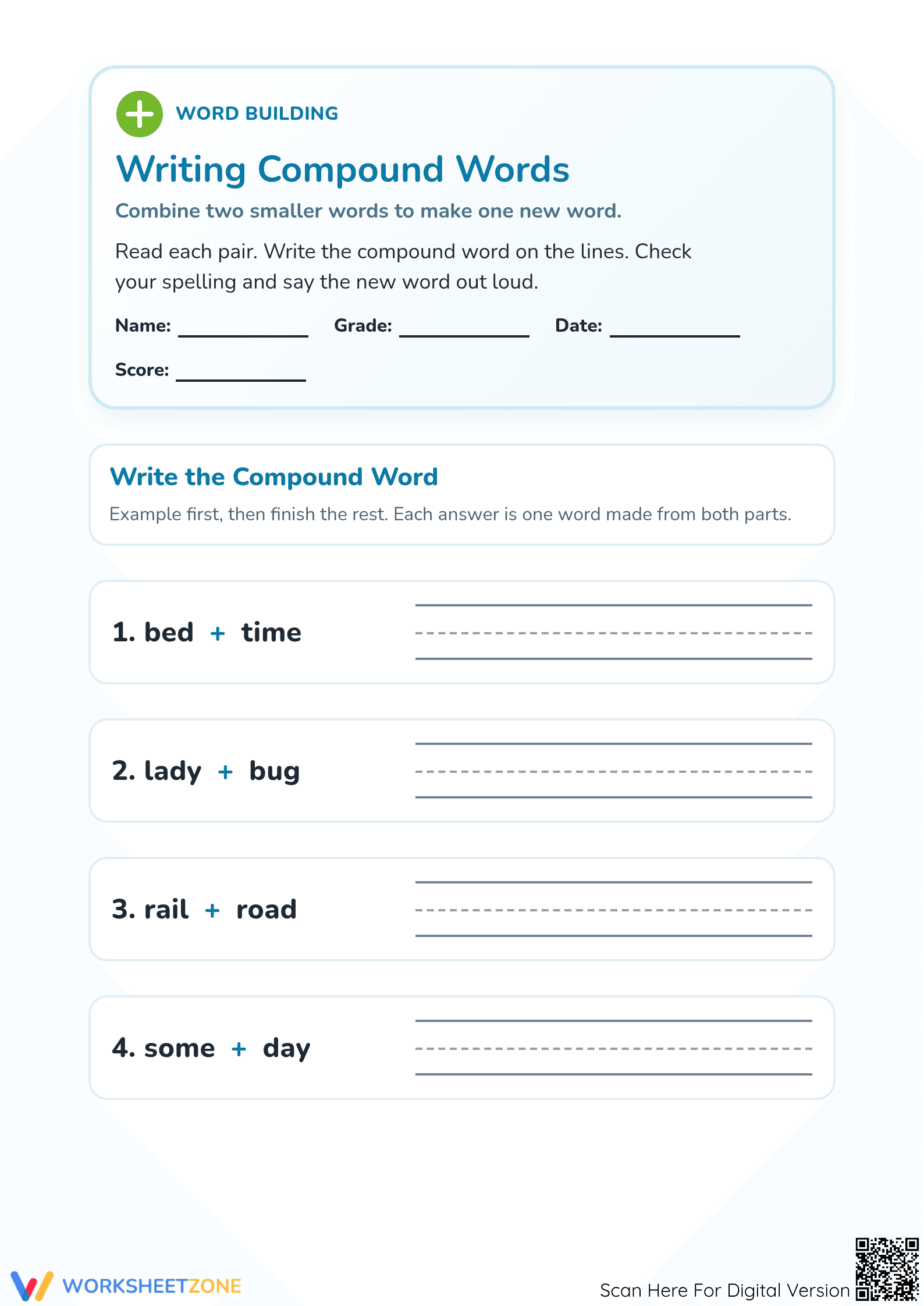
This Grade 2 compound words worksheet gives students 9 structured problems to master the mechanics of word building by combining two independent base words into a single new term. Students will identify the relationship between individual components and the resulting compound meaning. Answer key included. Aligned to CCSS.ELA-LITERACY.L.2.4.D.
At a Glance
- Grade: 2 · Subject: English Language Arts
- Standard:
CCSS.ELA-LITERACY.L.2.4.D— Use knowledge of the meaning of individual words to predict compound word meaning- Skill Focus: Morphology and Word Building
- Format: 2 pages · 9 problems · Answer key included · PDF
- Best For: Literacy centers and independent skill practice
- Time: 15–20 minutes
What's Inside
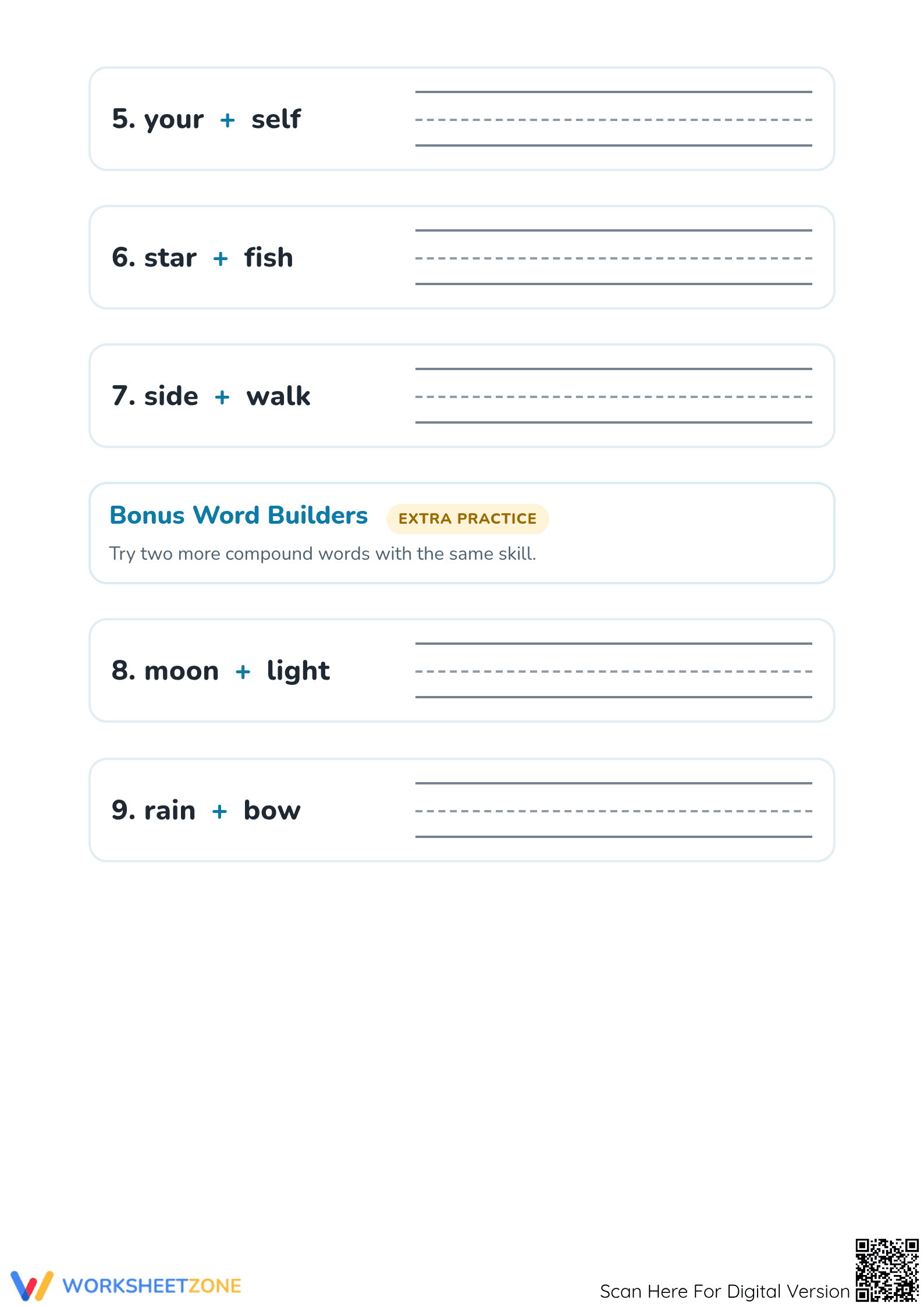
This comprehensive word-building resource contains two high-quality pages featuring a total of nine compound word construction tasks. The layout is intentionally clean, providing wide primary lines for students to practice their penmanship while spelling new terms. Each problem presents a simple "word + word" equation, such as "bed + time" or "lady + bug," ensuring students visualize the morphological synthesis of lexical units. A complete answer key is provided to facilitate rapid grading or student self-correction.
Skill Progression
- Guided Practice: The worksheet begins with clear, visual examples that establish the pattern of merging two smaller words without changing their internal spelling, using common high-frequency vocabulary.
- Supported Practice: Seven standard problems provide the root components and dedicated writing space, encouraging students to say the words aloud to reinforce phonetic recognition of the new compound term.
- Independent Practice: The final "Bonus Word Builders" section challenges students to apply the same synthesis logic to slightly more complex pairings like "moon + light" and "rain + bow" with minimal scaffolding.
This sequence follows a gradual-release model, moving from teacher-led modeling to independent student mastery of lexical compounding.
Standards Alignment
The primary focus of this activity is `CCSS.ELA-LITERACY.L.2.4.D`: "Use knowledge of the meaning of individual words to predict the meaning of compound words (e.g., birdhouse, lighthouse, housefly; bookshelf, notebook, bookmark)." By physically writing the combined forms, students solidify their understanding of how individual semantic units merge to create specialized meanings. This resource also supports foundational spelling standards by requiring accurate transcription of root words. Both standard codes can be copied directly into lesson plans, IEP goals, or district curriculum mapping tools.
How to Use It
Incorporate this worksheet during the "You Do" phase of a direct instruction lesson on morphology. It serves as an excellent formative assessment tool; teachers should observe whether students are incorrectly adding spaces between the two root words, which is a common developmental error in early writing. Expected completion time is approximately 15 to 20 minutes. Use the results to identify students who may need additional support with word boundaries or those ready for "open" compound word challenges.
Who It's For
While specifically designed for Grade 2 learners, this resource is highly effective for Grade 1 students ready for extension or Grade 3-4 students requiring targeted intervention in foundational language skills. It pairs naturally with a "Compound Word Memory" card game or an anchor chart displaying common compound word examples. The clear formatting is particularly beneficial for English Language Learners (ELLs) who are developing their English vocabulary through structural analysis.
Fisher & Frey (2014) emphasize that morphological awareness is a critical predictor of reading comprehension and vocabulary growth in early elementary grades. This worksheet aligns with research suggesting that explicit practice in word building helps students decode multi-syllabic words more efficiently. By focusing on the standard CCSS.ELA-LITERACY.L.2.4.D, this activity ensures students are not just memorizing words but are learning a generative strategy for understanding new text. The nine structured tasks provide the repetition necessary for long-term retention of spelling patterns. This resource is a proven tool for classroom-ready instruction that builds foundational literacy without excessive teacher preparation time.


