


























Views
Downloads

Printable Compound Words Worksheet | Grade 2 ELA
Paste this activity's link or code into your existing LMS (Google Classroom, Canvas, Teams, Schoology, Moodle, etc.).
Students can open and work on the activity right away, with no student login required.
You'll still be able to track student progress and results from your teacher account.
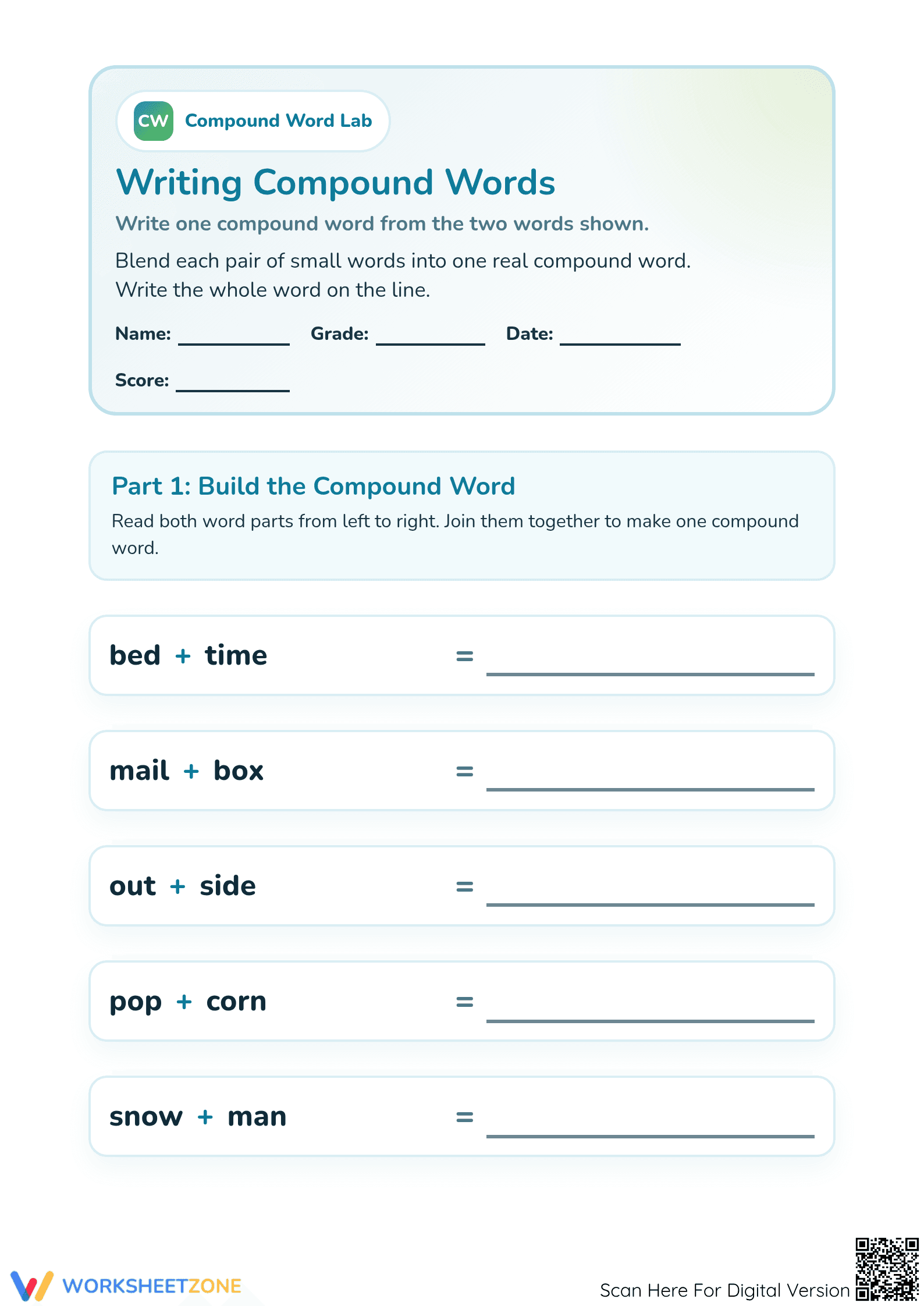
This printable worksheet helps Grade 2 students master compound word formation by blending two independent root words into a single, cohesive term. Students practice identifying how individual word meanings combine to create new vocabulary, strengthening their lexical foundation. This activity ensures students can confidently build and write compound words while improving their overall spelling and reading fluency.
At a Glance
- Grade: 2 · Subject: English Language Arts
- Standard:
L.2.4.D— Use knowledge of individual word meanings to predict and form compound words- Skill Focus: Compound word formation and spelling
- Format: 2 pages · 10 problems · Answer key included · PDF
- Best For: Literacy centers and independent skill practice
- Time: 15–20 minutes
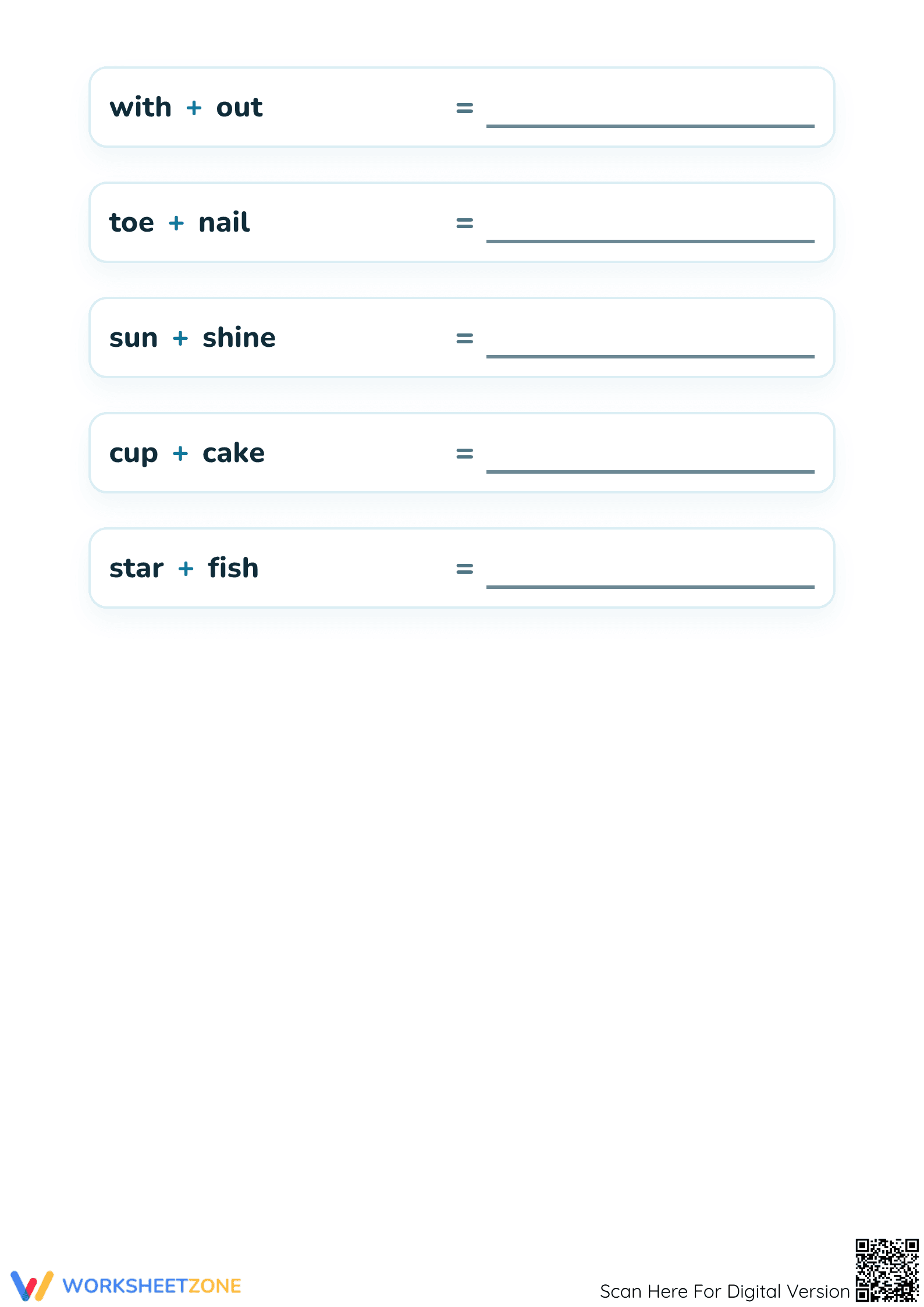
This resource consists of a two-page "Compound Word Lab" designed for clear, focused practice. It contains ten structured tasks where students are presented with two base words separated by a plus sign. A designated writing line follows each equation, prompting the student to join the parts into a complete compound word. The set includes a comprehensive answer key and a student information header.
This resource is designed for teacher efficiency. First, print the two-page PDF (30 seconds). Second, distribute the copies to your students for immediate independent work (1 minute). Third, use the included answer key to review student work or facilitate a whole-class check (1 minute). This zero-prep approach makes it an ideal choice for emergency sub plans or quick filler activities.
This worksheet is primarily aligned to `CCSS.ELA-LITERACY.L.2.4.D`, which requires students to use individual word meanings to predict the meaning of a compound word. By physically writing the combined forms of words like "popcorn" and "starfish," students reinforce the structural logic of the English language. This standard code can be copied directly into lesson plans, IEP goals, or district curriculum mapping tools.
Deploy this worksheet as a post-instruction check after a direct lesson on compound words. It serves as an excellent formative assessment to see if students can accurately merge root words without adding or omitting letters. Educators can observe whether students struggle with specific blends or if they are beginning to recognize the "hidden" words within larger terms. Most Grade 2 students complete both pages within a 20-minute block.
This resource is tailored for Grade 2 and Grade 3 students but is also appropriate for Grade 1 students ready for a challenge or Grade 4 students requiring remedial support. It is particularly effective for English Language Learners (ELL) who are learning how word parts combine to shift meanings. Pair this worksheet with a compound word anchor chart or a short reading passage for a complete instructional experience.
Building lexical awareness through the construction of compound words is a fundamental stage in early literacy development. According to Fisher & Frey (2014), the gradual release of responsibility in vocabulary acquisition is most effective when students engage in targeted, repetitive practice that isolates specific linguistic structures. This Grade 2 worksheet aligns with the L.2.4.D standard by requiring students to synthesize their existing knowledge of base words into more complex vocabulary. Research suggests that explicit instruction in morphological awareness—understanding how words are built—is a strong predictor of later reading comprehension and spelling accuracy. By providing ten discrete opportunities to form compound words such as "snowman" and "cupcake," this resource helps bridge the gap between simple decoding and sophisticated word recognition. This methodology ensures that students develop the necessary cognitive tools to decode unfamiliar multisyllabic words they will encounter in more advanced informational texts, such as those found in RAND AIRS 2024 studies on elementary literacy achievement.


