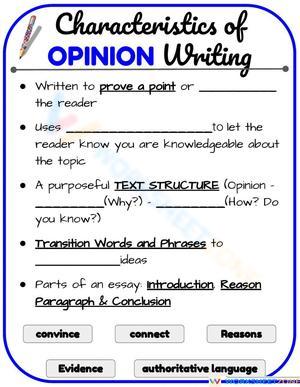
The writer's position on a problem or issue is called the: claim. In order to write a successful argument, you must use ___ to support claims, and ____ to support your reasons: reasons, evidence. When gathering evidence, use credible ___ and take notes: sources. Always make sure to disprove the ___ argument: opposing. This element is the first line of your writing: Hook. Acknowledging why someone may disagree with you is known as this: Counterclaim. This is based on personal experience, quotes, facts and statistics that support your reasons: Reason. This is a debatable statement that forms the main point of your argument: Claim. This helps support your main claim and gives the reader a basis for accepting your main claim: Reason. This element wraps up all loose ends and finishes strong: Conclusion. This is the part of the introduction paragraph that catches readers’ attention: Hook. This shows how you know you’re right: Evidence. This disputes or disagrees with your claim: Counterclaim. This follows your claim: Reason. Introduce this with statements such as, “It may be argued that ….”, “Contrary to evidence…”, “It is true, however, ….” or any other statement that acknowledges conflicting viewpoints: Counterclaim. What type of hook is this?I was living in Arkansas the first time I met prejudice face to face: Personal Anecdote. What type of hook is this?Each year there is one Lego block made for every person in the world. Think about it: Fascinating Fact. One type of hook you can use for writing is called an anecdote. What is the definition of anecdote? : A short story or scene. Which type of hook is this?John Wooden once said, "Never mistake activity for achievement." : Quote












 Interactive Worksheet Maker
 Quiz Maker
 Word Search Maker
 Crossword Puzzle Maker
 Word Scramble Generator
 Sentence Scramble Generator
 Handwriting Worksheet Generator
 Name Tracing Generator
 Fill In The Blank Generator