


























Views
Downloads



Grade 10 Brain Research — Printable No-Prep Worksheet
Paste this activity's link or code into your existing LMS (Google Classroom, Canvas, Teams, Schoology, Moodle, etc.).
Students can open and work on the activity right away, with no student login required.
You'll still be able to track student progress and results from your teacher account.
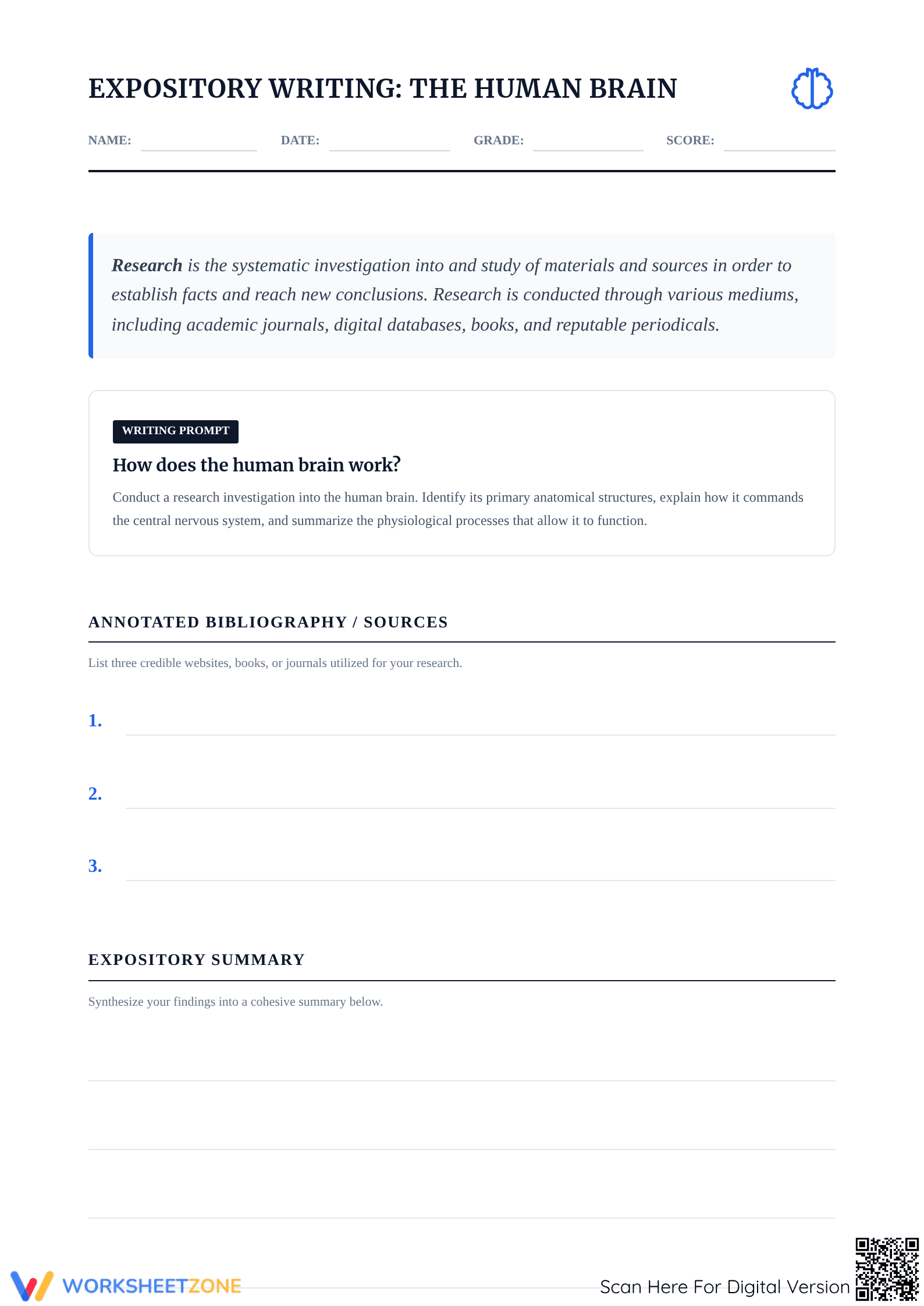
This Grade 10 expository writing worksheet prompts students to conduct independent research on the human brain and synthesize their findings. By investigating anatomical structures and physiological processes, learners develop critical research skills and practice organizing complex scientific information into a clear, cohesive summary.
At a Glance
- Grade: 10 · Subject: ELA
- Standard:
CCSS.ELA-LITERACY.W.9-10.7— Conduct short research projects to answer a question- Skill Focus: Expository Writing & Research
- Format: 3 pages · 2 tasks · Open-ended · PDF
- Best For: Independent research projects
- Time: 45–60 minutes
This three-page resource features a structured writing prompt asking students to explain how the human brain works. The first page includes a definition of research, the main prompt, a section for an annotated bibliography with space for three credible sources, and the beginning of the expository summary. The following two pages provide ample lined space for students to draft their comprehensive expository essays.
- Print (1 minute): Simply print the three-page PDF packet for each student. No special formatting or additional materials are required.
- Distribute (1 minute): Hand out the packets and briefly review the definition of research and the prompt provided on the first page.
- Review (0 minutes): Because this is an open-ended research task, students can immediately begin sourcing their information and drafting their bibliographies.
This resource requires under two minutes of total teacher prep time, making it an excellent, self-explanatory option for a substitute teacher plan or an independent study day.
Aligned to primary standard CCSS.ELA-LITERACY.W.9-10.7: Conduct short as well as more sustained research projects to answer a question or solve a problem; narrow or broaden the inquiry when appropriate; synthesize multiple sources on the subject. It also supports informative writing standards by requiring students to convey complex ideas clearly. These standard codes can be copied directly into lesson plans or IEP goals.
This worksheet is highly versatile and can be used during a cross-curricular unit combining ELA and biology. Assign it as an independent research project after a lesson on evaluating credible sources, allowing students to practice finding reputable academic journals. As a formative assessment observation tip, monitor students while they complete the annotated bibliography section to ensure they select high-quality sources before drafting their summaries. Expected completion time is 45 to 60 minutes.
Designed for 10th-grade general education students, this resource is also appropriate for 11th and 12th graders refining their research skills. To differentiate for students needing additional support, provide a pre-curated list of approved websites or a graphic organizer to help them outline findings before writing. This worksheet pairs naturally with a direct instruction lesson on writing annotated bibliographies or evaluating digital sources.
Integrating structured research tasks into the high school ELA curriculum enhances students' ability to process and synthesize complex information across disciplines. According to a RAND AIRS 2024 study, students who regularly engage in targeted inquiry tasks demonstrate higher proficiency in evaluating source credibility and organizing explanatory texts. By aligning directly with CCSS.ELA-LITERACY.W.9-10.7, this worksheet provides a rigorous framework for academic writing. The explicit inclusion of an annotated bibliography section ensures that learners actively vet their materials and document findings accurately, a critical foundational skill for college and career readiness. This evidence-based approach effectively bridges the gap between scientific inquiry and clear written communication, fostering deeper cognitive engagement.


