


























Views
Downloads
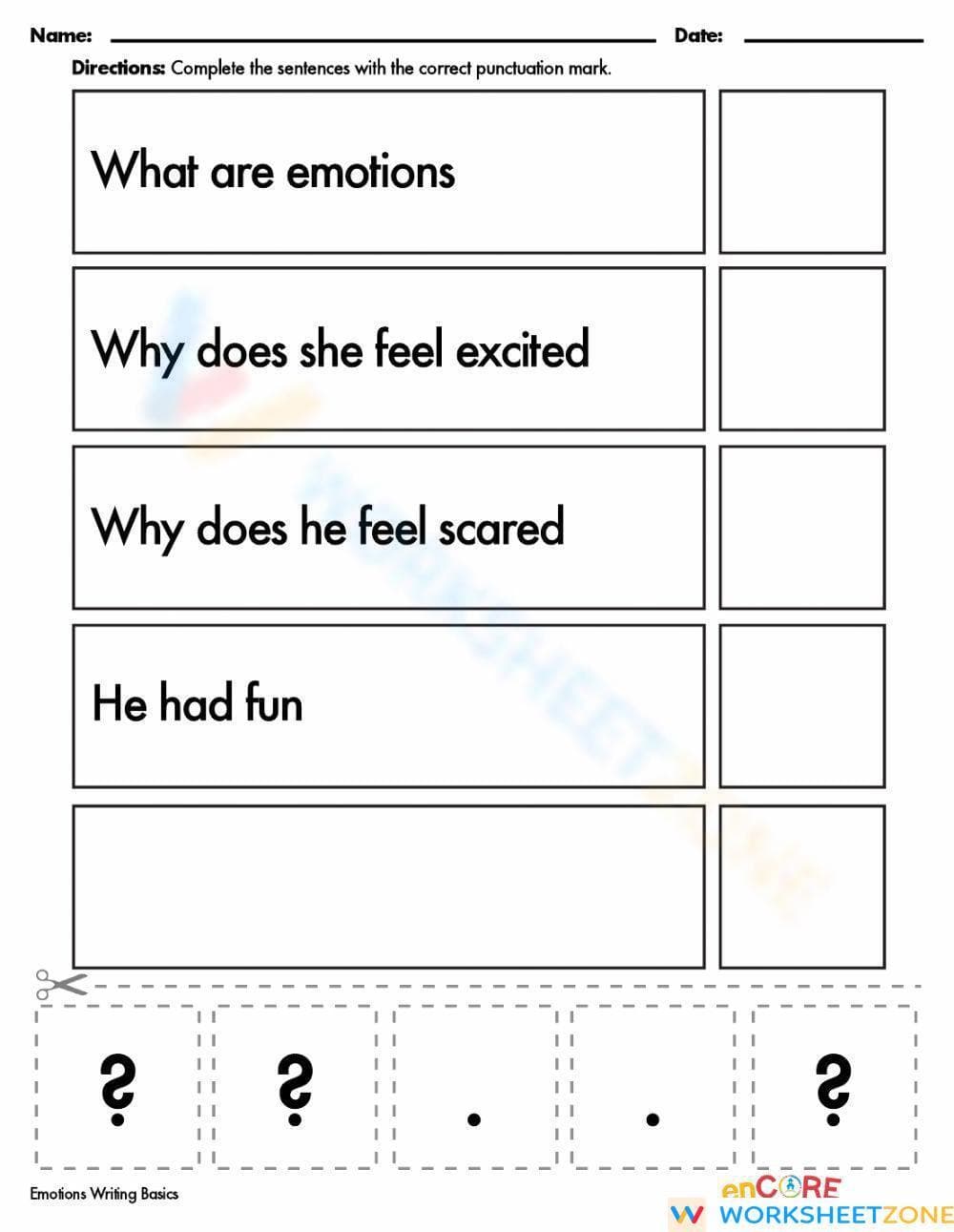

Essential Punctuation Practice: Writing Basics Worksheet
Paste this activity's link or code into your existing LMS (Google Classroom, Canvas, Teams, Schoology, Moodle, etc.).
Students can open and work on the activity right away, with no student login required.
You'll still be able to track student progress and results from your teacher account.
This Essential Punctuation Practice worksheet helps students in grades 2 through 4 master the critical skill of identifying end marks. By focusing on the distinction between statements and questions, learners build a foundation for clear communication. This activity transforms a basic drill into an engaging experience.
At a Glance
- Grade: 2–4 · Subject: ELA
- Standard:
CCSS.ELA-LITERACY.L.2.2— Demonstrate command of standard English punctuation when writing- Skill Focus: End Punctuation (Periods & Question Marks)
- Format: 1 page · 5 problems · Answer key included · PDF
- Best For: Independent practice or center rotations
- Time: 10–15 minutes
What's Inside
This single-page PDF features a student-friendly layout. It includes four sentences about emotions—covering both questions and statements—and space for a fifth entry. At the bottom, five punctuation tiles (three question marks, two periods) are provided with dashed lines for cutting. The tactile "cut and paste" design ensures students are actively involved in the learning process.
Zero-Prep Workflow
This resource is designed for a seamless classroom transition. First, print the single-page document in seconds. Second, distribute the sheets with scissors and glue. Finally, students independently complete the activity and review answers with the included key. This zero-prep workflow makes it an ideal choice for emergency sub plans, morning work, or quick literacy center rotations.
Standards Alignment
This resource aligns with CCSS.ELA-LITERACY.L.2.2, requiring students to demonstrate command of standard punctuation. By choosing between periods and question marks, learners reinforce how punctuation clarifies meaning. This standard code can be copied directly into lesson plans, IEP goals, or district curriculum mapping tools to ensure your instruction remains fully compliant with national expectations.
How to Use It
Use this worksheet as a formative assessment after teaching sentence types. Observe students as they sort the tiles; check if they recognize "wh-" question words as cues. Alternatively, assign it as a fast-finisher task. The expected completion time is roughly 12 minutes, making it a perfect tool for checking student understanding before moving to more complex writing.
Who It's For
This worksheet is for students in Grade 2 through Grade 4 who are refining their punctuation skills. It is especially beneficial for ELLs needing visual reinforcement of sentence boundaries. It pairs well with mentor texts on emotions or an anchor chart displaying sentence types to provide a scaffolded and comprehensive learning experience for all students.
The Essential Punctuation Practice worksheet targets CCSS.ELA-LITERACY.L.2.2, ensuring students build mastery of end marks through active engagement. Research from RAND AIRS 2024 emphasizes that tactile activities, like cut-and-paste sorting, improve retention of grammatical rules in early elementary learners. By isolating the choice between periods and question marks, this resource allows students to focus on the semantic differences between inquiries and declarative statements. This approach is critical for developing the sentence-level fluency required for complex writing in later grades. Educators can use this summary as a justification for integrating kinesthetic learning into their ELA curriculum, knowing the task is supported by evidence-based design that prioritizes immediate feedback. This focused practice ensures students are ready for higher-level standards while providing a classroom-ready solution for busy teachers.


