


























Views
Downloads

Essential Articles Worksheet | Grade 3 Printable
Paste this activity's link or code into your existing LMS (Google Classroom, Canvas, Teams, Schoology, Moodle, etc.).
Students can open and work on the activity right away, with no student login required.
You'll still be able to track student progress and results from your teacher account.
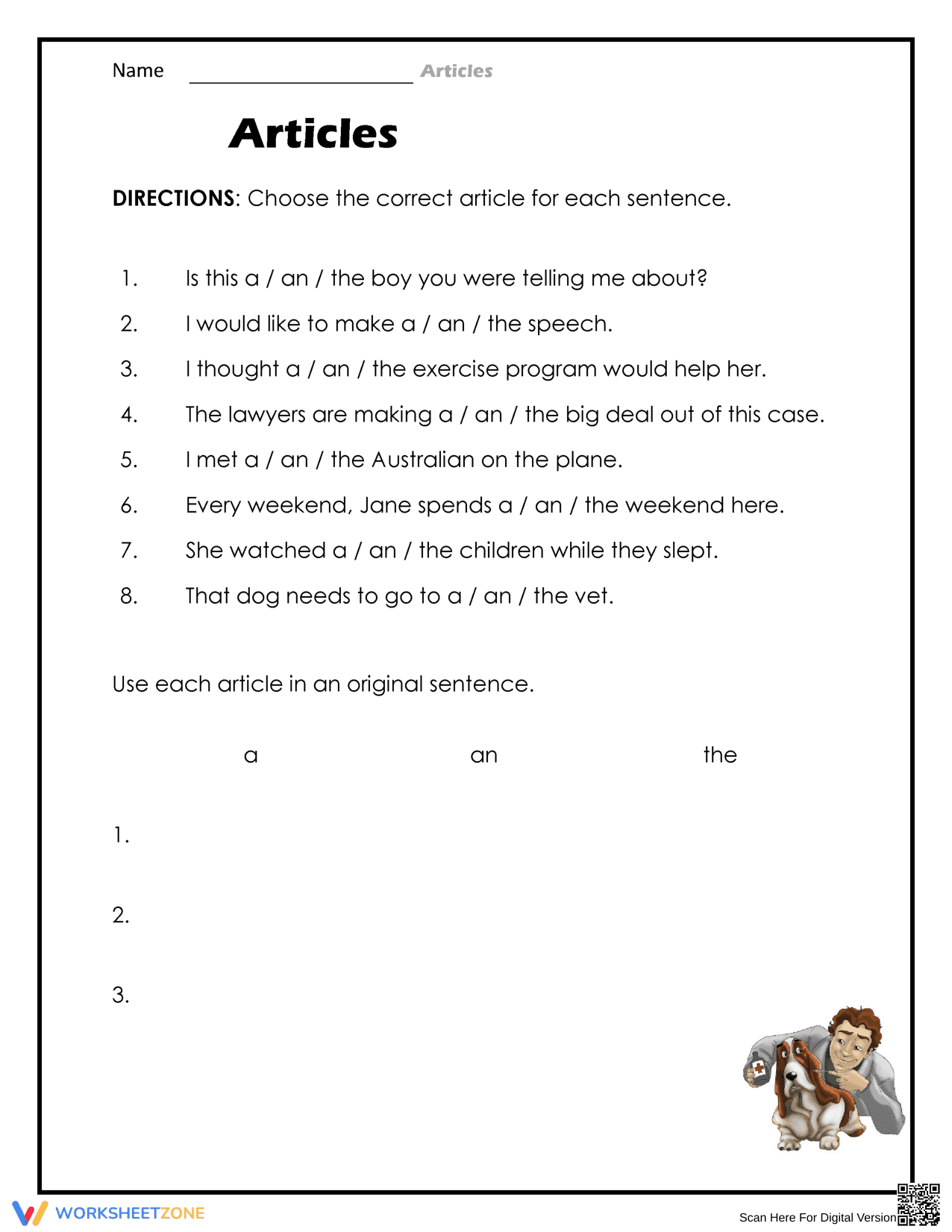
This Grade 3 articles worksheet provides students with targeted practice in identifying and using indefinite and definite articles (a, an, and the) within varied sentence contexts. By combining identification tasks with original sentence construction, learners move from recognition to application, ensuring they can fluently apply these grammar rules in their own writing and communication.
At a Glance
- Grade: 3 · Subject: English Language Arts
- Standard:
CCSS.ELA-LITERACY.L.1.1.H— Use determiners, specifically articles a, an, and the, correctly in sentences- Skill Focus: Definite and Indefinite Articles
- Format: 1 page · 11 problems · Answer key included · PDF
- Best For: Grammar warm-ups and quick assessments
- Time: 10–15 minutes
What's Inside
This high-utility printable contains two distinct sections designed to verify student mastery. The first section features eight multiple-choice sentences where students must select the most appropriate article. These sentences use practical vocabulary like "exercise program" and "Australian" to challenge reading comprehension. The second section provides three writing prompts, requiring students to generate original sentences using "a," "an," and "the" independently.
Zero-Prep Workflow
Teachers can implement this resource in under two minutes with three simple steps. First, print the single-page PDF. Second, distribute copies to students for an independent warm-up or bell-ringer activity. Third, use the included answer key for a rapid whole-class check or individual grading. This streamlined design makes it an ideal choice for emergency sub plans or last-minute grammar reviews.
Standards Alignment
The primary focus of this resource is CCSS.ELA-LITERACY.L.1.1.H, which requires students to use determiners including articles correctly. While introduced early, the complexity of these sentences supports Grade 3 and Grade 4 proficiency goals regarding the conventions of standard English. Both standard codes can be copied directly into lesson plans, IEP goals, or district curriculum mapping tools.
How to Use It
This worksheet is best utilized as a formative assessment during or after a lesson on vowel sounds and article pairing. During the "You Do" phase of gradual release, assign the identification section to check for common errors like "a" before vowel sounds. Use the original sentence section as an exit ticket to observe if students can maintain grammatical consistency when creating their own narratives.
Who It's For
This resource is designed for Grade 3-4 students, English Language Learners (ELLs) requiring syntax support, and students receiving Tier 2 interventions for grammar. It pairs naturally with a mentor text or an anchor chart that highlights the "a" vs "an" rule based on the following word's initial sound.
Mastering articles is a critical component of syntactic awareness, which directly correlates with reading fluency and written clarity. According to the RAND AIRS 2024 report on literacy foundations, consistent exposure to standardized grammar conventions through structured practice significantly reduces cognitive load during the drafting phase of the writing process. This worksheet addresses the specific mechanics of CCSS.ELA-LITERACY.L.1.1.H by requiring students to distinguish between specific (the) and general (a/an) nouns. By engaging in both receptive identification and expressive generation, students solidify their understanding of how articles function as essential "glue" words in English syntax. This dual-modality approach ensures that the skill focus on articles translates into broader writing proficiency. Research from Fisher & Frey (2014) suggests that such targeted, short-burst practice is most effective when integrated into a comprehensive literacy framework that emphasizes the gradual release of responsibility from teacher to student.


