


























Views
Plays


Essential Intro to Research Writing | Grades 3-6
Paste this activity's link or code into your existing LMS (Google Classroom, Canvas, Teams, Schoology, Moodle, etc.).
Students can open and work on the activity right away, with no student login required.
You'll still be able to track student progress and results from your teacher account.
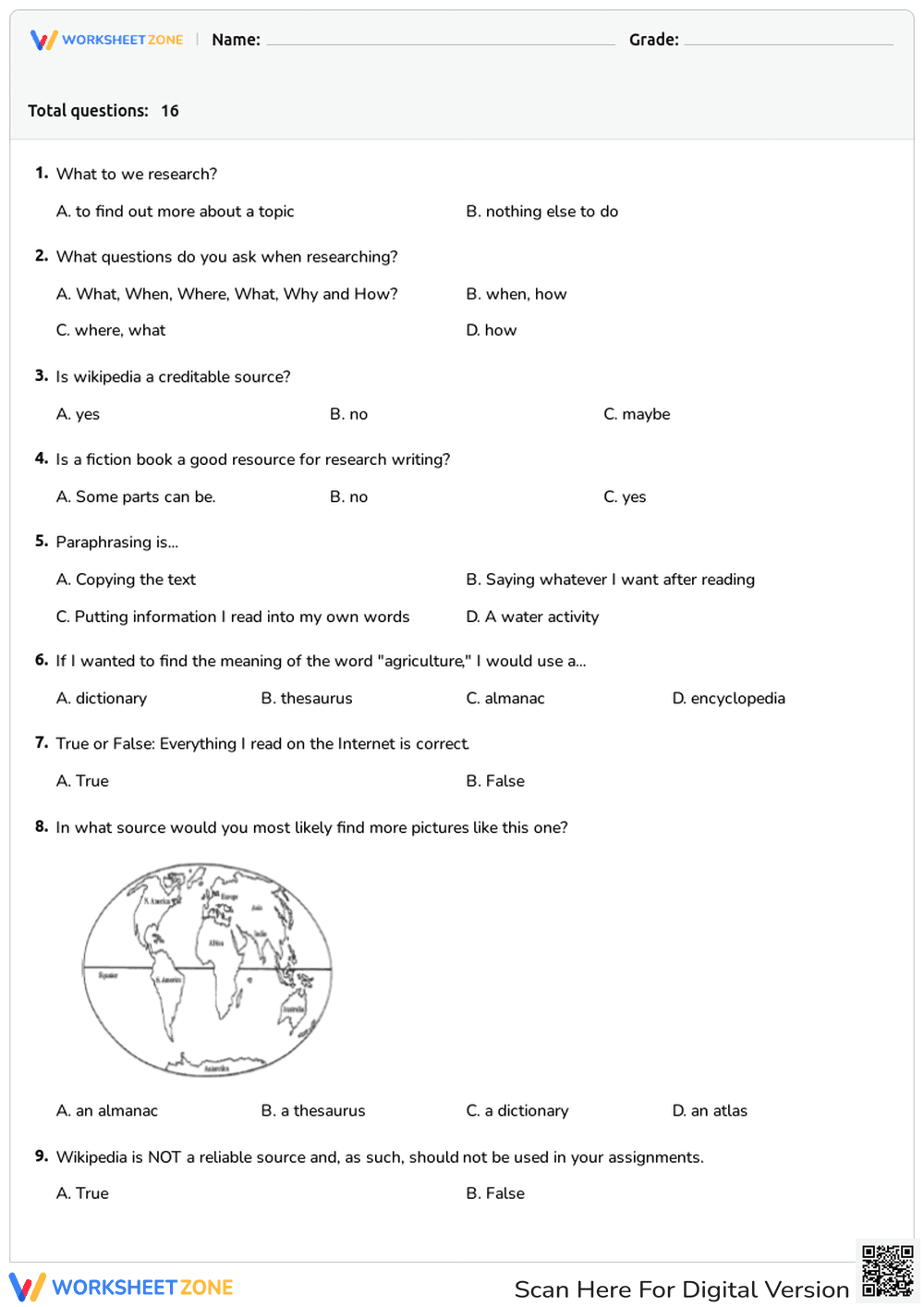
This Grade 5 research writing worksheet helps students master the fundamentals of information literacy and source evaluation. By identifying reliable sources and understanding the mechanics of paraphrasing, learners build the critical foundation needed for academic inquiry. It provides a comprehensive check for understanding before students begin their first major research project.
At a Glance
- Grade: 5 · Subject: ELA
- Standard:
CCSS.ELA-LITERACY.W.5.8— Gather information from print and digital sources and provide a list of sources- Skill Focus: Research Writing Fundamentals
- Format: 2 pages · 16 problems · Answer key included · PDF
- Best For: Formative assessment or research unit introduction
- Time: 20–30 minutes
What's Inside: This two-page assessment features 16 multiple-choice and true/false questions designed to test student knowledge of the research process. It covers essential topics including URL suffixes (.edu), the difference between primary and secondary sources, the definition of paraphrasing, and how to organize a bibliography. The clear layout ensures students can focus entirely on the content without visual distraction.
Zero-Prep Workflow: This resource is designed for immediate classroom implementation. First, print the two-page PDF (30 seconds). Next, distribute the worksheets to students as a pre-assessment or exit ticket (1 minute). Finally, review the answers using the included key to identify common misconceptions about source reliability (5 minutes). Total teacher preparation time is under two minutes, making it an ideal sub plan.
Standards Alignment: The primary focus is `CCSS.ELA-LITERACY.W.5.8`, which requires students to gather relevant information from print and digital sources and provide a list of sources. It also supports `CCSS.ELA-LITERACY.W.4.8` by emphasizing the sorting of evidence into provided categories. Both standard codes can be copied directly into lesson plans, IEP goals, or district curriculum mapping tools.
How to Use It: Use this worksheet as a diagnostic tool at the start of a research unit to gauge prior knowledge of source credibility. Alternatively, assign it as a summative quiz after teaching lessons on primary versus secondary sources. During the activity, observe if students struggle with the distinction between .com and .edu websites to guide your next small-group intervention. Completion typically takes 20 to 30 minutes.
Who It's For: This resource is tailored for upper elementary students in grades 3 through 6 who are beginning to write formal reports. It is particularly effective for English Language Learners who benefit from the clear, multiple-choice format. Pair this worksheet with a "Source Reliability" anchor chart or a direct instruction lesson on how to use a library database for maximum impact.
Research by Fisher & Frey (2014) emphasizes that information literacy is a prerequisite for successful academic writing, particularly as students transition from learning to read to reading to learn. This worksheet directly addresses this need by targeting CCSS.ELA-LITERACY.W.5.8, ensuring students can distinguish between credible digital sources and unreliable ones like open-edit wikis. By mastering the 16 core concepts presented here—including paraphrasing, primary source identification, and bibliographic organization—students develop the self-regulation skills necessary for independent inquiry. According to the NAEP frameworks, students who can evaluate source authority are significantly more likely to produce high-quality informational texts. This assessment provides the data points teachers need to verify that students have moved beyond simple searching to critical evaluation, a shift that is essential for meeting mid-elementary ELA benchmarks and preparing for middle school research demands.


