


























Views
Downloads
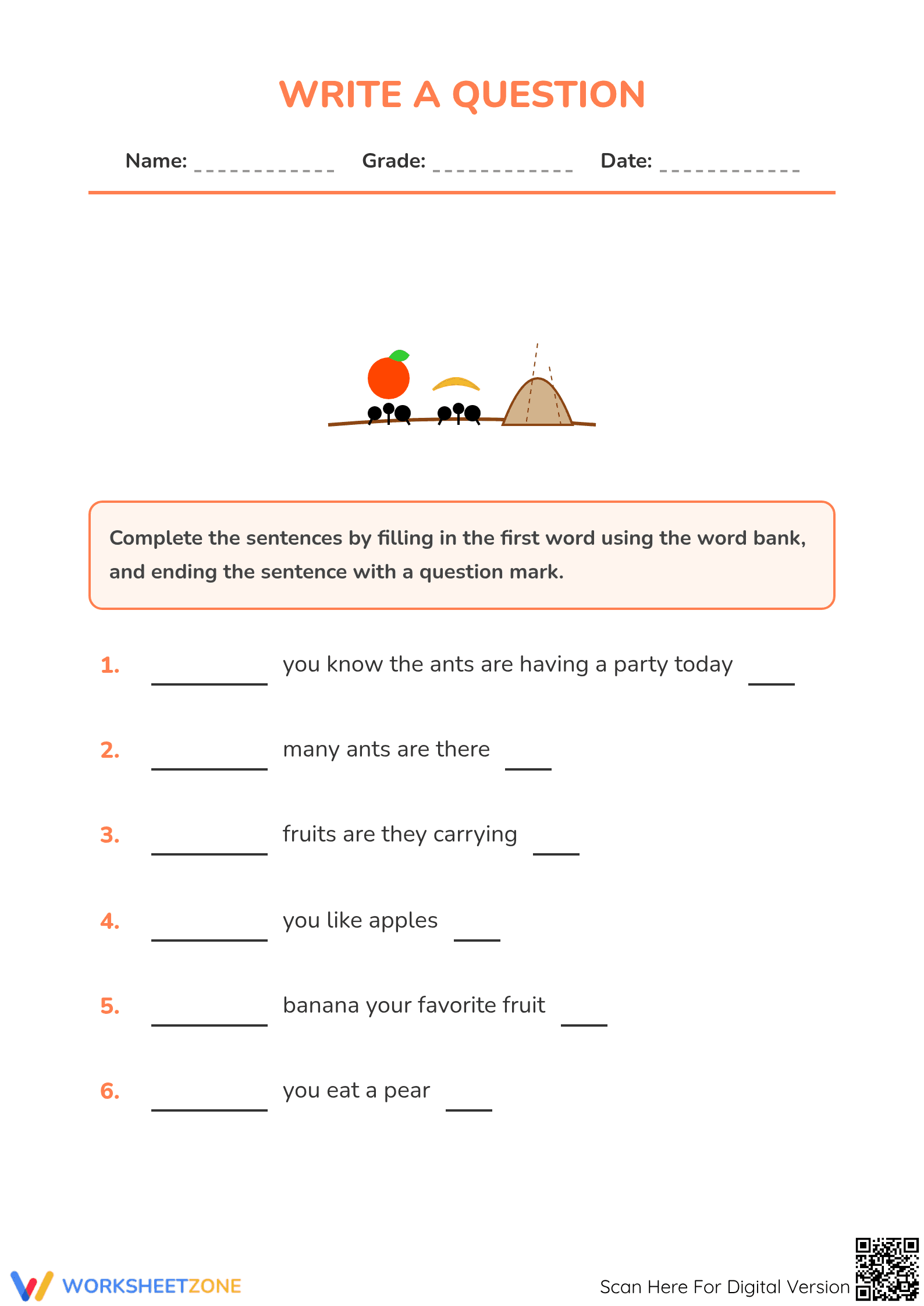


Grade 1 Writing Questions — Printable No-Prep Worksheet
Paste this activity's link or code into your existing LMS (Google Classroom, Canvas, Teams, Schoology, Moodle, etc.).
Students can open and work on the activity right away, with no student login required.
You'll still be able to track student progress and results from your teacher account.
Developing written fluency starts with recognizing how speech patterns translate to the page. This Grade 1 worksheet focuses on interrogative sentence structure, requiring students to identify appropriate starting words and apply correct ending punctuation. By bridging the gap between spoken inquiry and formal writing, learners build a foundation for clear communication and grammar mastery.
At a Glance
At a Glance
- Grade: 1 · Subject: English Language Arts
- Standard:
L.1.2.B— Use end punctuation for sentences to demonstrate command of capitalization and punctuation- Skill Focus: Interrogative sentence construction
- Format: 2 pages · 6 problems · Answer key included · PDF
- Best For: Early finishers or daily grammar warm-ups
- Time: 10–15 minutes
What's Inside
The resource consists of two high-quality pages designed for immediate classroom use. The first page features six fill-in-the-blank sentences centered around a friendly ant party theme, providing a cohesive narrative context that engages young learners. A specialized word bank on the second page includes essential question starters like What, Is, Did, and How, supporting vocabulary selection while reinforcing the requirement for a final question mark.
Zero-Prep Workflow
- Print: Select the two-page PDF and send it to your local printer; the high-contrast design ensures clear readability for all students in under 30 seconds.
- Distribute: Hand out the sheets during your literacy block or as a transition activity, requiring zero additional manipulatives or teacher setup.
- Review: Use the provided answer key to quickly verify student work or facilitate a peer-review session, keeping the total teacher engagement time under 2 minutes.
Standards Alignment
This activity is directly aligned with `L.1.2.B`, focusing on the proper application of end punctuation in written work. Additionally, it supports `L.1.1.J` by encouraging students to produce complete interrogative sentences in response to prompts. Both standard codes can be copied directly into lesson plans, IEP goals, or district curriculum mapping tools.
How to Use It
Assign this worksheet as a formative assessment after a direct instruction lesson on question marks to gauge individual understanding. Alternatively, place it in a literacy center as a self-directed practice task where students can work independently to match the starter words to the logical conclusion of each sentence. Observe whether students remember both the capital first letter and the final punctuation.
Who It's For
This resource is ideal for Grade 1 students who are beginning to distinguish between statements and questions. It provides necessary scaffolding for English Language Learners (ELL) through the inclusion of a clear word bank and thematic visual cues. Pair this worksheet with a short reading passage about insects to create a cross-curricular grammar and science lesson.
Academic research, including the RAND AIRS 2024 report on literacy foundations, emphasizes the critical role of explicit punctuation instruction in early elementary education. Mastering the interrogative form through the standard `L.1.2.B` allows students to transition from simple decoding to active participation in written discourse. This worksheet facilitates that growth by providing structured practice in selecting appropriate question words—such as Who, What, or How—and applying the corresponding terminal punctuation. By engaging with 6 specific tasks, students internalize the rhythmic and structural differences between declaring a fact and seeking information. These fundamental skills are precursors to complex reading comprehension and effective evidence-based writing. Providing these scaffolds ensures that learners maintain high accuracy while exploring sentence variety, ultimately leading to greater confidence in independent writing tasks during the pivotal first-grade year.


