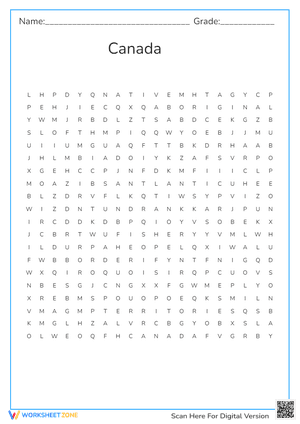
Country names are a tough category of vocabulary. They do not follow predictable English spelling patterns, they rarely show up in a students everyday reading, and many of them are long. A word search forces repeated visual scanning of each name, letter by letter, which is exactly the kind of active engagement that helps a new word move from unfamiliar to recognizable. Students are not just seeing the word once on a worksheet; they are tracing it, hunting for it in multiple directions, and often re-reading the list several times before they finish the puzzle.
Researchers studying vocabulary games have found that puzzle-based review activities like word searches can meaningfully support vocabulary retention when used alongside direct instruction, since the recognition-and-recall process reinforces spelling patterns that a single reading of a word list does not. According to The Effectiveness of Word Search Puzzles Game in Improving Students Vocabulary, published on ResearchGate, structured puzzle practice helped learners retain target vocabulary more effectively than passive review, supporting the case for using a countries word search as reinforcement rather than a stand-alone lesson.
Grade-Level Uses: Elementary and Middle School Geography
Elementary geography instruction, roughly ages six to ten, usually introduces continents, oceans, and a handful of well-known countries through games, songs, and simple maps rather than dense reading passages. A countries word search fits naturally here as a follow-up to a map lesson or a continents song, letting younger students practice spelling the country names they just learned to locate.
Middle school geography, roughly ages eleven to thirteen, shifts toward systematic regional study, where students move unit by unit through world regions. At this level, a countries word search works well as a quick recall check at the start of class or a review activity before a regional quiz. Because you control the word list, you can build a puzzle around a single region, such as Southeast Asia or West Africa, so the activity lines up directly with whatever unit your students are currently studying.
Cross-Curricular Uses Beyond the Geography Block
Geography content frequently shows up outside a dedicated geography class, appearing inside reading blocks, writing prompts, and homeroom morning work, which means a countries word search does not need a standalone geography period to be useful. A reading teacher covering a book set in another country can use it to preview setting-related vocabulary. A writing teacher assigning a country research report can hand it out as a pre-writing warm-up. Homeroom teachers running morning meeting time can rotate a country of the week and pair it with a short word search for early arrivals to complete while the rest of the class settles in.
Classroom Implementation
To get the most out of a countries word search, treat it as one piece of a short instructional sequence rather than a stand-alone handout. Start by choosing a word list tied to whatever your students are currently studying, whether that is a continent, a region, or a list of countries pulled from a current-events discussion. Hand out the puzzle at the start of class as a warm-up, or save it for the last ten minutes as a way to close out a lesson while checking who can still spell the terms correctly.
Pair the puzzle with a blank world map. As students find each country in the grid, have them locate and label that same country on the map. This turns a purely lexical task into a spatial one and gives you a fast visual check of which students are connecting the name to its actual location. For classes with mixed readiness levels, keep two versions of the list on hand: a shorter, continent-level list of well-known countries for students who need more support, and a longer, region-specific list for students ready for a challenge.
Frequently Asked Questions
1. How can teachers use a countries word search in a geography lesson?
Use it as a warm-up before introducing a new region, a review activity after a map lesson, or a closing task that checks whether students can recognize and spell the country names covered in class.
2. What grade levels is a countries word search appropriate for?
It works across elementary and middle school. Younger students benefit from a short list of familiar countries, while middle schoolers can handle longer, region-specific lists tied to their current unit.
3. How does a word search help students learn country names and spelling?
The repeated scanning required to find each word reinforces the exact letter sequence of unfamiliar proper nouns, supporting spelling recognition in a way that a single reading of a word list does not.
4. Can a countries word search be used for early finishers or substitute lesson plans?
Yes. Because it requires no direct instruction to complete, it works well as an early finisher task, a sub plan, or a low-stakes formative check during a geography unit.
5. How can teachers pair a countries word search with a map-based activity?
Have students label each country they find in the puzzle on a blank world map, which turns the vocabulary task into a spatial one and gives you a quick check of location knowledge.












 Interactive Worksheet Maker
 Quiz Maker
 Word Search Maker
 Crossword Puzzle Maker
 Word Scramble Generator
 Sentence Scramble Generator
 Handwriting Worksheet Generator
 Name Tracing Generator
 Fill In The Blank Generator