


























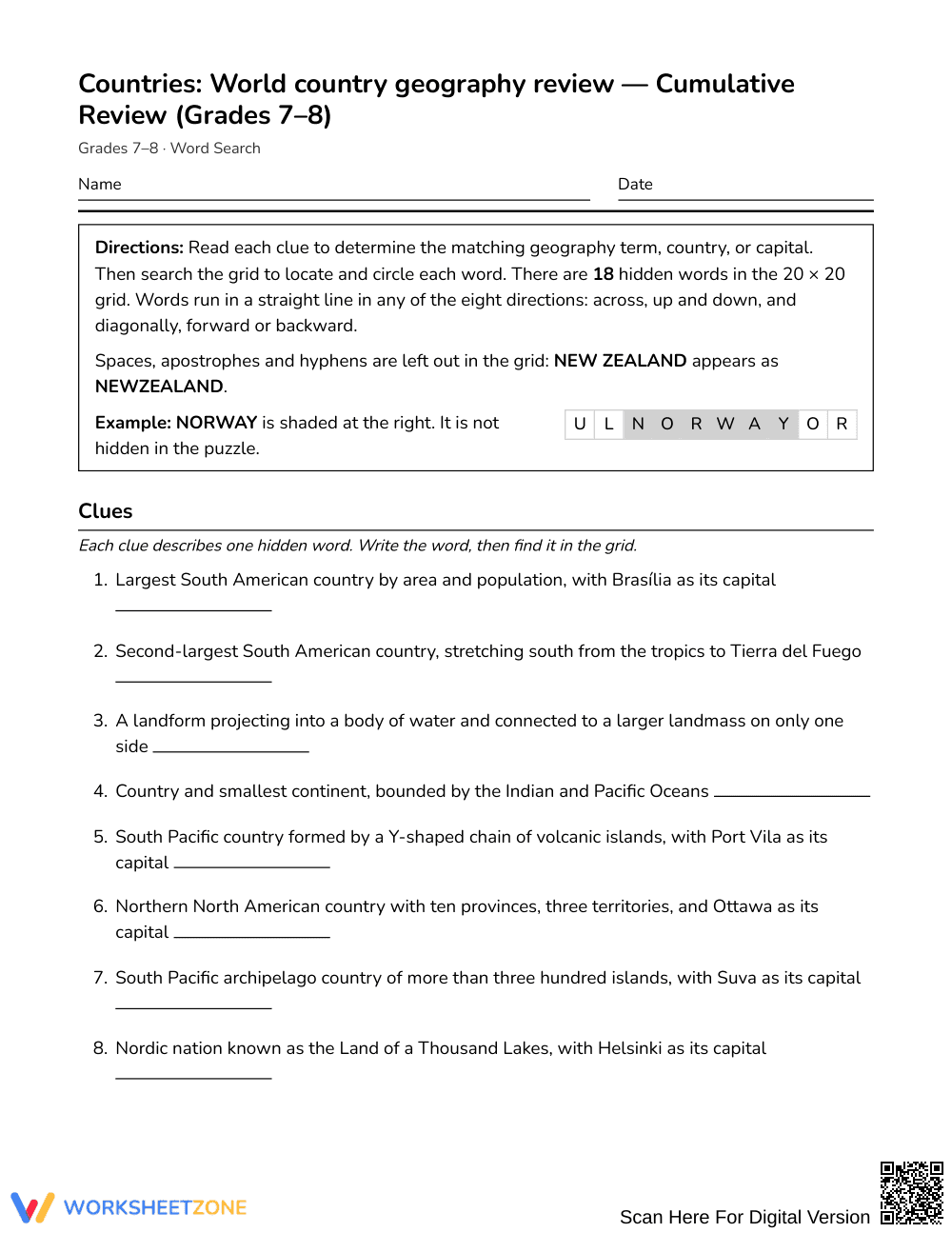


Printable Countries Word Search | Grades 7–8 Social Studies
Paste this activity's link or code into your existing LMS (Google Classroom, Canvas, Teams, Schoology, Moodle, etc.).
Students can open and work on the activity right away, with no student login required.
You'll still be able to track student progress and results from your teacher account.
Reinforce global geography knowledge with this cumulative world country review word search designed for middle school social studies classes. Students identify 18 sovereign nations, island territories, and core landform terms by solving informative regional clues before locating each hidden term across a challenging letter grid.
At a Glance
- Grade: Grades 7–8 · Subject: Social Studies
- Standard: Not standards-assessed — vocabulary enrichment
- Skill Focus: World country geography review
- Format: 3 pages · 18 hidden words · Full answer key included · Printable PDF
- Best For: Geography unit cumulative review, sub plans, and early finishers
- Time: 20–30 minutes
What's Inside
This 3-page printable resource includes an 18-term geography puzzle paired with descriptive clues and a complete 4-page answer key showing exact word placements. Rather than relying on a simple list, students read geographical descriptions highlighting capitals, continents, bodies of water, and landforms to deduce each target word. A shuffled word bank provides reference support, while the solution pages highlight letter coordinates for quick checking.
Puzzle Mechanics and Structure
The activity is built on a 20 x 20 letter grid containing 18 hidden vocabulary terms. Words run in all eight possible directions: north, northeast, east, southeast, south, southwest, west, and northwest, including backward and diagonal placements. Students engage with detailed text clues covering countries from Germany to Vanuatu, as well as essential geographic concepts like archipelago, landlocked, and peninsula.
Standards Alignment
This activity serves as vocabulary enrichment and is not formally tied to a specific state or national content standard. It reinforces essential cross-curricular literacy in social studies by expanding geographical naming fluency, spatial associations, and map-related terminology across multiple world regions.
How to Use It
Deploy this word search after completing a comprehensive unit on world geography or global regions. It works effectively as an engaging opener, an independent post-assessment task, or a reliable sub plan activity requiring zero teacher preparation. During completion, circulate to observe whether students use the descriptive clues to recall country capitals or rely strictly on letter scanning, which highlights retention gaps. Most learners complete the activity in 20 to 30 minutes.
Who It's For
This puzzle is tailored for students in Grades 7–8 studying world geography, global cultures, or regional social studies. It offers self-paced vocabulary reinforcement suitable for general education classrooms, English language learners building place-name recognition, and fast finishers seeking an intellectual challenge. Pair this puzzle with an unlabeled political world wall map or student atlas so learners can locate each nation geographically after finding its name.
Fisher & Frey (2014) emphasize that purposeful vocabulary reinforcement through contextual associations and retrieval practice strengthens domain-specific reading comprehension in secondary content areas. This Grades 7–8 world geography word search targets 18 essential geographic terms, sovereign nations, and geopolitical features, prompting students to connect definitions, capital cities, and continental locations with correct terminology. By requiring students to decode clues regarding national capitals, landform traits, and regional landmarks before locating terms in an eight-directional matrix, the activity promotes active retrieval rather than passive letter scanning. Integrating structured puzzle mechanics into social studies routines provides middle school learners with low-stakes, high-interest exposure to global place names. This intentional repetition helps cement spatial vocabulary essential for interpreting informational texts, analyzing thematic maps, and engaging in broader geopolitical discussions throughout middle school geography instruction.


