




























Views
Downloads

Essential Grade 4 Science: Action and Reaction Forces

Paste this activity's link or code into your existing LMS (Google Classroom, Canvas, Teams, Schoology, Moodle, etc.).
Students can open and work on the activity right away, with no student login required.
You'll still be able to track student progress and results from your teacher account.
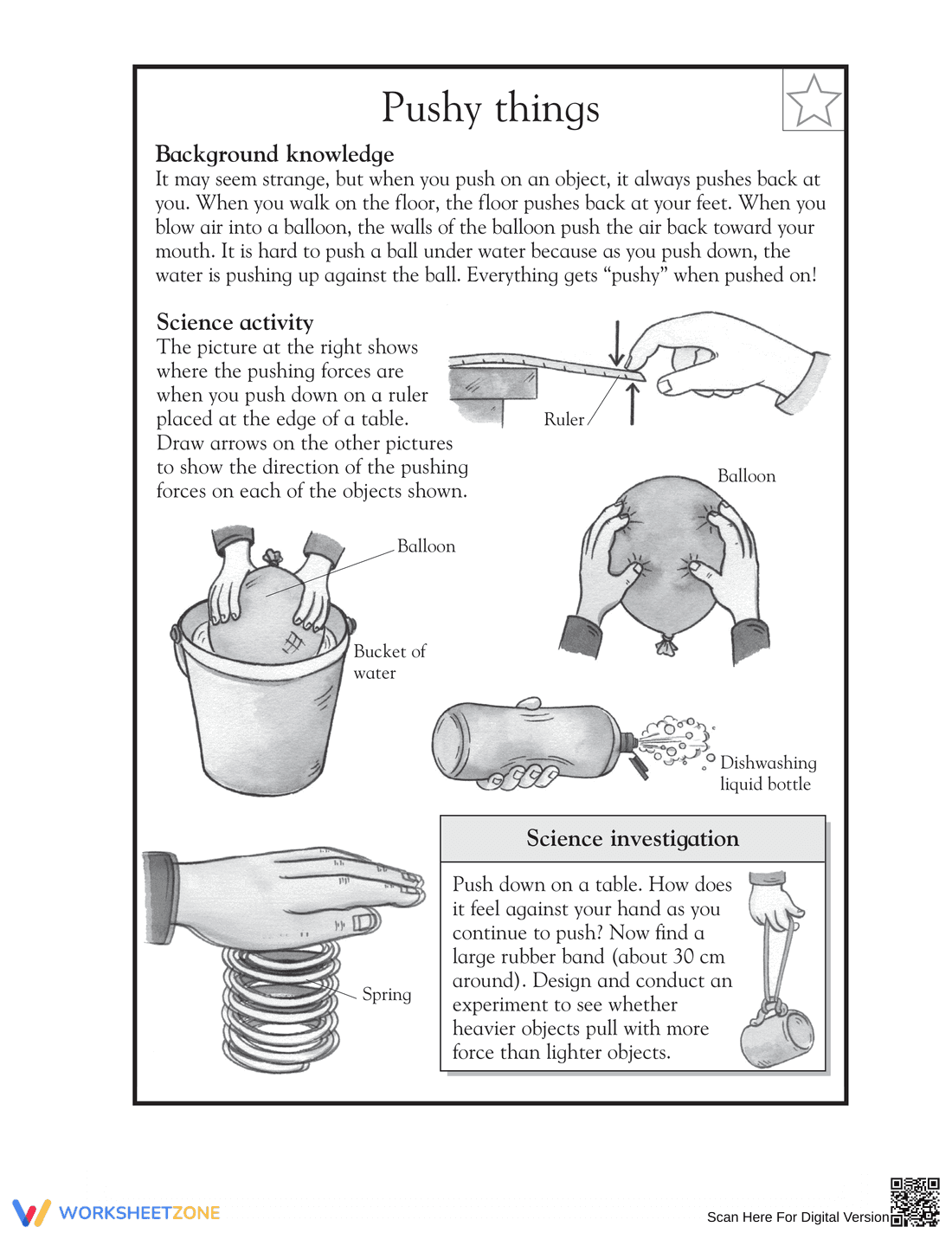
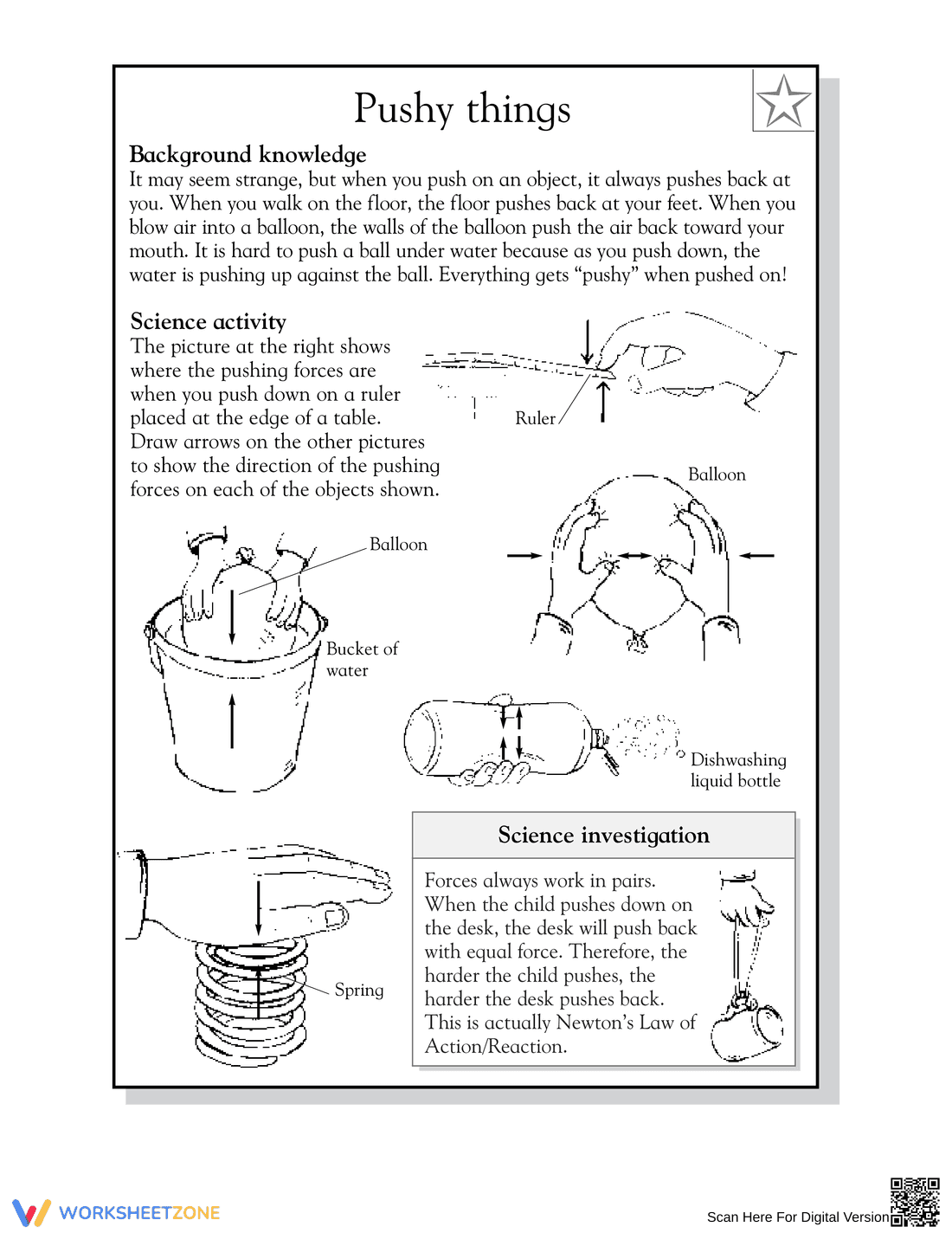
Students master the fundamental physics concept that every action has an equal and opposite reaction. This worksheet guides Grade 4 learners through identifying invisible counter forces in real-world scenarios, from pushing on a spring to submerging a balloon. By visualizing these interactions, students build a concrete understanding of Newton's Third Law through active diagramming and observation.
At a Glance
- Grade: 4 · Subject: Science
- Standard:
3-PS2-1— Investigate balanced and unbalanced forces to provide evidence of their effects on objects- Skill Focus: Action and reaction force pairs
- Format: 1 page · 5 tasks · Answer key included · PDF
- Best For: Independent practice or group labs
- Time: 15–20 minutes
This single-page PDF includes a clear "Background knowledge" section that introduces the concept of objects "pushing back." Students engage with five distinct tasks: one worked example with a ruler on a table, and four drawing prompts involving a balloon in water, hands squeezing a balloon, a dishwashing liquid bottle, and a compressed spring. A separate "Science investigation" prompt encourages hands-on experimentation with rubber bands and weights.
The workflow is designed for immediate classroom deployment. First, print the single-page document (30 seconds). Second, distribute to students as a bell-ringer or supplemental activity during a unit on forces; the built-in background text allows students to work with minimal teacher introduction (2 minutes). Finally, review student diagrams using the provided answer key to check for correct arrow direction and placement (5 minutes). It is a perfect addition to a substitute teacher folder.
Primary standard 3-PS2-1 focuses on planning and conducting investigations to provide evidence of the effects of balanced and unbalanced forces on the motion of an object. This worksheet specifically addresses the "evidence" portion by requiring students to diagram the forces present in static and dynamic interactions. Both standard codes can be copied directly into lesson plans, IEP goals, or district curriculum mapping tools.
Use this worksheet as a formative assessment immediately after a direct instruction lesson on Newton's Laws. Observe whether students correctly place the reaction force arrows directly opposite the action force to gauge their understanding of force directionality. It also serves as a high-quality "quiet time" activity or a scaffolded lead-in to a more complex physical science laboratory experiment involving spring scales.
Designed for Grade 4 elementary students, this resource is easily differentiated for English Language Learners through its heavy reliance on visual diagramming and clear, concise vocabulary. It pairs naturally with a hands-on demonstration involving a skateboard or a wall-push activity to make the abstract concept of counter-forces tangible for kinesthetic learners.
The integration of visual diagramming to represent abstract physical concepts like reaction forces is a cornerstone of effective elementary science instruction. By requiring students to draw arrows representing force direction, this worksheet aligns with the "modeling" practice of NGSS standard 3-PS2-1, which emphasizes investigating balanced and unbalanced forces. Research by Fisher & Frey (2014) highlights that gradual release of responsibility—moving from the provided "Background knowledge" and worked examples to independent student diagramming—is critical for mastery of complex spatial and conceptual relationships in physics. This Grade 4 resource provides scaffolding to move students from simple observations to evidence-based models of force interactions. The inclusion of a "Science investigation" extension further supports the development of inquiry-based thinking, ensuring students can transition from paper-based theory to real-world application, a key metric in modern educational assessments like the NAEP science framework.


