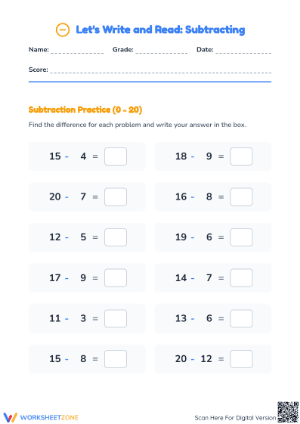
These subtraction within 20 printable worksheets give first- and second-grade teachers a print-ready practice set targeting every combination with a minuend of 20 or below — including the teen-number facts where most first graders stall. The set spans the developmental stretch from mid-first grade through the end of second, exactly when students need repeated, varied exposure to turn fragile strategies into automatic recall.
The Specific Skills Targeted
Each worksheet addresses a distinct dimension of subtraction fluency rather than recycling the same format with slightly different numbers. Across the set, students:
- Solve equations in both horizontal and vertical alignment, building the spatial flexibility they need before column subtraction with regrouping appears in third grade
- Work missing-minuend and missing-subtrahend problems — equations like ___ − 7 = 9 — which require students to reason about the relationship among all three numbers rather than apply a rote procedure
- Complete fact families using a single number triple, writing both the addition and subtraction equations to surface the inverse relationship explicitly
- Apply facts inside word problems where identifying the correct operation is part of the task, not just executing the calculation
- Practice short timed quick-checks designed to measure automaticity once conceptual understanding is already in place
The word problems throughout the set use classroom-sized numbers and everyday situations — sharing crayons, returning library books — rather than abstract placeholder contexts. Students who freeze on word problems often do so because the language feels unfamiliar, not because the arithmetic is beyond them. Familiar contexts lower that barrier without reducing the mathematical demand.
Frequent Student Errors Worth Watching For and Correcting
The most consistent error pattern at this level appears when students cross the tens barrier. A student solving 13 − 5 by counting back will move correctly from 13 — twelve, eleven, ten — and then treat 10 as a natural stopping point, recording 10 instead of continuing to 8. The number line worksheets expose this immediately because the student's hops stop at 10 rather than traveling through it. Spotting this early, before it becomes ingrained, saves weeks of reteaching.
A second predictable mistake appears on missing-subtrahend problems. Students who internalized "big minus small" as a shortcut will flip the numbers when a horizontal equation shows what looks like a larger number being subtracted from a smaller one, writing 8 − 14 = 6 instead of recognizing that 14 − 8 = 6. Both errors point to conceptual gaps — not careless slips — and the worksheet formats that generate these mistakes are the same ones that make those gaps visible before the unit ends.
Recommended Lesson-Planning Strategies for Getting the Most From These Worksheets
The most effective placement is the five minutes immediately after direct instruction ends — not homework, not the following morning. When a teacher finishes modeling the "make ten" strategy with a ten-frame on the board and immediately puts three or four practice problems in front of students, working memory is still holding the procedure. Waiting until the next day introduces enough decay that many students approach the worksheet as if the concept is new. Short, same-day practice is the single most consistent factor in building retention at this level.
For stations rotation, one worksheet per plastic sleeve works well with dry-erase markers, creating a reusable center that doesn't require weekly reprinting. During small-group pull-outs, use the missing-number format specifically — it generates the "wait, how do I figure this out?" pause that makes a five-minute group genuinely productive. The subtraction within 20 printable worksheets in this set are short enough that a single one functions as an exit ticket at the close of a math block, giving you next-day grouping data before you've left the building.
Standard Alignment
These worksheets align to CCSS.MATH.CONTENT.1.OA.C.6, which requires students to add and subtract within 20 using strategies such as making ten, decomposing toward a ten, and applying the relationship between addition and subtraction. The standard distinguishes between demonstrating fluency within 10 — a first-grade benchmark — and fluency within 20, which is the end-of-second-grade expectation under CCSS.MATH.CONTENT.2.OA.B.2. That two-year window is intentional. First-grade teachers use these worksheets to build initial fluency across the full range; second-grade teachers use them to consolidate and maintain it alongside multi-digit work. Both contexts are legitimate uses of the set, and the problem variety across worksheets supports instruction at either point in the progression.
Differentiating the Worksheets Across Ability Levels
For students who are not yet ready to work with minuends above 10, the horizontal-format worksheets adapt easily: cover the problems with larger minuends using a sticky note and assign only the bottom portion. This keeps the worksheet format consistent without overwhelming students still consolidating within-10 facts. Adding a number line clipped to the top of the page gives those students a concrete reference without requiring a separate manipulative kit or a different resource entirely.
Students who demonstrate quick recall of basic facts and need to push forward benefit from the multi-step word problems and the missing-minuend format, both of which demand more from working memory than a standard fill-in equation. The subtraction within 20 printable worksheets can also be paired with a simple recording sheet that asks students to name the strategy they used — making ten, think-addition, counting back — which moves them toward metacognitive monitoring of their own fluency. That's a meaningful extension that doesn't require entirely different content or a separate preparation.
Frequently Asked Questions
Does "within 20" include 20 itself, or does the range stop at 19?
It includes 20. Subtraction within 20 covers any equation where the minuend is 20 or less — including 20 − 1, 20 − 7, and 20 − 20. The phrase follows the same convention used in the Common Core standard: the starting number does not exceed 20. Problems like 20 − 13 = 7 appear in the set and represent the upper end of what students are expected to master by the close of second grade.
How do I move students away from finger counting without creating math anxiety?
Don't prohibit finger counting outright — it is a legitimate early strategy, and removing it without a concrete replacement tends to produce more anxiety than it solves. Instead, pair worksheet practice with explicit instruction in making ten or think-addition before the worksheet goes out. During practice, prompt students to picture a ten-frame in their mind rather than their fingers. Over two to three weeks of consistent short sessions, most students naturally move away from finger counting once they experience that a mental strategy is faster. The transition happens through repeated success, not through prohibition.
Are these appropriate for second-grade review, or are they strictly first-grade content?
Both grades use them, for different reasons. First-grade teachers use them to build fluency across the full range as students encounter the teen-number facts for the first time. Second-grade teachers use them for morning warm-ups, targeted fluency maintenance, or quick review alongside multi-digit work. The fact-family and missing-number formats are particularly useful in second grade because they connect directly to the early algebraic thinking that second-grade standards begin developing — understanding that a subtraction equation describes a relationship, not just a calculation direction.
Can these double as a formal assessment, or are they better kept for practice?
Each worksheet works well as a formative check — an exit ticket or quick-check at the close of instruction. For summative purposes, a single worksheet gives a reasonable snapshot of fact fluency on a given day, but fluency is better measured across multiple data points over time. A student who scores poorly on one worksheet but has been performing well on daily checks likely had an off day; one consistent gap pattern across three or four worksheets points to a specific misconception worth addressing in small-group instruction. The subtraction within 20 printable worksheets in this set include enough problem variety that recurring errors reveal which strategy a student is missing, rather than simply flagging that something went wrong.
















 Interactive Worksheet Maker
 Quiz Maker
 Word Search Maker
 Crossword Puzzle Maker
 Word Scramble Generator
 Sentence Scramble Generator
 Handwriting Worksheet Generator
 Name Tracing Generator
 Fill In The Blank Generator