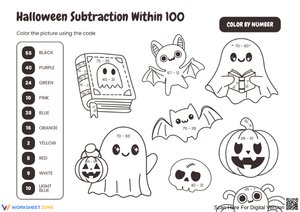
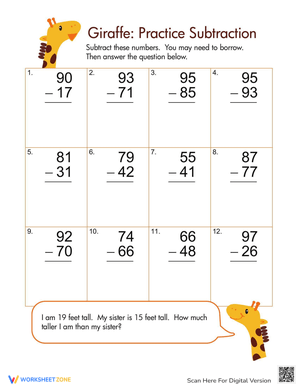
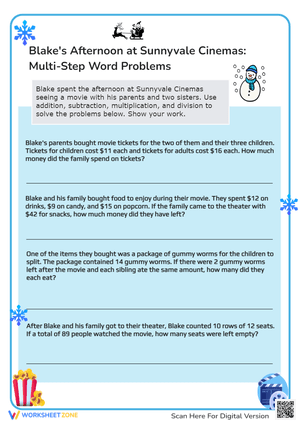
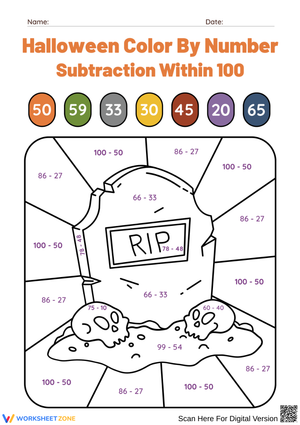
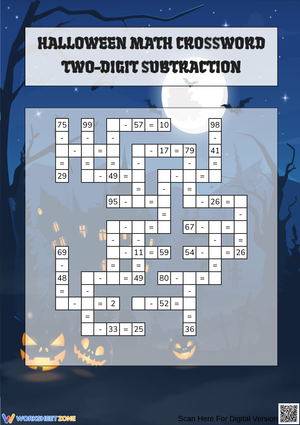
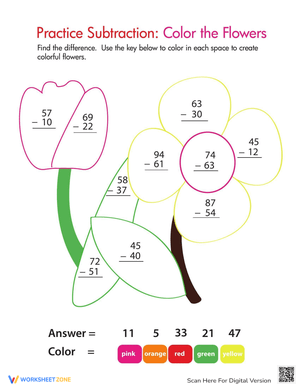
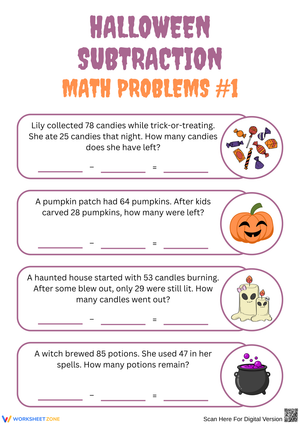
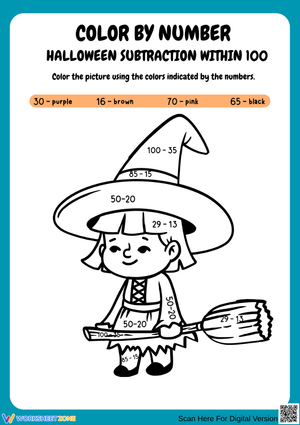
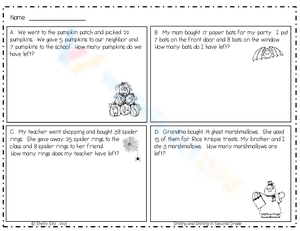
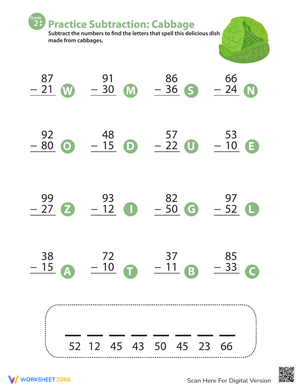
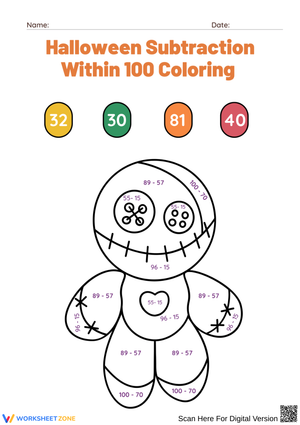
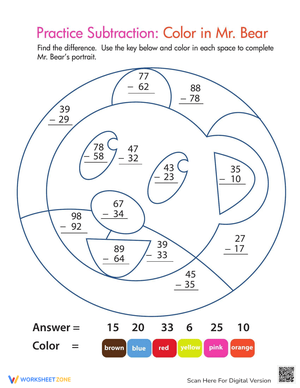
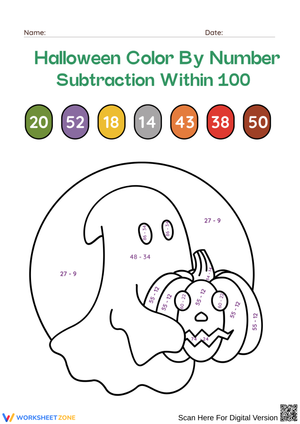
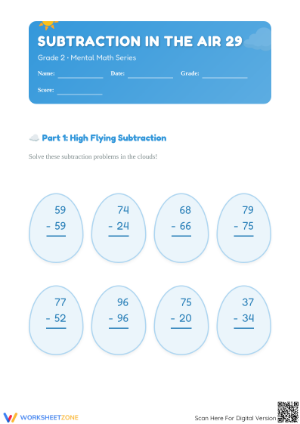
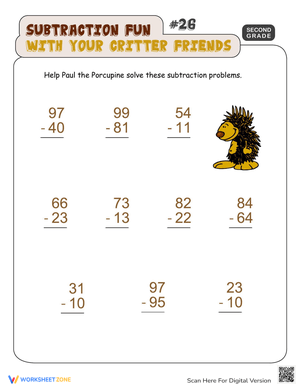
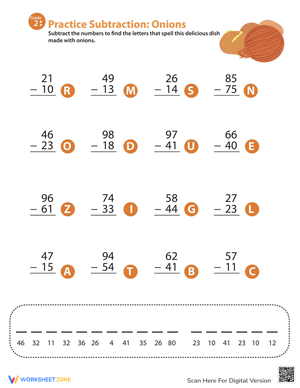
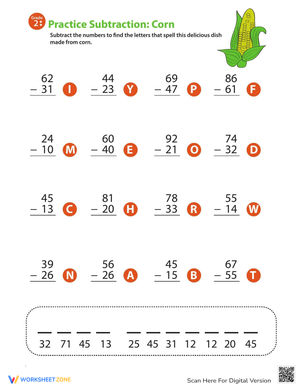
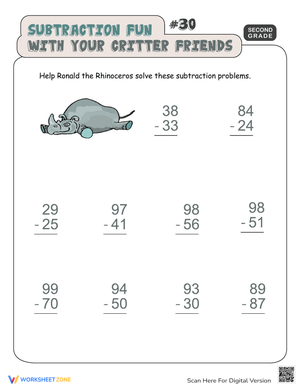
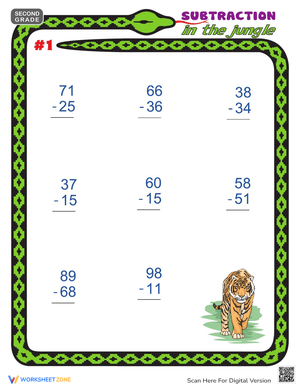
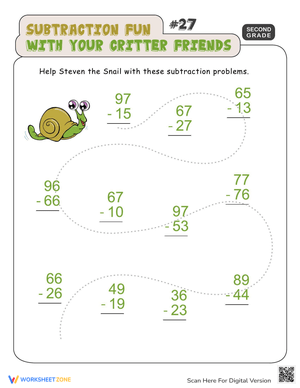
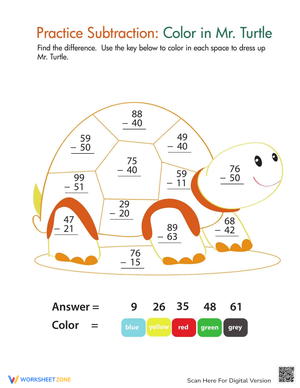
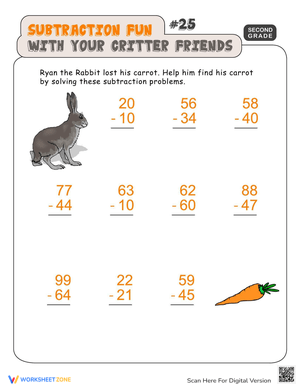
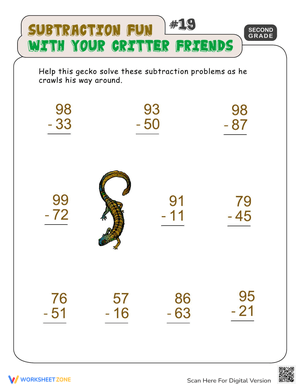
These subtraction within 100 pdf worksheets give 1st- and 2nd-grade teachers a ready-built practice set spanning the full range of two-digit subtraction — no-regrouping problems like 74 − 31, borrowing problems that require decomposing the tens place, missing-number equations, and applied word problems drawn from measurement and money contexts. Each worksheet stands alone as a self-contained assignment, so you pull exactly what a class needs on any given day.
Skills Across the Set
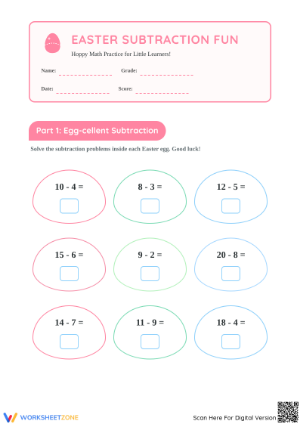
The worksheets address subtraction at three levels of complexity. The first group targets subtraction without regrouping: problems where each digit in the subtrahend is smaller than the corresponding digit in the minuend. These build accuracy and reinforce place-value language before students encounter any procedural demands beyond careful column alignment. The second group moves into regrouping — problems like 63 − 28, where students must decompose a ten into ten ones before subtracting in the ones place. The third group pushes further with missing-number problems such as __ − 36 = 47, which require students to reason about the relationship between addition and subtraction rather than execute an algorithm.
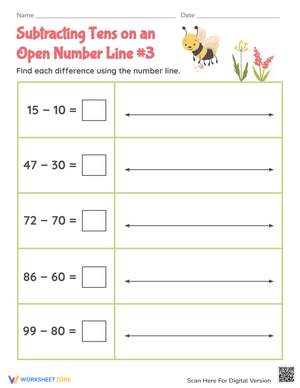
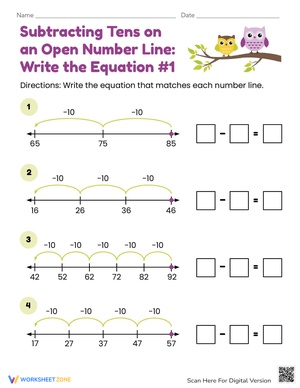
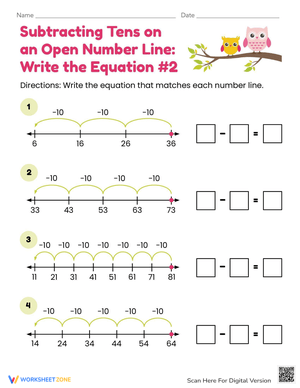
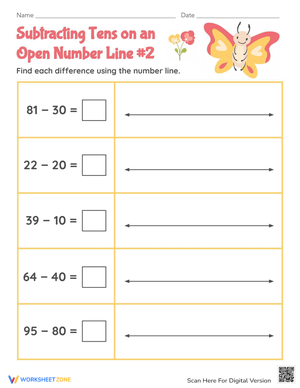
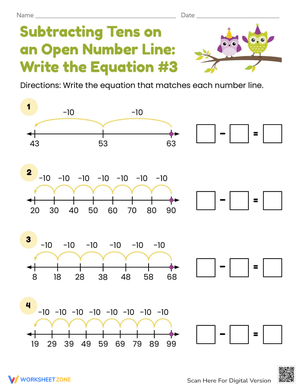
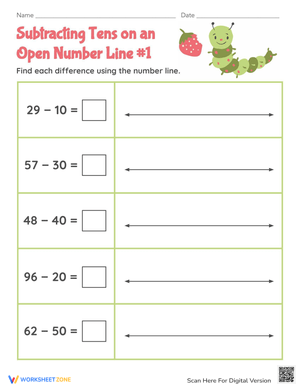
Several worksheets pair computation with number-line diagrams, asking students to mark a starting point, show a jump, and record the difference. This format links the abstract vertical algorithm to the visual model students first encounter during hands-on work, reinforcing underlying structure rather than just procedure.
Student Mistakes to Anticipate When You Assign These
Regrouping errors follow a remarkably consistent pattern in actual student work. The most common: a student encounters 52 − 28 and writes 36, because they subtracted 2 from 8 in the ones place instead of recognizing they needed to borrow. They've applied the rule "subtract the smaller digit from the larger digit" as if it were universal — and in non-regrouping problems, it is. The answer looks plausible enough to slip past a quick scan. What reveals it is the inverse check: 36 + 28 = 64, not 52. Building that check into a few worksheets trains students to catch their own errors before you collect the page.
A second pattern appears in missing-number problems. Students who learned subtraction purely as "top minus bottom" frequently treat __ − 36 = 47 as a subtraction equation and write 11 (47 − 36) rather than thinking additively. If you see that consistently, the fix is not re-teaching the subtraction algorithm — it's returning to the part-part-whole model and making the addition-subtraction relationship explicit again before assigning more computation practice.
Fitting These Worksheets Into Your Instructional Week
The most reliable slot for these is the five to eight minutes before transitioning out of morning meeting. A single worksheet with ten to twelve no-regrouping problems settles students into math thinking without demanding heavy cognitive effort first thing. Save borrowing problems for the independent practice block that follows whole-group instruction — that's where procedural work belongs, immediately after you've modeled the decomposition step with base-ten blocks while it's still fresh.
These subtraction within 100 pdf worksheets also work well at a rotation station. The key is pre-sorting them by type before the week begins: one stack for students still building confidence with non-regrouping, one for students ready for borrowing, and one of missing-number equations and word problems for students who have the algorithm but need flexibility. When the stacks are sorted ahead of time, the rotation manages itself. You pull the group that needs reteaching while everyone else works independently.
For homework, send home one worksheet with a brief note at the top naming the strategy — "Tonight's problems use place value to subtract. Try decomposing the tens and ones separately." Parents who know the strategy being practiced can offer a useful prompt instead of defaulting to finger-counting or a different algorithm that contradicts what's happening in class.
Adjusting the Set for Different Points on the Learning Continuum
Students who are not yet fluent with basic subtraction facts within 20 will hit a wall the moment regrouping appears — because regrouping requires a quick, accurate ones-place subtraction before the student can move to the tens place. For those students, pair each worksheet with a reference card showing the most common subtraction facts. The goal is not to shortcut fact fluency; it's to prevent fact-retrieval failures from masking whether the student understands the regrouping procedure itself.
Students working above grade level benefit most from error-analysis tasks: a fictional student's completed work with five or six planted mistakes across different error types. Finding and correcting those errors requires deeper understanding than solving fresh problems, and it produces the kind of mathematical conversation — "She forgot to reduce the tens digit after she borrowed" — that reveals genuine comprehension. Missing-number problems with regrouping, such as 7__ − 4_8 = 25, also extend thinking without simply increasing the problem count.
Standard Alignment
These worksheets align with CCSS 2.NBT.B.5, which calls for fluent addition and subtraction within 100 using strategies grounded in place value, properties of operations, and the inverse relationship between the two operations. Instructionally, this standard runs through the entire 2nd-grade math year — not as a single unit but as a thread. Teachers who use these subtraction within 100 pdf worksheets alongside their core program use them to monitor that thread: a student still making consistent regrouping errors in March needs targeted intervention before the class moves to three-digit work.
First-grade teachers will find the no-regrouping worksheets useful for reinforcing 1.NBT.C.6, which addresses subtracting multiples of 10 from two-digit numbers — a precursor skill that feeds directly into the 2nd-grade fluency standard.
Frequently Asked Questions
At what point in 2nd grade should regrouping worksheets be introduced?
After students have demonstrated accuracy on non-regrouping problems and worked through the concept with physical base-ten blocks. A rough readiness benchmark: if a student can consistently solve problems like 76 − 43 without errors and can explain what each digit represents, they're ready to explore what happens when the ones digit in the subtrahend is larger than the one above it. Moving to regrouping practice before that conceptual grounding is in place tends to produce the "subtract the smaller digit" error described above.
How many problems per worksheet is appropriate for 2nd graders?
For fluency drills, ten to fifteen problems fits a five-minute window and yields a clean accuracy percentage without overwhelming students. For conceptual work — number-line diagrams, word problems, missing-number equations — six to ten problems is enough. Cognitive load on a conceptually demanding task rises sharply as problem count increases; fewer problems with adequate processing time produces stronger retention than a full page of rushed work.
Can these worksheets support 3rd graders who haven't yet mastered two-digit subtraction?
Subtraction within 100 pdf worksheets are regularly used in 3rd grade as a focused review and intervention tool. A student struggling with three-digit subtraction almost always has an unresolved gap in two-digit regrouping. Targeting that gap directly with two-digit practice — rather than persisting through three-digit problems the student isn't ready for — is the faster path back to grade-level work.













 Interactive Worksheet Maker
 Quiz Maker
 Word Search Maker
 Crossword Puzzle Maker
 Word Scramble Generator
 Sentence Scramble Generator
 Handwriting Worksheet Generator
 Name Tracing Generator
 Fill In The Blank Generator