


























Views
Downloads


Printable Solving Proportions Worksheet | Grade 7-9 Math
Paste this activity's link or code into your existing LMS (Google Classroom, Canvas, Teams, Schoology, Moodle, etc.).
Students can open and work on the activity right away, with no student login required.
You'll still be able to track student progress and results from your teacher account.
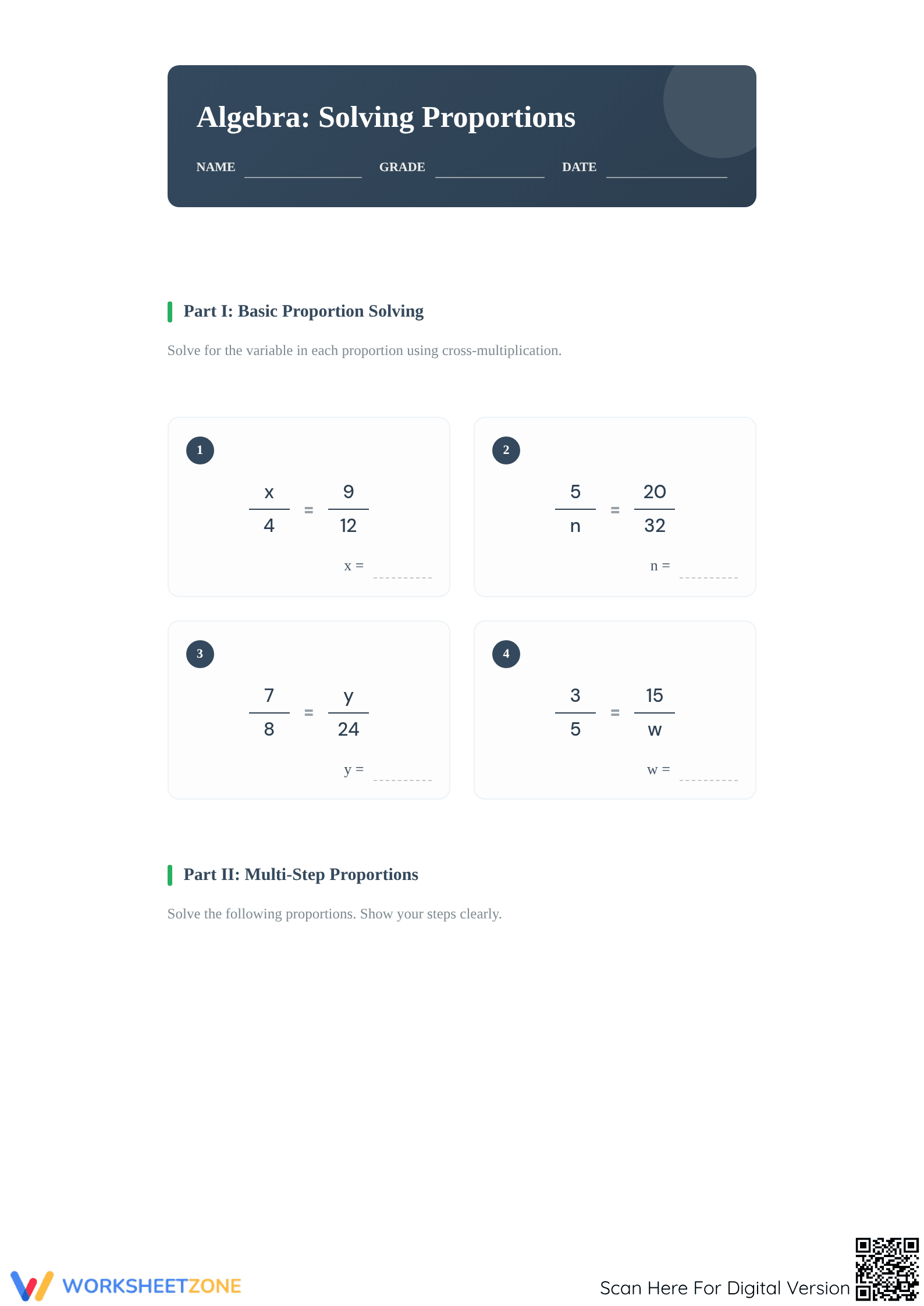
This comprehensive math worksheet empowers students to master the critical algebraic skill of solving proportions through a scaffolded four-part progression. By moving from basic cross-multiplication to complex multi-step equations with variables on both sides, learners build the conceptual fluency required for higher-level geometry and physics. Students will achieve measurable accuracy in proportional reasoning.
At a Glance
- Grade: 7–9 · Subject: Math
- Standard:
7.RP.A.2.C— Represent proportional relationships by equations to solve real-world and mathematical problems.- Skill Focus: Proportional reasoning and algebraic solving
- Format: 3 pages · 14 problems · Answer key included · PDF
- Best For: Algebra I prep and ratio mastery
- Time: 35–45 minutes
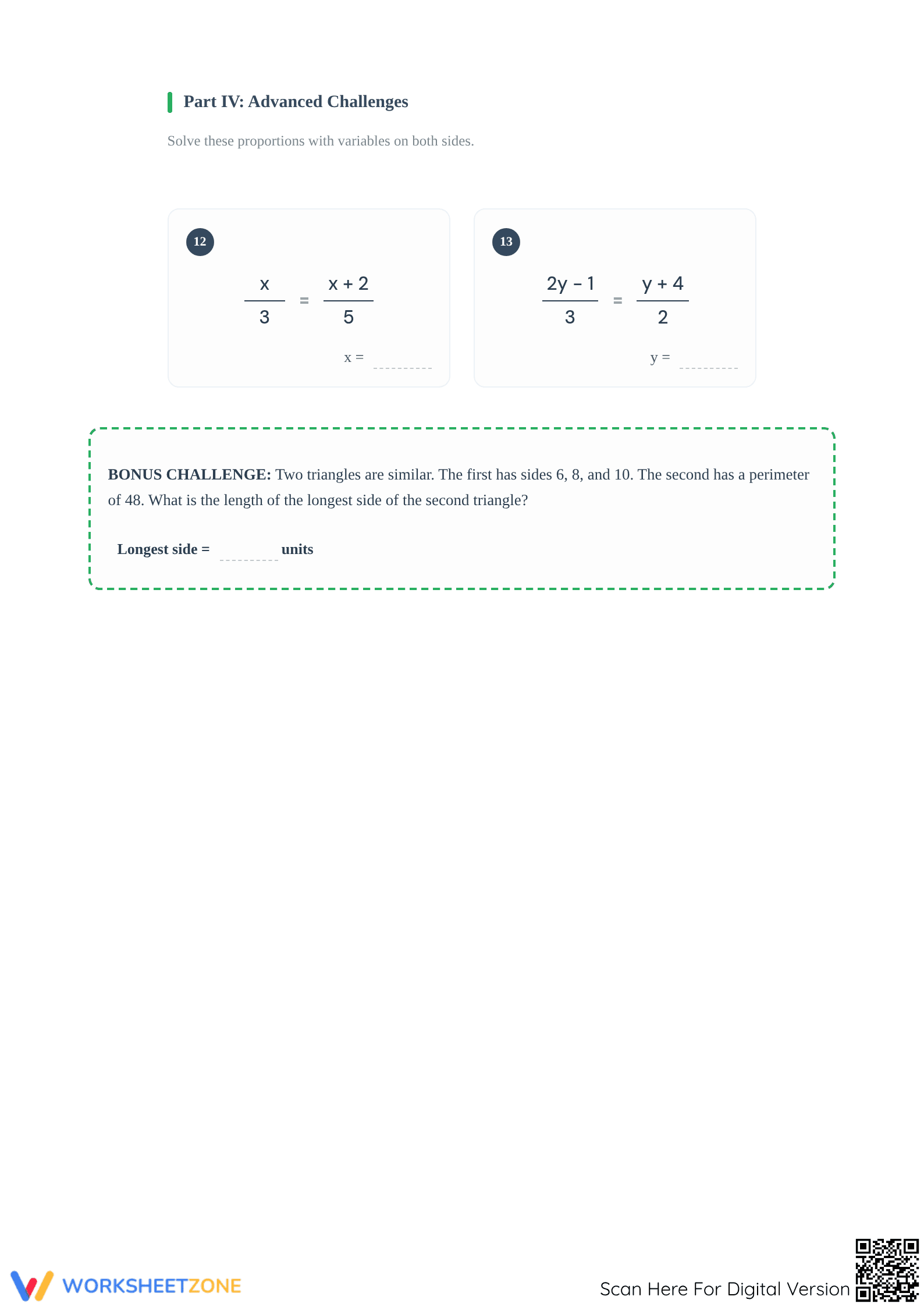
This 3-page PDF provides a robust practice set consisting of 14 distinct tasks, including a final bonus challenge. The layout includes ample workspace for students to show their algebraic steps. A full answer key is included to facilitate immediate feedback or self-grading, covering everything from simple unit rate comparisons to multi-step word problems involving interest and similar triangles.
Skill Progression
- Guided Practice: 4 introductory problems focusing on the cross-product property to isolate a single variable in the denominator or numerator.
- Supported Practice: 4 multi-step equations where students must distribute or combine terms before solving the proportion using inverse operations.
- Independent Practice: 3 real-world word problems and 2 advanced algebraic challenges featuring variables on both sides of the equal sign.
The worksheet follows a gradual-release model, ensuring students master the mechanic before applying it to complex scenarios through an I Do, We Do, You Do instructional flow.
Standards Alignment
The primary focus is 7.RP.A.2.C, which requires students to represent proportional relationships by equations. Additionally, the advanced sections align with 8.EE.C.7 for solving linear equations in one variable. Both standard codes can be copied directly into lesson plans, IEP goals, or district curriculum mapping tools.
How to Use It
Assign Part I and II as an in-class practice session immediately following a direct instruction lesson on cross-multiplication. Use the word problems in Part III as a formative-assessment tool to observe if students can translate verbal descriptions into mathematical ratios. Expected completion time ranges from 35 to 45 minutes depending on the student's prior algebraic exposure.
Who It's For
This resource is designed for Grade 7 through Grade 9 students enrolled in Pre-Algebra or Algebra I. It offers natural differentiation by allowing advanced learners to skip to Part IV, while struggling students can focus on the scaffolds provided in Part I. It pairs perfectly with a direct instruction lesson on the means-extremes property.
According to the NAEP framework and research from Fisher & Frey (2014), the ability to solve proportions is a gateway skill that connects arithmetic to functional algebra. This worksheet targets the 7.RP.A.2.C standard, emphasizing the student's ability to represent proportional relationships by equations. Research indicates that scaffolded practice sets, which gradually increase cognitive demand from basic computation to multi-step application, significantly improve long-term retention of algebraic concepts. By providing 14 targeted problems, this resource ensures that students encounter a variety of equation structures, reducing common errors associated with variable placement. Educators can utilize these findings to justify the inclusion of multi-page practice sets in secondary math curriculum, ensuring that students meet rigorous college-and-career readiness benchmarks in proportional reasoning.


