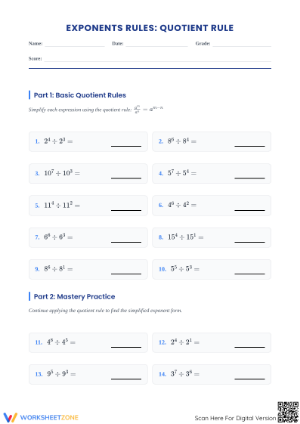
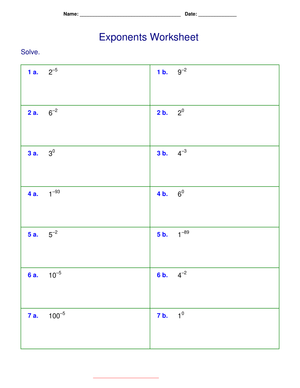
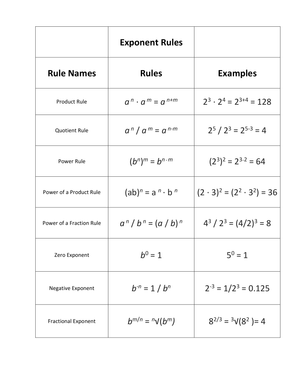
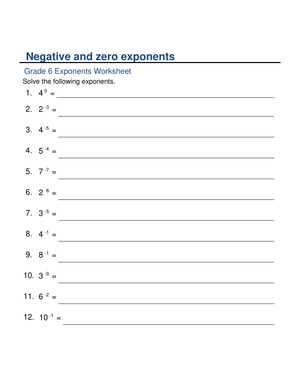
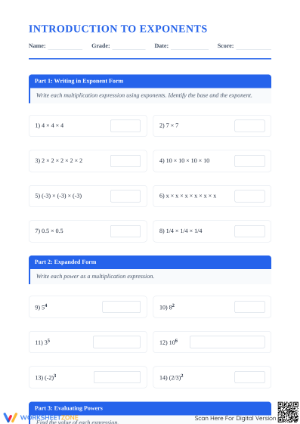
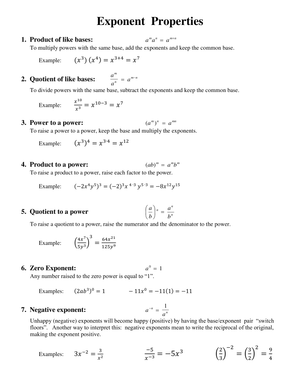
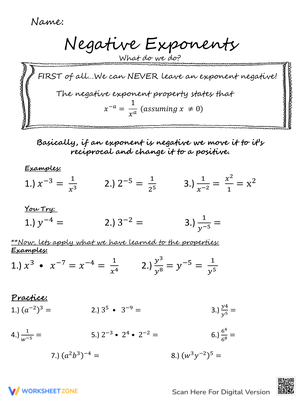
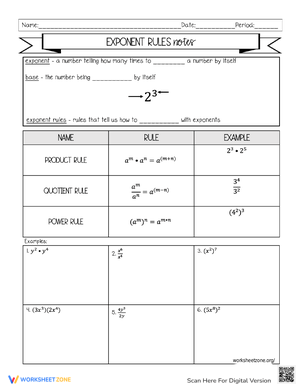
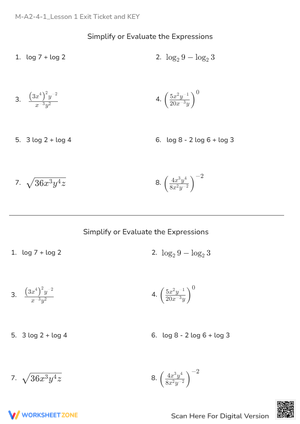
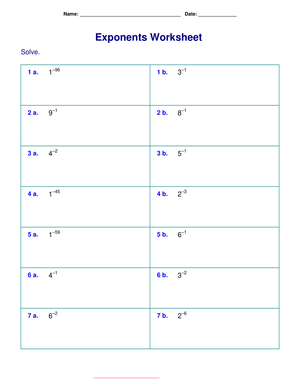
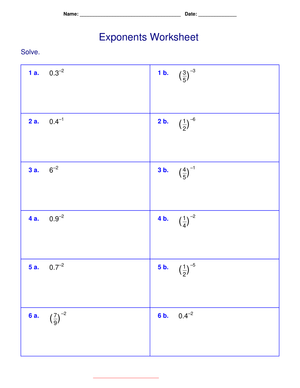
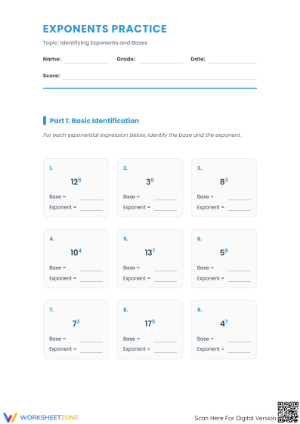
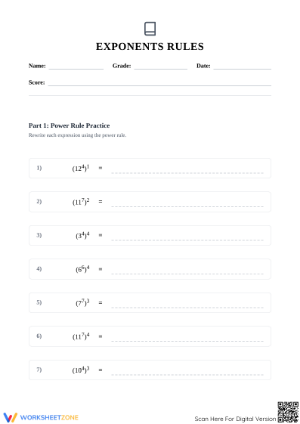
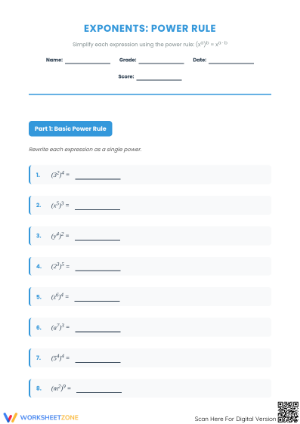
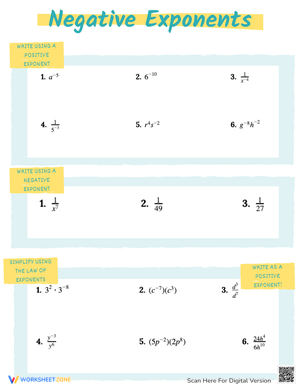
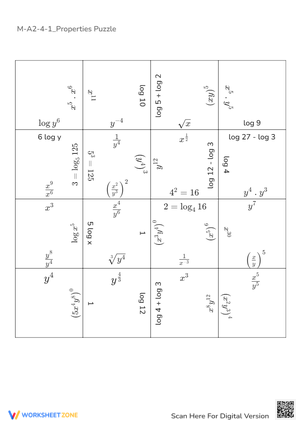
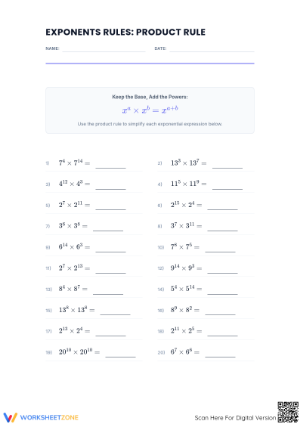
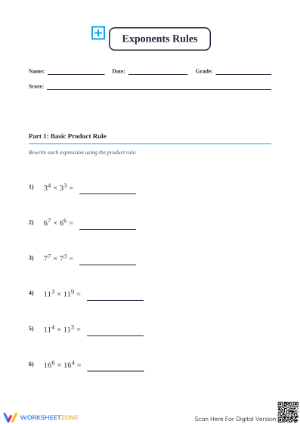
These properties of exponents worksheets give 8th through 10th grade math teachers a structured sequence of standalone practice resources covering every major exponent rule — product, quotient, power of a power, zero exponent, and negative exponent — with enough variety across the set to carry a unit from first introduction through mixed-review fluency. The worksheets are built for the moment students stop treating exponents as shorthand and start working with them as an algebraic system.
The Specific Skills Targeted
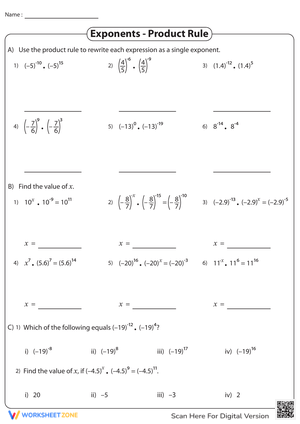
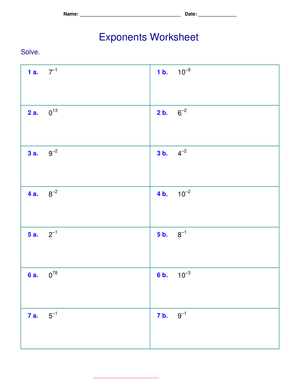
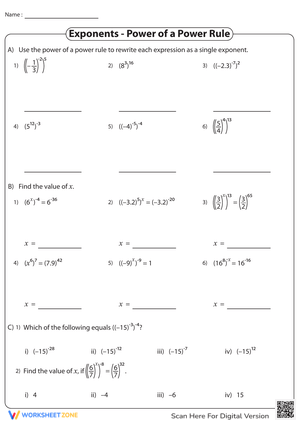
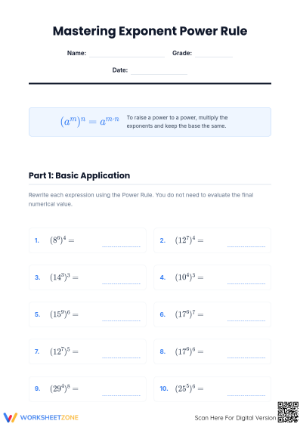
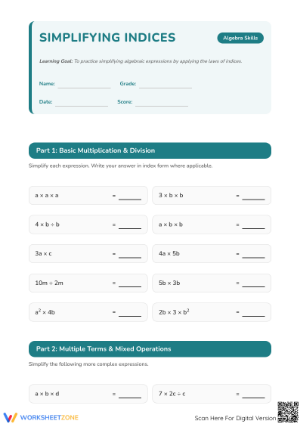
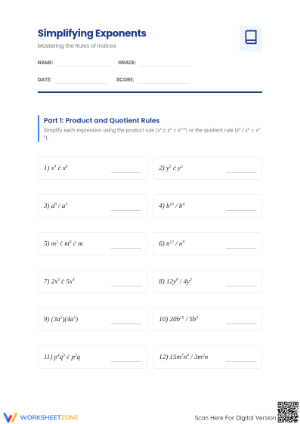
Each worksheet isolates or combines the rules students are expected to apply fluently before moving into polynomial operations or exponential functions. The product rule — add exponents when multiplying same-base expressions — gets its own focused practice before it appears alongside the quotient rule. The power of a power rule, which requires multiplying exponents, is treated separately because students confuse it with the product rule at a rate that warrants dedicated attention. Zero and negative exponents round out the integer exponent work, and several worksheets extend into rational exponents for high school Algebra 2 contexts.
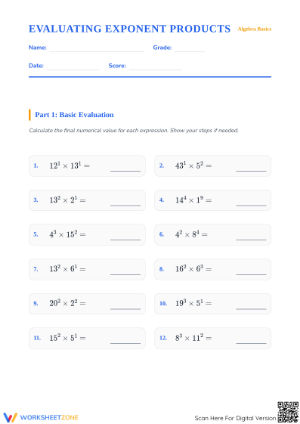
Problem types across the set include simplification with numeric bases, simplification with variable bases, multi-step expressions combining two or three rules, and rewriting expressions to use only positive exponents. A handful of worksheets present expressions already simplified — some correctly, some not — and ask students to verify or correct the work, which builds a different kind of fluency than straightforward simplification.
Standard Alignment
The integer exponent worksheets align to CCSS 8.EE.A.1, which expects 8th graders to apply the properties of integer exponents to generate equivalent expressions. This standard sits at the opening of the Expressions and Equations domain for a reason — it is the prerequisite for 8.EE.A.3 and 8.EE.A.4 (scientific notation), and students who do not have fluent recall of the exponent rules spend their working memory on rule retrieval instead of notation conversion. The rational exponent worksheets address CCSS HSN-RN.A.1 and A.2, which extend the properties of integer exponents to rational exponents in the high school Number and Quantity domain. Instruction on rational exponents typically appears midway through Algebra 2 or in a pre-calculus bridge unit.
Mistakes Students Make That These Worksheets Help You Catch
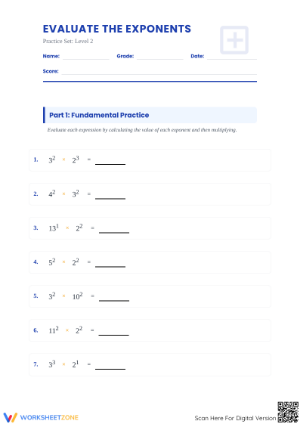
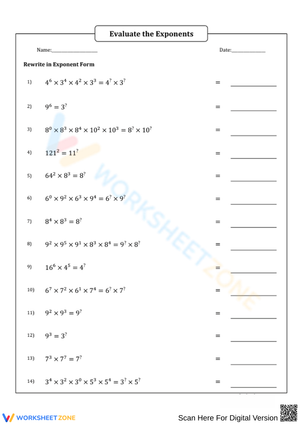
The error that surfaces most reliably in student work is base confusion on the product rule. When students see 3² × 3³, a significant portion will write 9⁵ — they multiplied the bases as if this were regular multiplication and then added the exponents correctly. The logic is internally consistent and wrong. Catching this early requires problems where the base is a single-digit integer, because variable bases hide the error: students write x⁵ correctly whether they understood the rule or not.
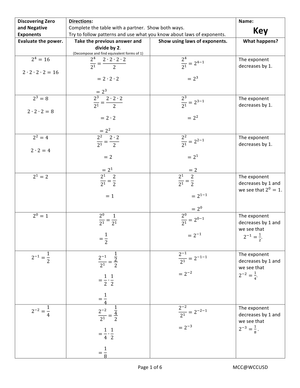
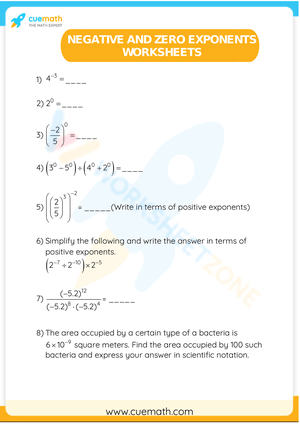
Negative exponents produce a different but equally durable misconception. Students read x⁻³ and conclude it represents a negative quantity. This is not a careless mistake — it reflects a reasonable, if incorrect, inference from arithmetic experience, where a negative sign reliably produces a negative result. The most effective correction is not a restatement of the rule but a pattern table: start at 2³ = 8, move through 2² = 4 and 2¹ = 2, make students articulate what operation is happening at each step (dividing by 2), and continue past 2⁰ = 1 to 2⁻¹ = ½. Students who work through that table stop reading the negative as a sign and start reading it as an instruction.
A subtler error appears when students apply the power of a power rule to a product inside parentheses — for instance, (2x³)⁴. They correctly multiply the variable exponent (3 × 4 = 12) but forget to raise the coefficient to the fourth power, writing 2x¹² instead of 16x¹². This worksheets catch that pattern because several problems use numeric coefficients inside the parentheses specifically to surface it.
How to Build These Worksheets Into Your Lesson Plans
The most effective sequencing is to spend the first three to four days on isolated-rule worksheets before introducing any mixed practice. A student who is shaky on the quotient rule cannot diagnose their own errors when the quotient rule is buried inside a problem that also requires the power of a power rule. Isolated worksheets let you identify which rule is breaking down before the rules start interacting.
A strong use of the mixed-review worksheets is the "expanded form requirement" in early instruction. Before students apply the shortcut rules, require them to rewrite every expression in expanded form for the first five problems on a given day — (x²)(x³) becomes (x·x)(x·x·x) before it becomes x⁵. This is slower, and students resist it, but it builds the conceptual scaffolding that makes the shortcut feel earned rather than arbitrary. By the second week, most students abandon the expansion voluntarily because they have internalized why the rule works.
The error-analysis worksheets — pre-completed problems with embedded mistakes — work well as Monday warm-ups after a weekend gap, when retrieval is more valuable than new production. Give students eight minutes before morning meeting to find and explain two errors. "Explain why this is wrong" forces a different cognitive process than solving from scratch and surfaces the language students use (or avoid) when describing mathematical reasoning.
For classes that move into scientific notation, the product and quotient rule worksheets carry over directly. Multiplying (4 × 10⁶)(2 × 10³) is the same operation as any same-base multiplication problem — students are just applying rules they already drilled to base-10 expressions. Running one exponent rule worksheet as a warm-up on the first day of the scientific notation unit makes that connection explicit.
Adjusting the Worksheets for a Range of Learners
Students who are still unstable on the underlying concept of repeated multiplication need the numeric-base problems before the variable-base problems. A student who does not yet see that x⁵ means x multiplied by itself five times cannot reason about why the product rule works — they can only memorize it. Pairing the early worksheets with a reference card showing the expanded form of each rule gives those students a scaffold to work from without interrupting instruction for the whole class.
On the other end, students who simplify correctly and quickly benefit from the constraint problems — "rewrite this expression using only negative exponents" or "find a value of n such that this equation is true." These push against procedural fluency in ways that straightforward simplification does not. A student can complete a standard simplification worksheet on autopilot; a constraint problem requires them to work the rule in reverse and think about the underlying structure.
For multilingual learners, the symbolic nature of exponent work is actually an advantage here — the notation is largely language-independent — but the error-analysis worksheets require careful attention to academic language. Pre-teaching vocabulary like "simplify," "equivalent expression," and "rewrite using positive exponents" before those worksheets reduces the chance that language is the variable rather than math understanding.
Frequently Asked Questions
Are these worksheets designed for 8th grade, or do they work in high school algebra courses too?
The set spans both. Worksheets focused on integer exponents — product, quotient, power of a power, zero, and negative — are written for the 8th grade CCSS 8.EE.A.1 context, but they also work as review material in Algebra 1 or as a diagnostic at the start of an Algebra 2 unit. The rational exponent worksheets are written specifically for high school, where students are expected to connect fractional exponents to radical notation.
How do I help students who keep confusing the product rule with the power of a power rule?
The confusion is structural — both rules involve multiplication — but the visual form of the expressions is different, and that is where instruction should focus. In a product rule problem, there are two separate bases being multiplied: x² · x³. In a power of a power problem, one base is wrapped in parentheses with an exponent outside: (x²)³. Have students circle the number of distinct bases before they apply any rule. One base means power of a power; two same-base terms being multiplied means product rule. Running five problems where that circling step is required as written work interrupts the automaticity of the confusion.
Can these worksheets be used for test prep?
Exponent properties appear on most state algebra assessments and on the SAT Math section, so the procedural fluency these worksheets build is directly useful. The mixed-review format, in particular, mirrors test conditions where students must first identify which rule applies before applying it. That said, the worksheets are structured practice resources — the test-prep value comes from the fluency they build over repeated use, not from any single worksheet used the night before an exam.













 Interactive Worksheet Maker
 Quiz Maker
 Word Search Maker
 Crossword Puzzle Maker
 Word Scramble Generator
 Sentence Scramble Generator
 Handwriting Worksheet Generator
 Name Tracing Generator
 Fill In The Blank Generator