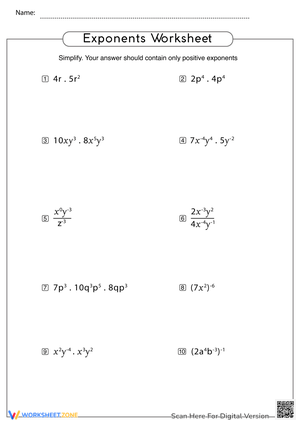
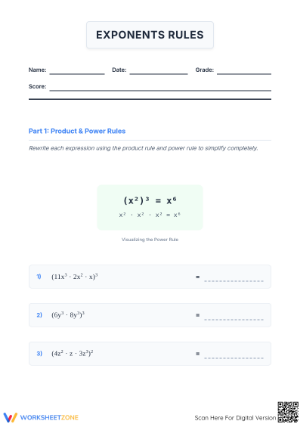
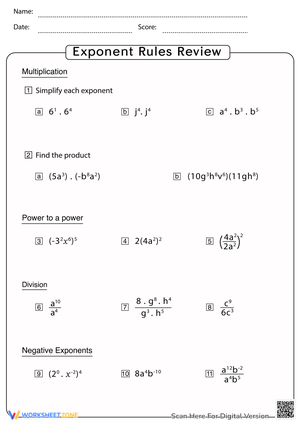
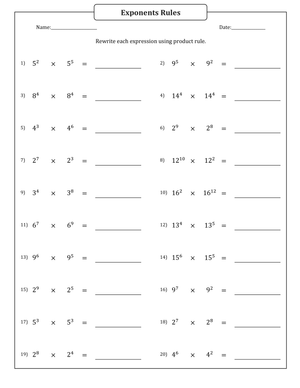
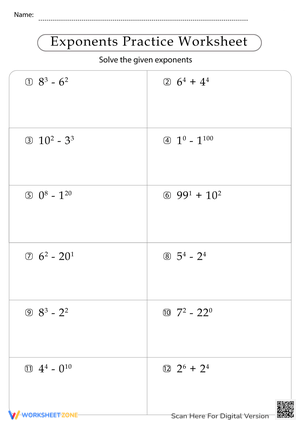
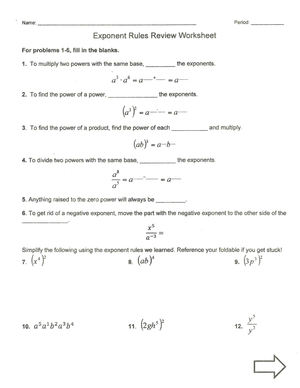
Before a unit test on Expressions and Equations, most 8th grade math teachers hit the same wall: students can multiply and divide powers on a good day but freeze the moment a zero or negative exponent shows up. A focused set of exponent rules review worksheets gives you one resource that walks through every rule students need without forcing you to hunt through five different packets. This matters most in the week before an assessment, when class time is tight and you need practice that maps directly onto what will be tested.
Exponent rules review worksheets work well as a pre-test review station, a week of warm-ups, or a small-group intervention tool for students who are close but not quite ready. Because the rules build on each other, the right worksheet set does more than drill facts. It exposes exactly where a students understanding breaks down.
What CCSS.Math.Content.8.EE.A.1 Actually Requires
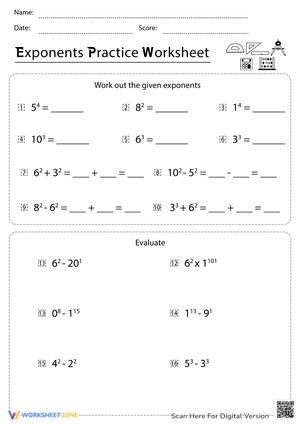
CCSS.Math.Content.8.EE.A.1 requires students to know and apply the properties of integer exponents to generate equivalent numerical expressions. That single standard covers positive, zero, and negative exponents, which is why review worksheets built for grade 8 need to include all of them rather than stopping at the product and quotient rules. A worksheet set that only covers positive exponents leaves out roughly half of what 8.EE.A.1 actually tests, since zero and negative exponent items appear just as often on unit assessments built around this standard.
In Grade 8 Module 1 curricula, students extend positive integer exponent rules to prove the laws of exponents for any integer exponent, including zero and negative exponents. That means review practice should mirror the instructional sequence: start with rules students already know from earlier in the unit, then move into the newer, more abstract cases.
Sequencing Review Practice: Product Rule Through Mixed Review
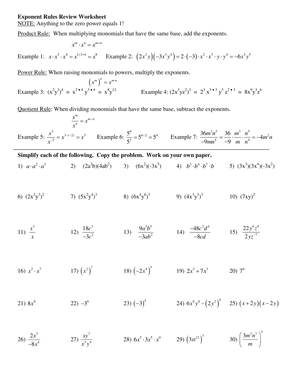
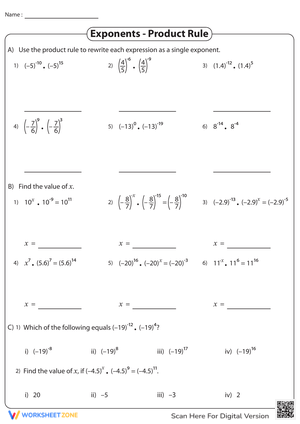
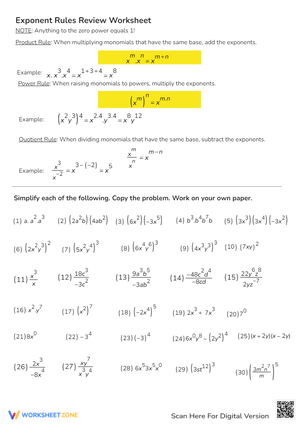
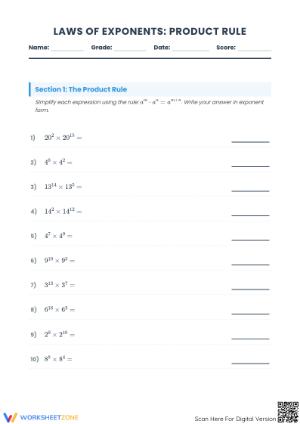
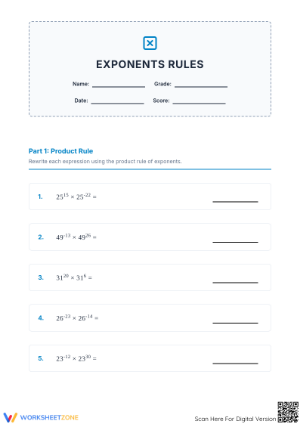
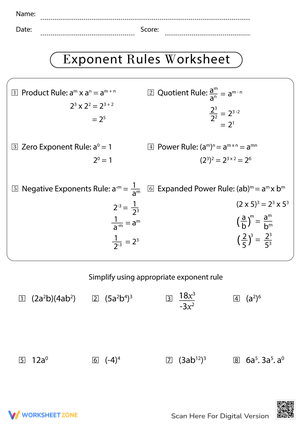
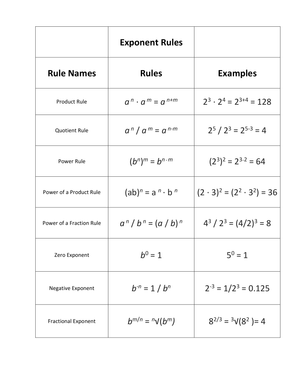
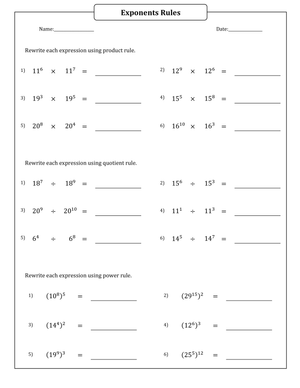
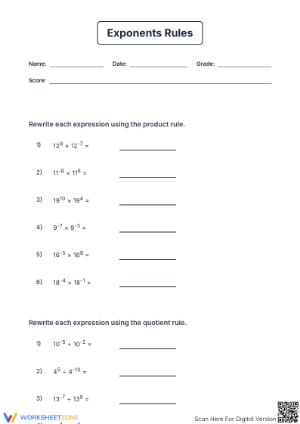
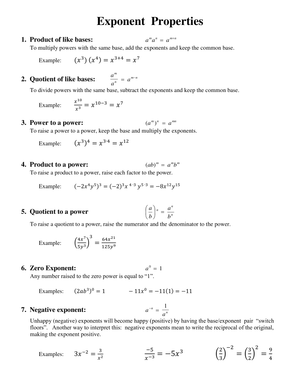
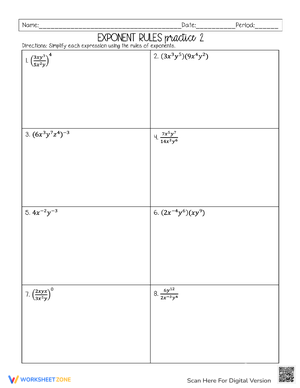
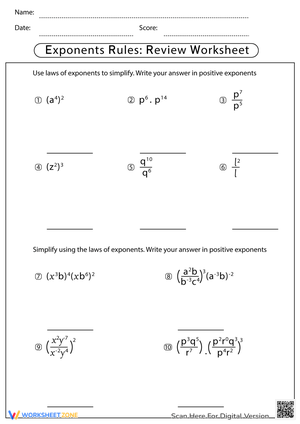
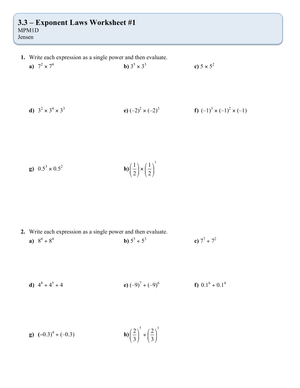
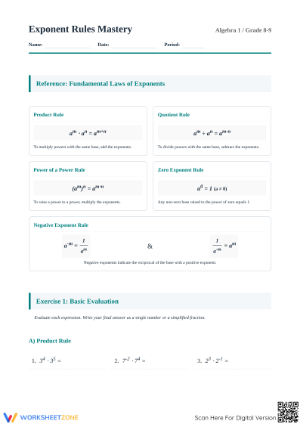
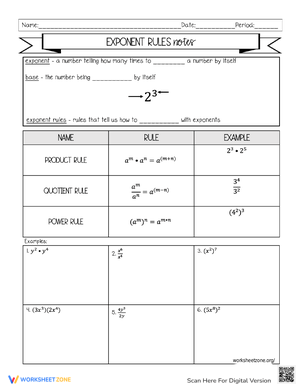
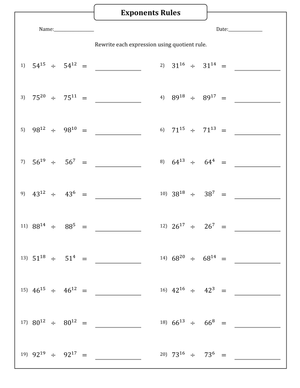
The most effective order for exponent rules review worksheets follows the same progression most curricula use for initial instruction. Start with the product rule, where multiplying powers with the same base means adding exponents, for example a to the third power times a to the fifth power equals a to the eighth power. Once that is solid, move to the quotient rule, where dividing powers with the same base means subtracting exponents, for example n to the seventh power divided by n to the third power equals n to the fourth power.
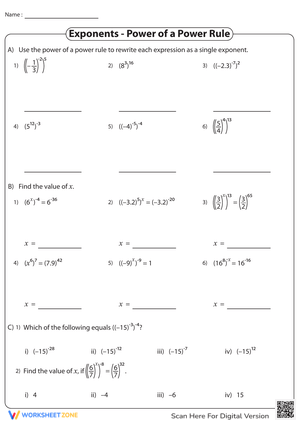
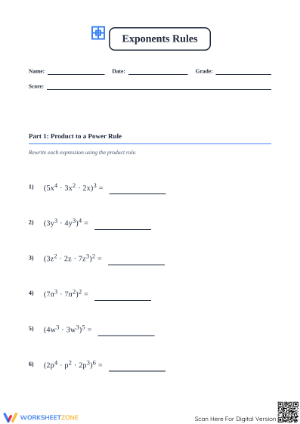
After those two, introduce the power to a power rule, where raising a power to another power means multiplying exponents, for example x to the fifth power raised to the second power equals x to the tenth power. Only after students can apply these three confidently should you layer in zero and negative exponents, followed by a mixed review page that forces students to identify which rule applies without being told in advance. This sequencing prevents the common mistake of jumping straight to mixed problems before any single rule is automatic.
Using Review Worksheets as a Diagnostic Tool
A well-structured exponent rules review worksheet does double duty as a diagnostic. If a student adds exponents when the operation is subtraction, or subtracts bases instead of working with exponents, that pattern shows up clearly on paper in a way that whole-class discussion often misses. Reviewing worksheets in real time, even just scanning for a specific type of error across the room, tells you which students need a quick reteach before the actual test.
This is especially useful because exponent errors tend to be procedural rather than conceptual. A student might understand what an exponent represents but still default to adding bases out of habit. Spotting that early, during review, is far more useful than discovering it on a graded assessment.
Connecting Exponent Review to Algebra 1 Readiness
Exponent rules review is not only an 8th grade concern. It also functions as prerequisite review at the start of Algebra 1, where students are expected to simplify expressions with variable bases and apply the same integer exponent rules to more complex terms. Teachers who introduce Algebra 1 often find that a short exponent rules review, even for students coming from a strong 8th grade background, saves time later when those rules get folded into polynomial operations and rational expressions.
Framing exponent review this way, as a bridge rather than a one-time test prep exercise, helps students see the rules as a tool they will keep using rather than a topic to forget once the unit test is over.
Frequently Asked Questions
1. What exponent rules should a review worksheet cover for grade 8
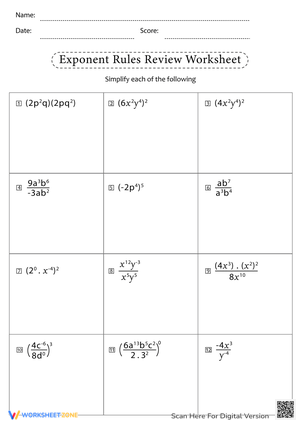
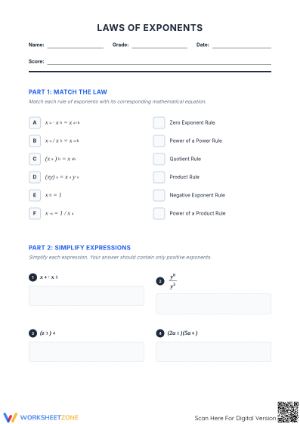
A grade 8 review worksheet should cover the product rule, quotient rule, power to a power rule, zero exponent rule, and negative exponent rule, aligned with CCSS.Math.Content.8.EE.A.1, which requires students to apply properties of integer exponents to generate equivalent expressions.
2. How can teachers use exponent rules review worksheets for a pre-test warm-up
Assign one rule per day as a short warm-up in the days leading up to the test, then finish with a mixed review worksheet so students practice identifying which rule applies without being told in advance.
3. What is the difference between the product rule and the power rule
The product rule applies when multiplying two powers with the same base, and the exponents are added, as in a to the third power times a to the fifth power equals a to the eighth power. The power to a power rule applies when a power is raised to another power, and the exponents are multiplied, as in x to the fifth power raised to the second power equals x to the tenth power.
4. How should teachers sequence exponent rules review before an assessment
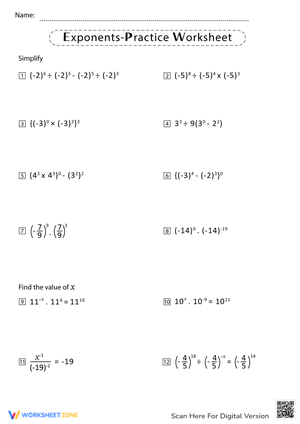
Start with the product rule, then the quotient rule, then the power to a power rule, then zero and negative exponents, and finish with mixed review problems that require students to determine which rule to apply.
5. What are common student mistakes with negative and zero exponents
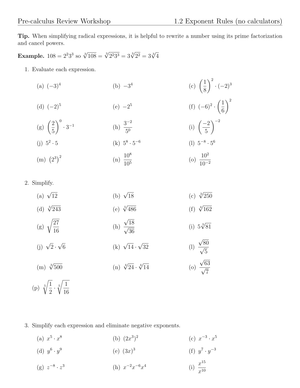
Students often assume a negative exponent makes a number negative, rather than indicating a reciprocal, and some assume any base raised to the zero power equals zero instead of one. Review worksheets that isolate these two rules help catch and correct both misconceptions before a test.













 Interactive Worksheet Maker
 Quiz Maker
 Word Search Maker
 Crossword Puzzle Maker
 Word Scramble Generator
 Sentence Scramble Generator
 Handwriting Worksheet Generator
 Name Tracing Generator
 Fill In The Blank Generator