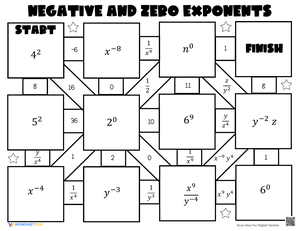
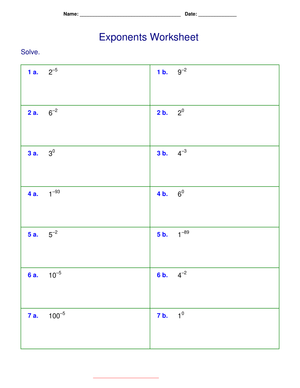
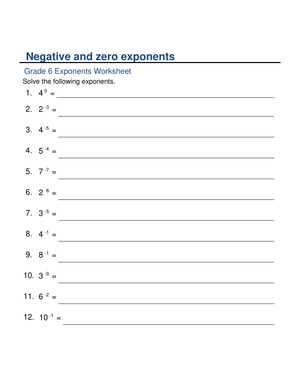
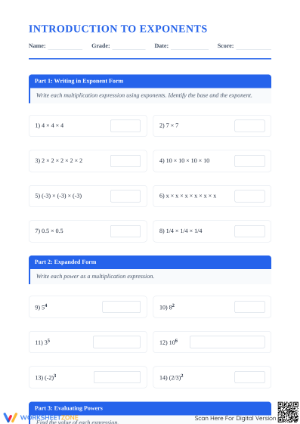
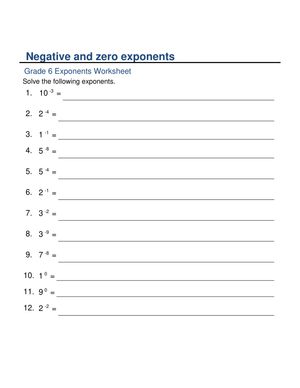
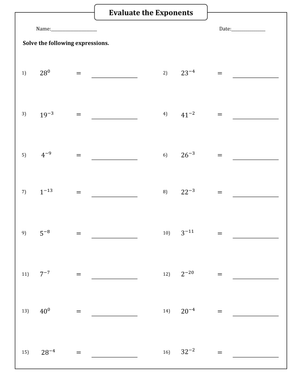
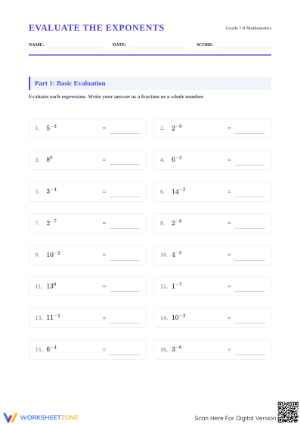
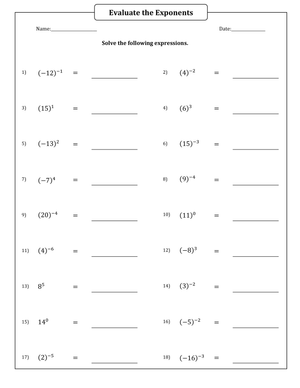
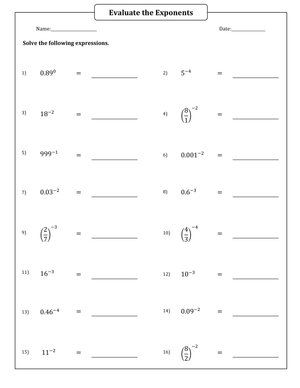
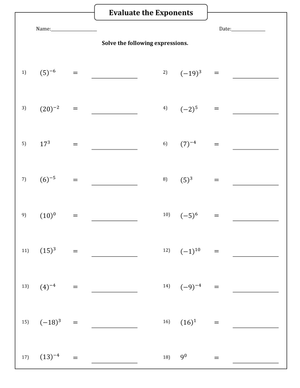
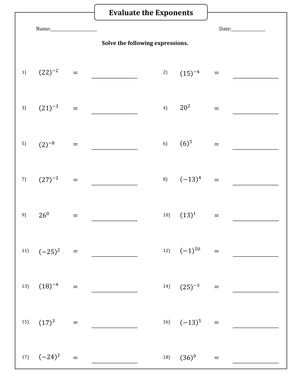
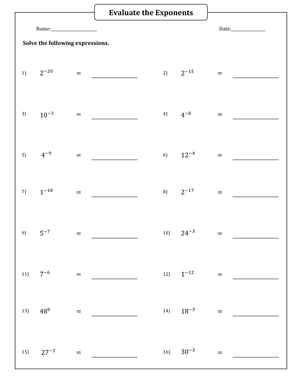
The zero exponent rule
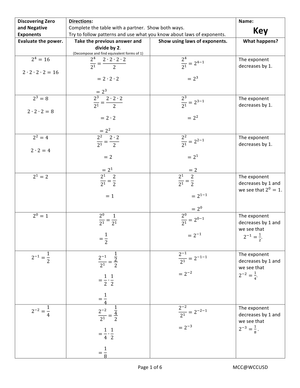
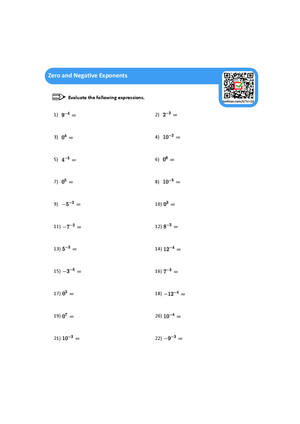
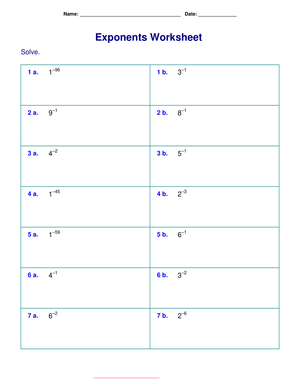
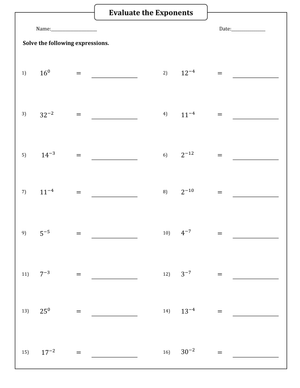
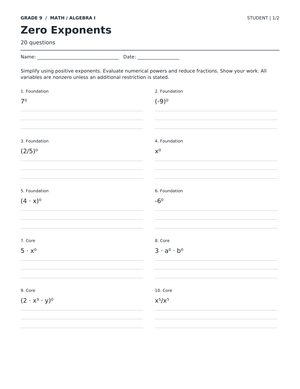
The rule students meet first is the cleanest one: any nonzero base raised to the 0 power equals 1. So 7^0 = 1, 100^0 = 1, and any nonzero number to the zero power is 1. The reason isn't magic. If you divide 3^2 by 3^2, you get 3^(2-2) = 3^0, and any nonzero number divided by itself is 1. Worksheets that show that division pattern next to the answer help students see why the rule holds instead of treating it as one more fact to store.
Worth flagging on the page itself: 0^0 is left undefined at this level, and the rule only applies to nonzero bases. A single sentence about that condition saves a lot of confusion later in the unit.
The negative exponent rule
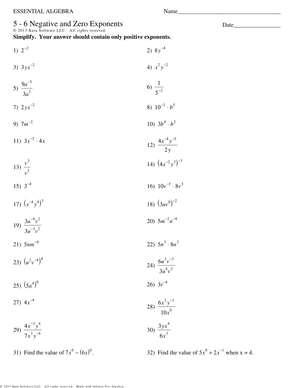
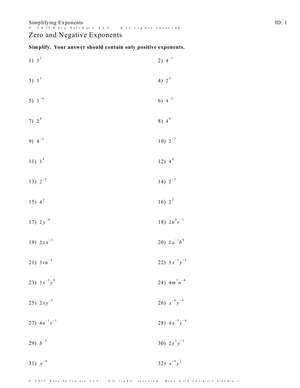
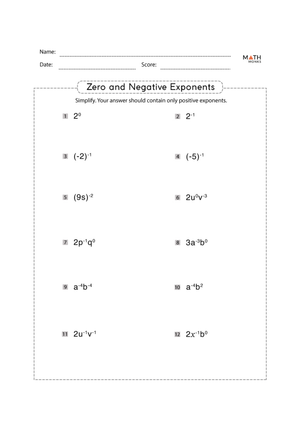
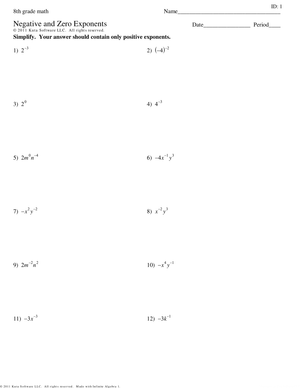
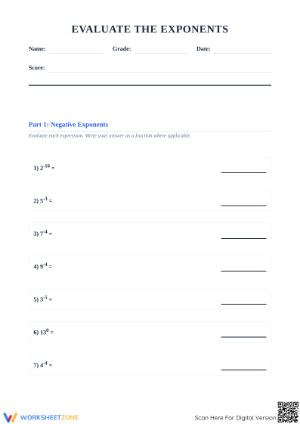
The second rule is the one that trips students up: a^-n = 1/a^n. A negative exponent tells you to take the reciprocal, not to make the number negative. So 2^-3 = 1/2^3 = 1/8, a positive value. Practice items that pair a negative-exponent expression with its positive-exponent twin, 2^-3 sitting right next to 1/2^3, reinforce that the two forms name the same number.
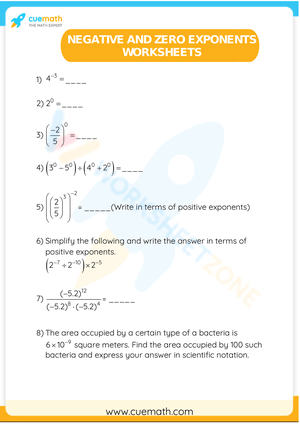
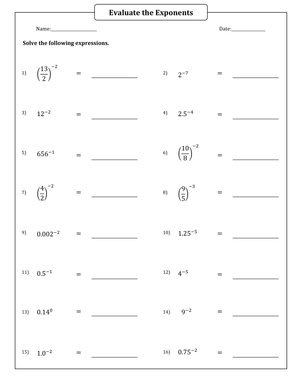
In practice, the most reliable signal that an eighth grader has actually internalized the negative exponent rule isn't how they handle 2^-3, but how they handle a base that is already a fraction, such as (1/2)^-2. Students who only pattern-match "flip and drop" freeze here. The ones who understand reciprocals correctly get (1/2)^-2 = 2^2 = 4. Slipping two or three of these fraction-base items into every worksheet surfaces shallow understanding a full week before a summative test would.
Sequencing practice from single rules to combined expressions
Once each rule is stable on its own, worksheets can combine them. This is where the standard's own worked example earns its place: 3^2 x 3^-5 = 3^(2 + (-5)) = 3^-3 = 1/3^3 = 1/27. Every step in that chain is a separate checkpoint. Can the student add the exponents correctly? Do they convert the negative exponent to a reciprocal? Do they finish the arithmetic cleanly?
A sequencing tip that pays off: keep bases small, like 2, 3, 5, and 10, so the arithmetic never distracts from the exponent reasoning. A student who gets lost multiplying 12^3 has lost the exponent thread for reasons that have nothing to do with the standard you're assessing.
How these worksheets align to grade 8 standards
According to the Common Core State Standards Initiative, standard 8.EE.A.1 requires grade 8 students to know and apply the properties of integer exponents to generate equivalent numerical expressions, explicitly naming zero and negative exponents; its worked example shows 3^2 x 3^-5 = 3^-3 = 1/27, a single benchmark most eighth graders are expected to reach.
Because the standard names both zero and negative exponents, a worksheet that covers only one of them leaves a gap. The strongest sets treat the two rules as a pair and build toward the combined expressions the standard uses in its own example, so classroom practice and the assessment target stay in step.
Common student errors to watch for
- Treating a negative exponent as a negative number. Students write 2^-3 = -8 instead of 1/8. Pair each item with a reminder that the exponent controls the reciprocal, not the sign of the value.
- Applying the zero rule to a base of 0. 0^0 isn't 1 at this level; the rule needs a nonzero base, and worksheets should say so.
- Dropping the reciprocal. Students rewrite 5^-2 as 5^2 and forget the fraction entirely.
- Adding exponents when bases differ. The product rule only applies when bases match, so 2^3 x 3^2 can't collapse into a single power.
Classroom Implementation
Open with a five-minute warm-up on the zero rule only, then release the negative-exponent set once you've seen most hands moving confidently. For small-group intervention, hand struggling students a version with the positive-exponent twin already printed beside each item so they can focus on the reciprocal move rather than the arithmetic.
For enrichment, add fraction bases and a few combined-rule chains like the 3^2 x 3^-5 example, and ask fast finishers to write one sentence explaining why the answer is positive. Use a short mixed set as a formative checkpoint the day before you introduce scientific notation, since that unit leans on negative exponents constantly. If more than a quarter of the class still writes negative values, reteach the reciprocal idea before moving on.
Frequently Asked Questions
1. What grade level typically covers zero and negative exponents?
In US classrooms this is grade 8 pre-algebra work, tied to standard 8.EE.A.1. Some accelerated seventh graders see it early, and it gets reinforced in high school Algebra 1, but eighth grade is where students are first expected to know and apply the rules.
2. How is a^0 = 1 different from a^-n = 1/a^n?
The zero rule gives a fixed result of 1 for any nonzero base, while the negative rule produces a reciprocal that depends on the base and exponent. One is a single value; the other is a fraction you have to compute. Keeping them on separate practice sets first prevents students from blending the two ideas.
3. What models help students see negative exponents as reciprocals?
A place-value chart that continues past 10^0 into 10^-1 and 10^-2 shows the pattern of halving or tenthing at each step. Pairing each expression with its positive-exponent twin also works, since students can see 2^-3 and 1/2^3 name the same point on a number line.
4. How do these worksheets connect to scientific notation?
Scientific notation uses negative exponents to write very small numbers, such as 4.2 x 10^-6. Students who are fluent with the negative exponent rule read those values as reciprocals of powers of ten instead of negative numbers, which makes the later unit far smoother.
5. What are the most common errors when simplifying negative exponents?
The top three are turning a negative exponent into a negative number, forgetting the reciprocal and leaving a positive exponent, and adding exponents when the bases don't match. Building a few items around each error, then asking students to spot the mistake, tends to fix all three faster than more of the same practice.













 Interactive Worksheet Maker
 Quiz Maker
 Word Search Maker
 Crossword Puzzle Maker
 Word Scramble Generator
 Sentence Scramble Generator
 Handwriting Worksheet Generator
 Name Tracing Generator
 Fill In The Blank Generator