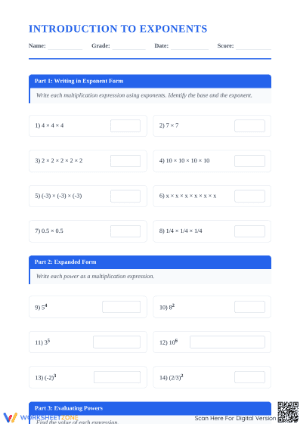
Negative exponents can feel like a math rule that appears out of nowhere. Negative exponents worksheets help make that rule feel less mysterious. By practicing step by step, learners begin to see that a negative exponent does not make a number negative. Instead, it shows where the base belongs in a fraction and how powers can be rewritten in a simpler form.
The main idea is simple: a value with a negative exponent can be rewritten using its reciprocal. Once students understand this movement between numerator and denominator, they can simplify expressions with more confidence. These worksheets often include single terms, fractions, variables, and mixed expressions so students can practice the same rule in different formats. If learners need more background on how expressions work, this guide to mathematical expressions can help build a stronger foundation.
What makes negative exponents challenging is that they rarely appear alone. Students may need to combine them with product rules, quotient rules, powers of powers, or zero exponents. A problem like 3x^-2y^4 or a^-3/b^-2 requires careful thinking about each base. Negative exponents worksheets give students enough repetition to slow down, apply the correct rule, and avoid common errors. For a wider review of related concepts, teachers can pair these pages with a comprehensive exponent rules review set.
These worksheets fit well into middle school math, Algebra 1, and algebra review lessons. Teachers can use them as warm-ups, guided practice, homework, exit tickets, math centers, quiz review, or small-group support. Some pages may focus only on rewriting expressions with positive exponents, while others may include simplifying full expressions. This makes it easy to adjust the difficulty for students who are just beginning the topic or those who are preparing for more advanced algebra.
Worksheetzone’s negative exponents worksheets are designed to help students move from memorizing a rule to understanding how the rule works. With consistent practice, learners can simplify expressions more accurately, recognize exponent patterns faster, and feel more prepared for scientific notation, rational expressions, and advanced algebra topics. Instead of seeing negative exponents as a confusing trick, students begin to treat them as another useful tool in their math toolbox.
Frequently Asked Questions
Question 1: What do students learn from negative exponents worksheets?
Students learn how to rewrite expressions with negative exponents using positive exponents. They practice moving terms between the numerator and denominator, simplifying variables and numbers, and applying exponent rules in different types of algebraic expressions.
Question 2: What grade levels are these worksheets best for?
Negative exponents worksheets are most useful for middle school students, Algebra 1 learners, and students reviewing exponent rules. They are commonly used in grades 7 through 10, depending on the curriculum and each student’s readiness.
Question 3: Why do students often struggle with negative exponents?
Students often think a negative exponent means the answer should be negative. In reality, the negative sign in the exponent tells students to rewrite the base as a reciprocal. Practice helps learners separate the meaning of a negative exponent from the meaning of a negative number.
Question 4: How can teachers use negative exponents worksheets in class?
Teachers can use them for guided examples, independent practice, homework, warm-ups, exit tickets, quiz review, or small-group reteaching. They work especially well after students have learned basic exponent rules and are ready to simplify more complex expressions.
















 Interactive Worksheet Maker
 Quiz Maker
 Word Search Maker
 Crossword Puzzle Maker
 Word Scramble Generator
 Sentence Scramble Generator
 Handwriting Worksheet Generator
 Name Tracing Generator
 Fill In The Blank Generator