Why word problems belong in every Pythagorean unit
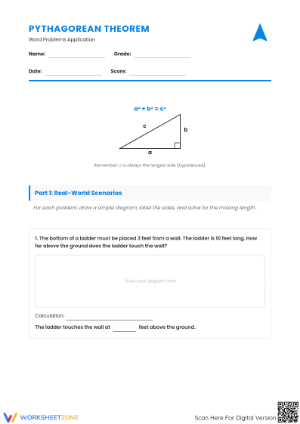
By the time your 8th graders can find a missing hypotenuse on a labeled diagram, the harder work is just starting. Real understanding shows up when students read a scenario, decide which sides are the legs, and figure out where the right angle actually is. That is exactly what Pythagorean theorem word problems worksheets are built to practice. They ask students to translate a sentence into a right-triangle model before touching a^2 + b^2 = c^2.
For US middle school teachers, this matters because Grade 8 assessments rarely hand students a clean triangle. Instead they describe a ladder, a ramp, a TV screen, or two points on a grid. Students who only drilled diagram problems freeze when the triangle is hidden inside a story. A dedicated word-problem set closes that gap and gives you a clear read on who can model and who is still guessing.
What the Grade 8 standards ask students to do
The word problems on these sheets map directly to the Grade 8 Geometry cluster 'Understand and apply the Pythagorean Theorem.' Two standards drive the work, and good worksheet sets hit both.
CCSS.MATH.CONTENT.8.G.B.7 asks students to apply the Pythagorean Theorem to determine unknown side lengths in right triangles in real-world and mathematical problems in two and three dimensions. CCSS.MATH.CONTENT.8.G.B.8 asks students to apply the theorem to find the distance between two points in a coordinate system. Together they define the full range of word problems your practice set should cover.
According to the Common Core State Standards Initiative, standard 8.G.B.7 requires Grade 8 students to apply the Pythagorean Theorem to determine unknown side lengths in right triangles within real-world and mathematical problems in two and three dimensions, making applied word problems a required part of the domain, not an optional extension.
Knowing which standard a problem targets also makes grading faster. A leg-or-hypotenuse ladder problem is 8.G.B.7 evidence; a two-points-on-a-grid problem is 8.G.B.8 evidence. Tagging each item lets you report cluster mastery instead of a single blended score.
Word problem types worth including
A strong set rotates through a handful of recognizable scenarios so students learn to spot the triangle no matter how the story is dressed up. The classics carry most of the load:
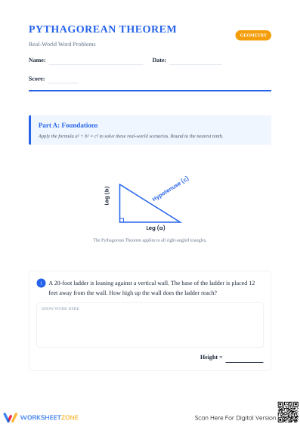
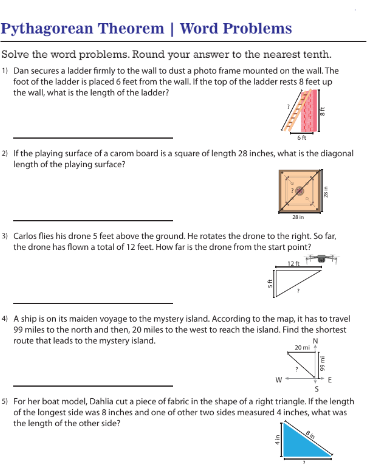
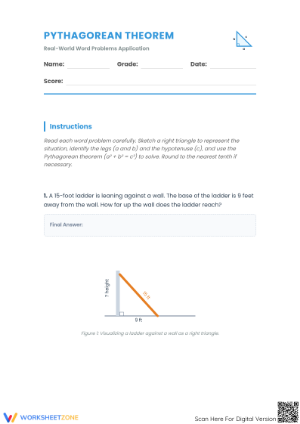
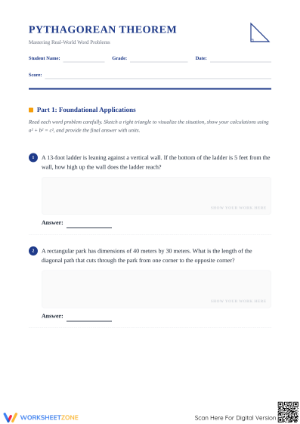
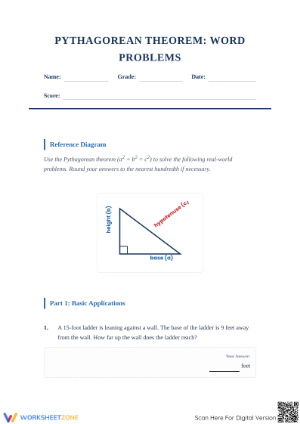
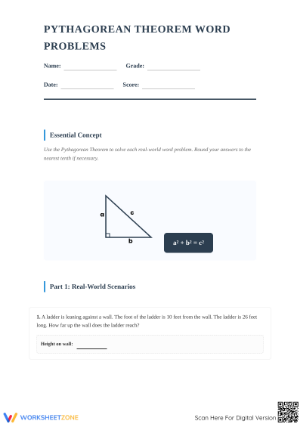
- Ladder against a wall. The wall height and ground distance are the legs; the ladder is the hypotenuse.
- Diagonal of a rectangle or square. Length and width are the legs; the diagonal is the hypotenuse.
- Area of an isosceles triangle from given side lengths, where students find the height before computing area.
- Baseball diamond and TV-screen problems that hide a right triangle inside a familiar object.
- Coordinate-plane distance between two points, which turns a grid into a right triangle.
Mixing these keeps students from pattern-matching to a single setup. When every problem looks a little different, they have to reason about which measurement is the hypotenuse instead of plugging numbers into memorized slots. A good printed set also varies whether the missing value is a leg or the hypotenuse, so students cannot assume they are always solving for c.
Sequencing from diagrams to multi-step problems
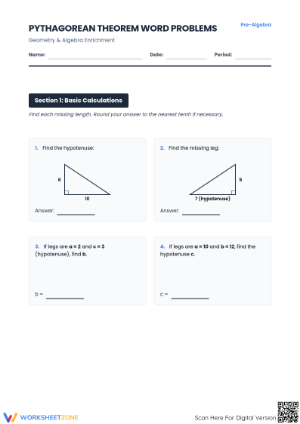
Order matters more than volume. Start a worksheet with two or three labeled right triangles so students confirm the mechanics of solving for a leg versus the hypotenuse. Then move to short word problems that still include a picture. Finally, remove the picture and ask students to sketch their own model from the text.
This gradual release keeps the cognitive load manageable. Students are not learning the theorem and the translation step at the same moment; they lock in the arithmetic first, then take on the modeling. For a 45-minute period, three diagram problems and four word problems usually give you enough evidence without rushing.
It also helps to label the answer type you expect. If a problem asks for a ladder length, students should report the hypotenuse; if it asks how far the base sits from the wall, they are solving for a leg. Writing that expectation into the worksheet keeps the focus on modeling and prevents students from stopping at a squared value instead of taking the square root.
Pairing side-length and coordinate-distance practice
Because 8.G.B.7 and 8.G.B.8 live in the same cluster, it helps to practice them together rather than in separate weeks. After students work a few ladder and diagonal problems, drop in two coordinate-plane distance problems on the same sheet. Ask them to plot the points, draw the horizontal and vertical legs, and recognize that the distance formula is just the Pythagorean theorem in disguise.
Resources like Khan Academy and IXL organize their 8th grade Pythagorean word-problem practice the same way, moving between applied side-length questions and coordinate distance. Building your printed set with both keeps students fluent across the entire cluster instead of siloing the two skills.
This pairing also previews high school work. Students who see the distance formula as the Pythagorean theorem applied to a grid carry that connection into coordinate geometry, so the time you spend here pays off well beyond the 8th grade unit test.
Classroom Implementation
Word-problem sheets flex across most of your instructional formats. For a warm-up, assign a single ladder or diagonal problem and have students annotate the triangle before solving. During small-group intervention, sit with students on the translation step alone: have them label the legs and hypotenuse out loud before any calculation, since that is where most errors start.
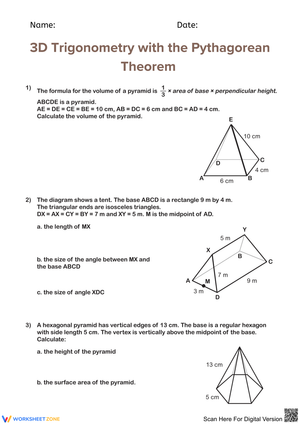
For review before a unit test, a mixed sheet of six to eight problems works as a quick formative check. Enrichment groups can tackle the three-dimensional and multi-step area problems while an intervention group stays with two-dimensional ladder and rectangle scenarios. Same standard, same page layout, different depth. Collecting the sheets gives you a fast, sortable snapshot of who is ready to move on to the converse and who needs another day of modeling.
Common errors these worksheets address
The value of a word-problem set is diagnostic as much as instructional. A few predictable mistakes show up again and again, and spotting them early saves reteaching later.
The single most common error is not arithmetic; it is misidentifying the hypotenuse. In a ladder problem, students frequently treat the ladder as a leg because it is mentioned first, then solve for the wrong side. Because both 8.G.B.7 and 8.G.B.8 require translating a scenario into a model, a worksheet that forces students to label the right angle before writing the equation catches this misconception on the page, where you can correct it, rather than on the summative test, where it silently costs points.
The second frequent slip is skipping the sketch entirely. Students who try to hold the scenario in their heads tend to square the wrong numbers. A worksheet that leaves blank space for a diagram nudges them to externalize the model, and that small structural choice reduces setup errors.
Frequently asked questions
1. What grade level are Pythagorean theorem word problems taught in?
In US classrooms these word problems are a Grade 8 topic, aligned to the Grade 8 Geometry cluster on the Pythagorean Theorem. Some accelerated 7th graders and high school geometry review classes use them too, but the standards live in 8th grade.
2. Which Common Core standards do these worksheets align to?
They align to CCSS.MATH.CONTENT.8.G.B.7 for applying the theorem to unknown side lengths in real-world and mathematical problems, and CCSS.MATH.CONTENT.8.G.B.8 for finding the distance between two points in a coordinate system.
3. What are examples of real-world Pythagorean word problems?
Common examples include a ladder leaning against a wall, the diagonal of a rectangular screen or field, the distance across a baseball diamond, and the straight-line distance between two points plotted on a coordinate grid.
4. How can teachers use these worksheets for intervention or review?
Use a short mixed sheet as a formative check, then pull a small group to work only the translation step. Having students label the legs and hypotenuse before calculating targets the exact place where struggling students break down.
5. How is a word problem worksheet different from a diagram worksheet?
A diagram worksheet hands students a labeled triangle and tests the calculation. A word problem worksheet hides the triangle inside a scenario, so students first have to build the model, then apply a^2 + b^2 = c^2. It assesses modeling, not just arithmetic.













 Interactive Worksheet Maker
 Quiz Maker
 Word Search Maker
 Crossword Puzzle Maker
 Word Scramble Generator
 Sentence Scramble Generator
 Handwriting Worksheet Generator
 Name Tracing Generator
 Fill In The Blank Generator