


























Views
Downloads



Printable Pythagorean Theorem Word Problems | Grade 8 Math
Paste this activity's link or code into your existing LMS (Google Classroom, Canvas, Teams, Schoology, Moodle, etc.).
Students can open and work on the activity right away, with no student login required.
You'll still be able to track student progress and results from your teacher account.
Solve real-world geometry challenges with this comprehensive Pythagorean Theorem word problems worksheet. Students apply the mathematical formula a² + b² = c² to calculate distances, heights, and lengths in practical contexts like ladders, ships, and airplanes. This resource bridges the gap between abstract theory and tangible application for Grade 8 learners.
At a Glance
- Grade: 8 · Subject: Math
- Standard:
CCSS.MATH.CONTENT.8.G.B.7— Apply the Pythagorean Theorem to find unknown side lengths in real-world problems- Skill Focus: Pythagorean Theorem Word Problems
- Format: 3 pages · 9 problems · Answer key included · PDF
- Best For: Independent practice and formative assessment
- Time: 30–45 minutes
What's Inside
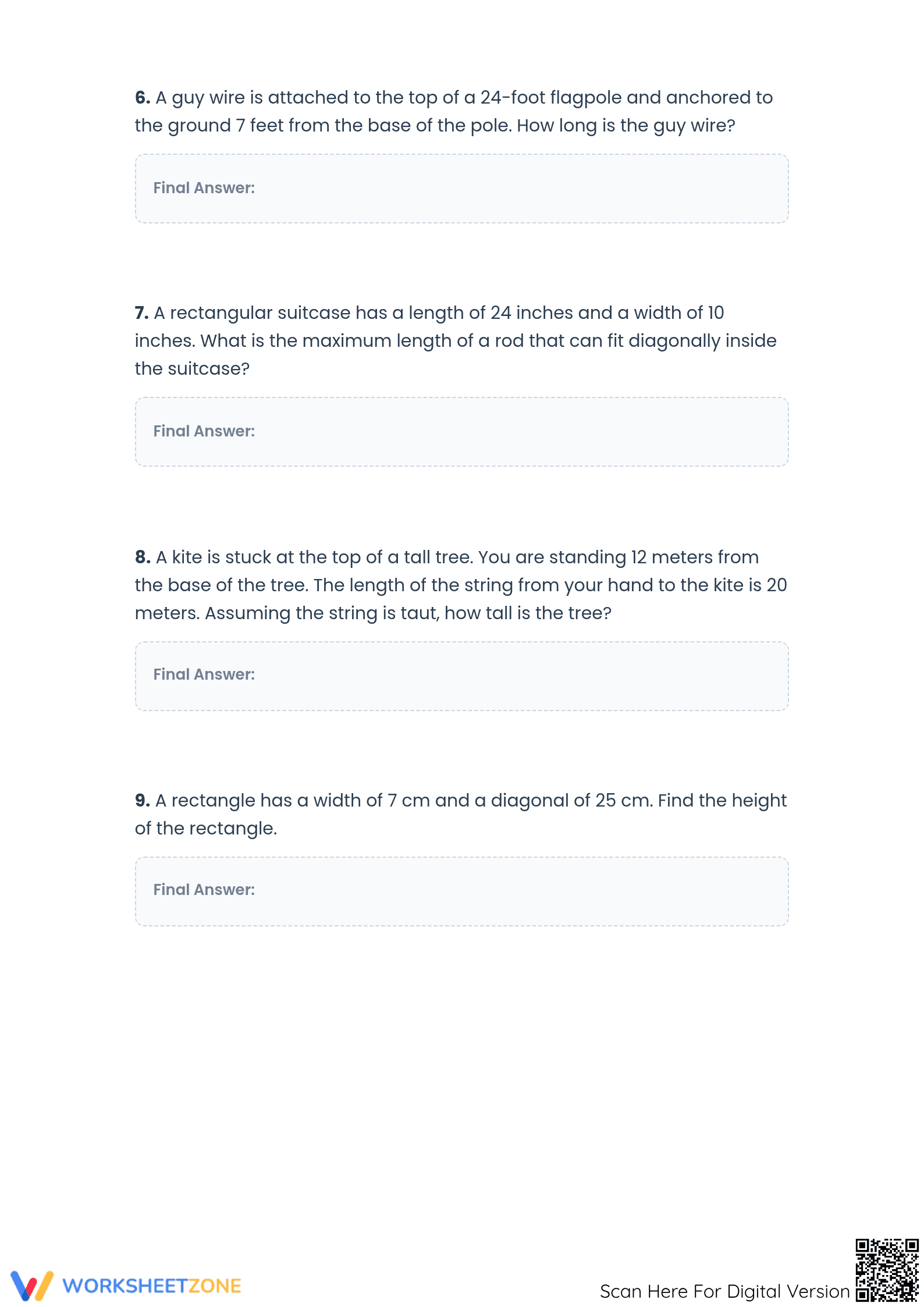
The worksheet spans 3 pages and contains 9 distinct word problems divided into two parts. Part 1 introduces fundamental scenarios like leaning ladders and television dimensions, while Part 2 presents advanced challenges involving airplanes and guy wires. A visual reference of a right triangle is provided on the first page to support spatial reasoning. A complete answer key is included.
Skill Progression
- Guided Practice: Problem 1 features a detailed diagram and labeling prompt to help students identify legs and the hypotenuse before solving.
- Supported Practice: Problems 2-4 require students to sketch their own triangles and identify variables based on text descriptions.
- Independent Practice: Problems 5-9 focus on multi-step reasoning and larger numbers to build computational stamina and mastery.
Students move through this gradual-release model to ensure confident application of geometric principles.
Standards Alignment
This resource is directly aligned with `CCSS.MATH.CONTENT.8.G.B.7`. It focuses on applying the Pythagorean Theorem to determine unknown side lengths in right triangles within real-world and mathematical problems in two dimensions. This standard code can be copied directly into lesson plans, IEP goals, or district curriculum mapping tools.
How to Use It
Use this worksheet as a summative task after introducing the formula. It works effectively as a homework assignment or a small-group rotation activity. Teachers can observe how students translate text into geometric sketches as a formative checkpoint. Expect completion within 35 minutes for average learners, though advanced scenarios may require additional time for thorough calculation.
Who It's For
This resource is designed for Grade 8 math students and high schoolers requiring geometry intervention. It is ideal for general education classrooms, resource rooms, or tutoring sessions. For differentiation, teachers might provide a calculator or pre-drawn sketches for students who struggle with the initial visualization step during direct instruction.
Modern pedagogical research, including the EdReports 2024 review of middle school mathematics, emphasizes the necessity of situating geometric concepts within authentic, multi-step problem-solving environments. The CCSS.MATH.CONTENT.8.G.B.7 standard requires students to move beyond simple calculation to complex interpretation of spatial data. Studies from ScienceDirect TpT Analysis suggest that worksheets featuring a gradual-release structure—moving from visual support to text-heavy independent tasks—significantly improve retention of the Pythagorean Theorem. By requiring students to sketch their own models, this resource facilitates the cognitive mapping required for geometric proficiency. According to NAEP frameworks, students who can successfully translate word problems into right-triangle models demonstrate a higher level of mathematical literacy compared to those who only perform rote computation. This 3-page set provides the structured repetition needed to solidify these critical STEM skills and ensure students are prepared for high school trigonometry.


