


























Views
Downloads



Pythagorean Theorem Word Problems | Essential Grade 8 Math
Paste this activity's link or code into your existing LMS (Google Classroom, Canvas, Teams, Schoology, Moodle, etc.).
Students can open and work on the activity right away, with no student login required.
You'll still be able to track student progress and results from your teacher account.
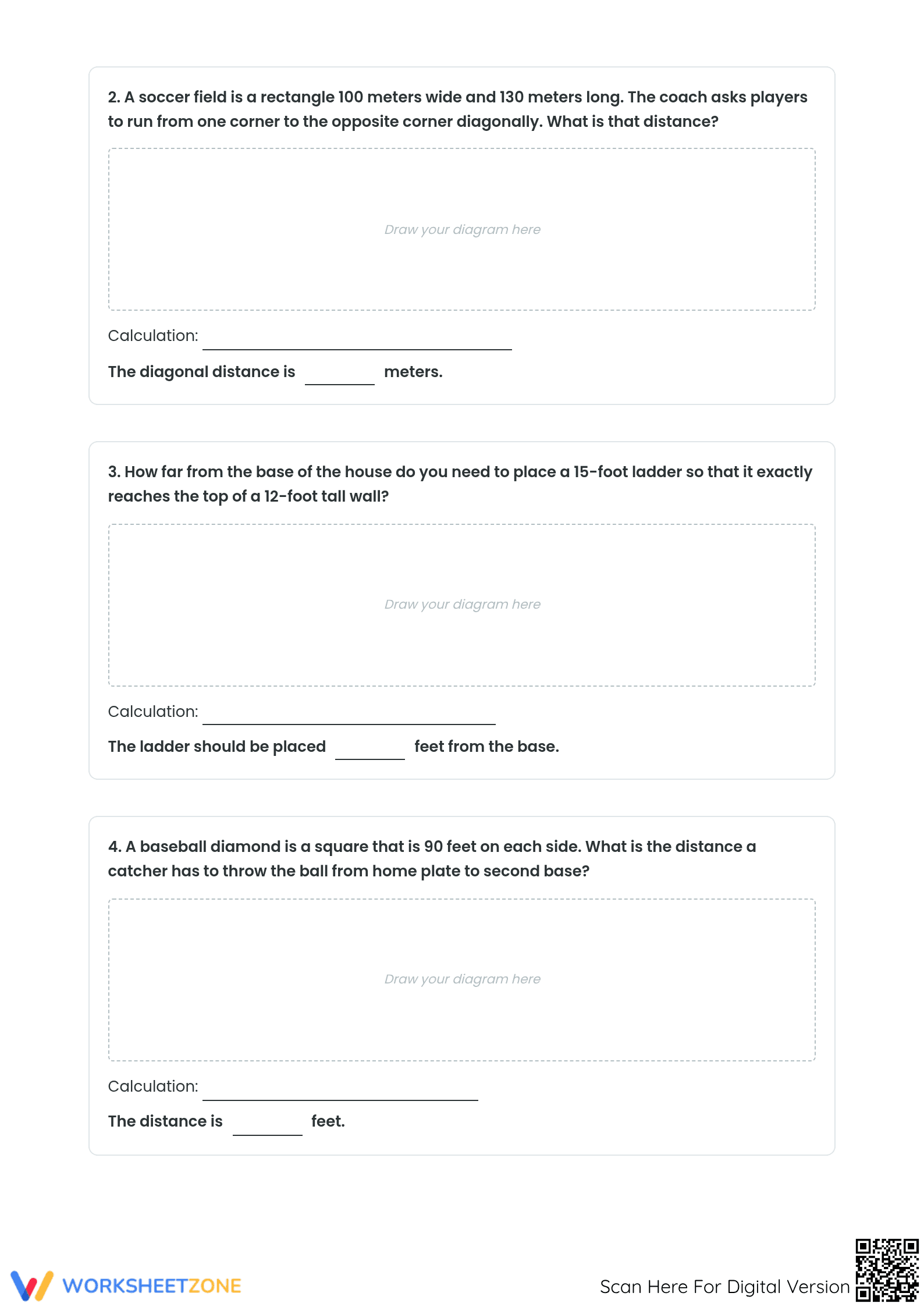
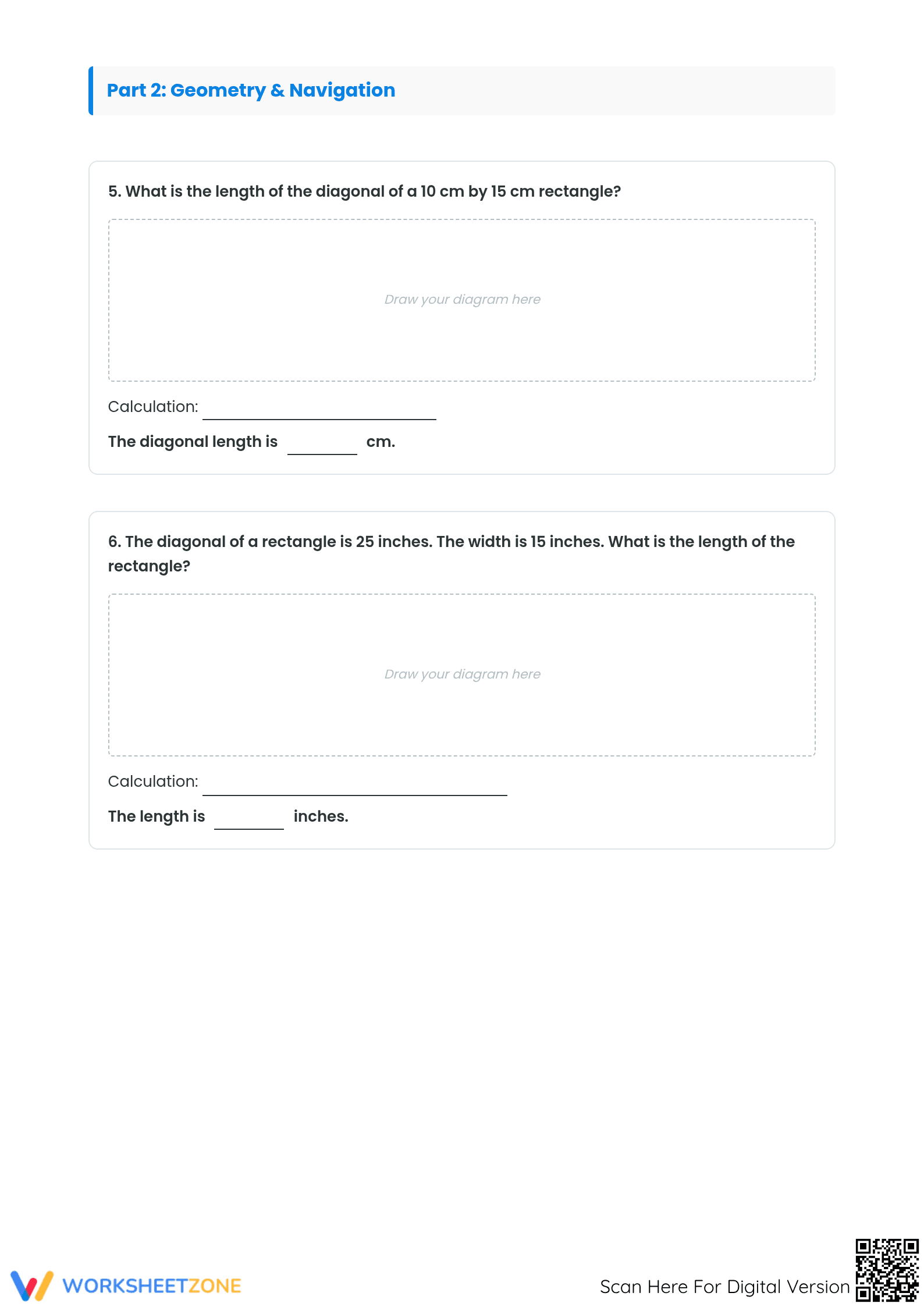
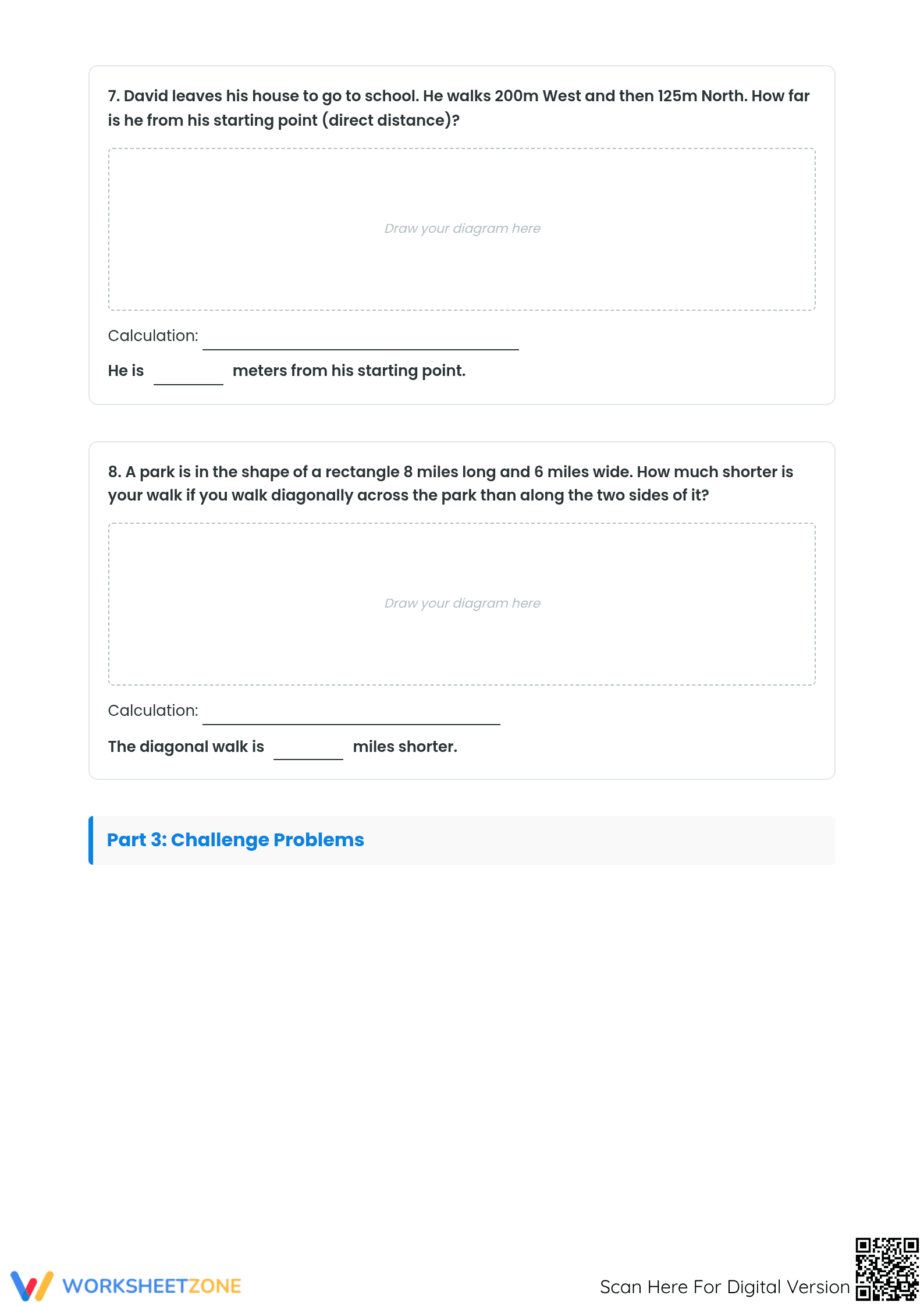
This comprehensive worksheet helps Grade 8 students master the Pythagorean Theorem through 11 diverse word problems. By drawing diagrams and calculating missing side lengths, learners bridge the gap between abstract geometry and real-world application. It ensures students can confidently solve for hypotenuses and legs in practical contexts like navigation, construction, and athletics.
At a Glance
- Grade: 8 · Subject: Math
- Standard:
CCSS.MATH.CONTENT.8.G.B.7— Apply the Pythagorean Theorem to find missing side lengths in real-world triangles- Skill Focus: Right triangle geometry and word problem solving
- Format: 5 pages · 11 problems · Answer key included · PDF
- Best For: Independent practice or homework assignments
- Time: 45–60 minutes
This 5-page printable packet features 11 multi-step word problems organized by complexity. Each problem includes a dedicated "Draw your diagram here" box to encourage visualization, followed by space for calculations and a final answer line. The set covers real-world scenarios like ladders and soccer fields, geometry applications involving rectangles and squares, and navigation using cardinal directions. A complete 5-page answer key is provided for immediate grading.
Zero-Prep Workflow
- Print: Select the 5-page student set for high-quality grayscale or color reproduction (approx. 1 minute).
- Distribute: Hand out the packets to students for a standard 50-minute instructional block (approx. 1 minute).
- Review: Use the matching 5-page answer keys for peer-grading, self-correction, or teacher-led review (approx. 5 minutes).
Total teacher preparation time is under 2 minutes, making this an ideal "grab-and-go" resource for sub plans, morning work, or reinforcement after a direct instruction lesson on right triangle properties.
Standards Alignment
This resource is directly aligned to `CCSS.MATH.CONTENT.8.G.B.7`, which requires students to "Apply the Pythagorean Theorem to determine unknown side lengths in right triangles in real-world and mathematical problems in two and three dimensions." It also supports 8.G.B.8 by calculating distances between points in a coordinate-like context during the navigation exercises. Both standard codes can be copied directly into lesson plans, IEP goals, or district curriculum mapping tools.
How to Use It
Assign this worksheet as a summative assessment after introducing the formula a² + b² = c². Use the "Geometry & Navigation" section to specifically observe how students translate compass directions into right-angled diagrams. For formative assessment, walk the room while students work on the first ladder problem to ensure they are correctly identifying the hypotenuse versus the legs. Expected completion time for the full 11-problem set is 45–60 minutes.
Who It's For
Designed for Grade 8 math students and high schoolers requiring geometry remediation. It is particularly effective for visual learners who benefit from the explicit diagram-drawing requirements. This resource pairs naturally with an anchor chart displaying the Pythagorean formula and common Pythagorean triples to support calculation fluency and student confidence.
According to the NAEP 2024 framework, students' ability to represent mathematical situations through diagrams is a critical predictor of success in higher-level geometry and trigonometry. This worksheet aligns with the Fisher & Frey (2014) gradual release of responsibility model by moving from highly familiar scenarios to more abstract challenge problems involving navigation and composite shapes. Research from ScienceDirect TpT Analysis suggests that "zero-prep" resources with built-in visualization scaffolds significantly reduce student cognitive load during the initial phase of skill application. By isolating the standard code CCSS.MATH.CONTENT.8.G.B.7 and focusing on the plain-English skill of finding missing side lengths, this packet provides high-utility evidence of student mastery. Educators can integrate these 11 tasks into existing spiraled curriculum designs to ensure long-term retention of essential geometric principles across the academic year.


