


























Views
Downloads
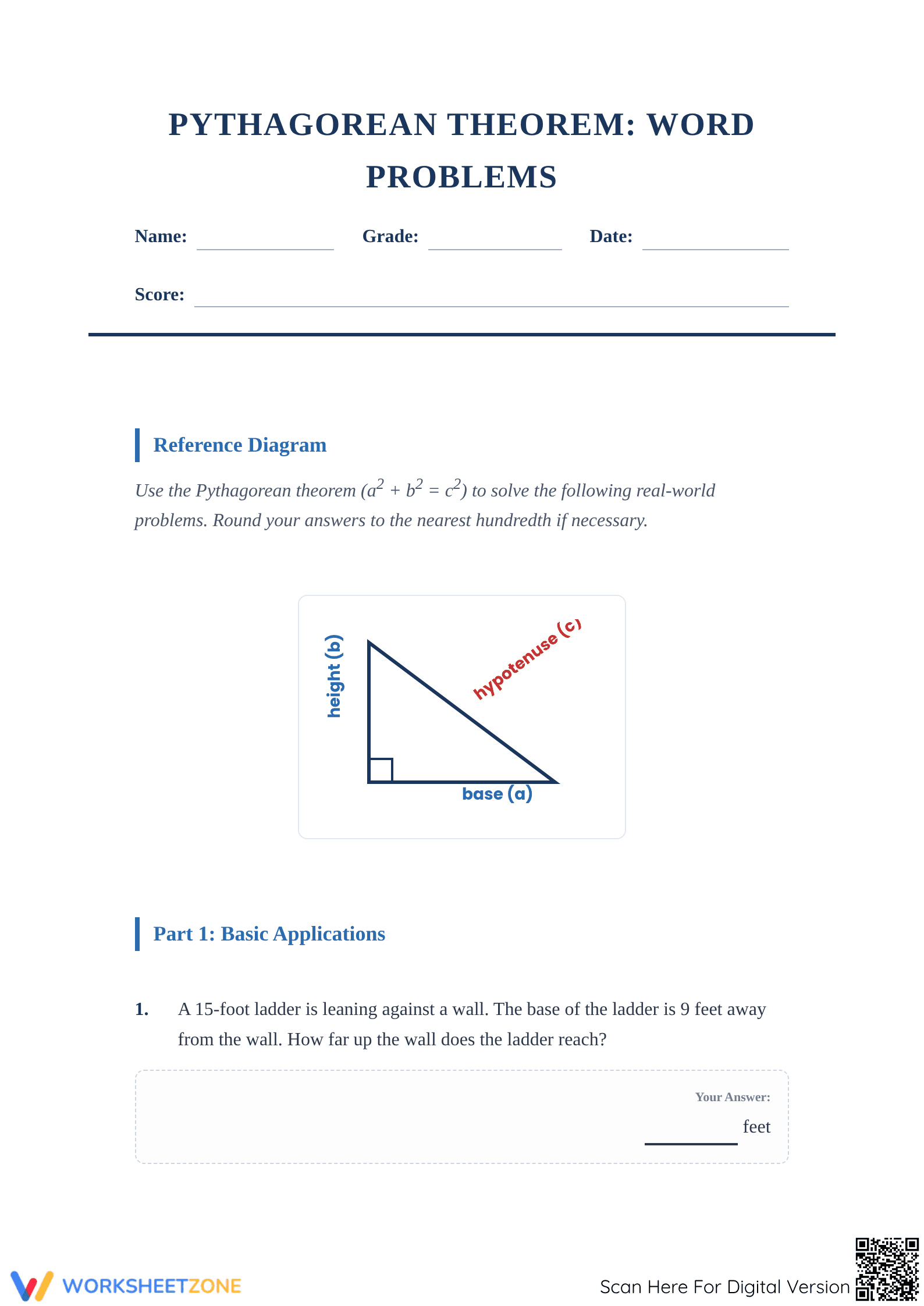
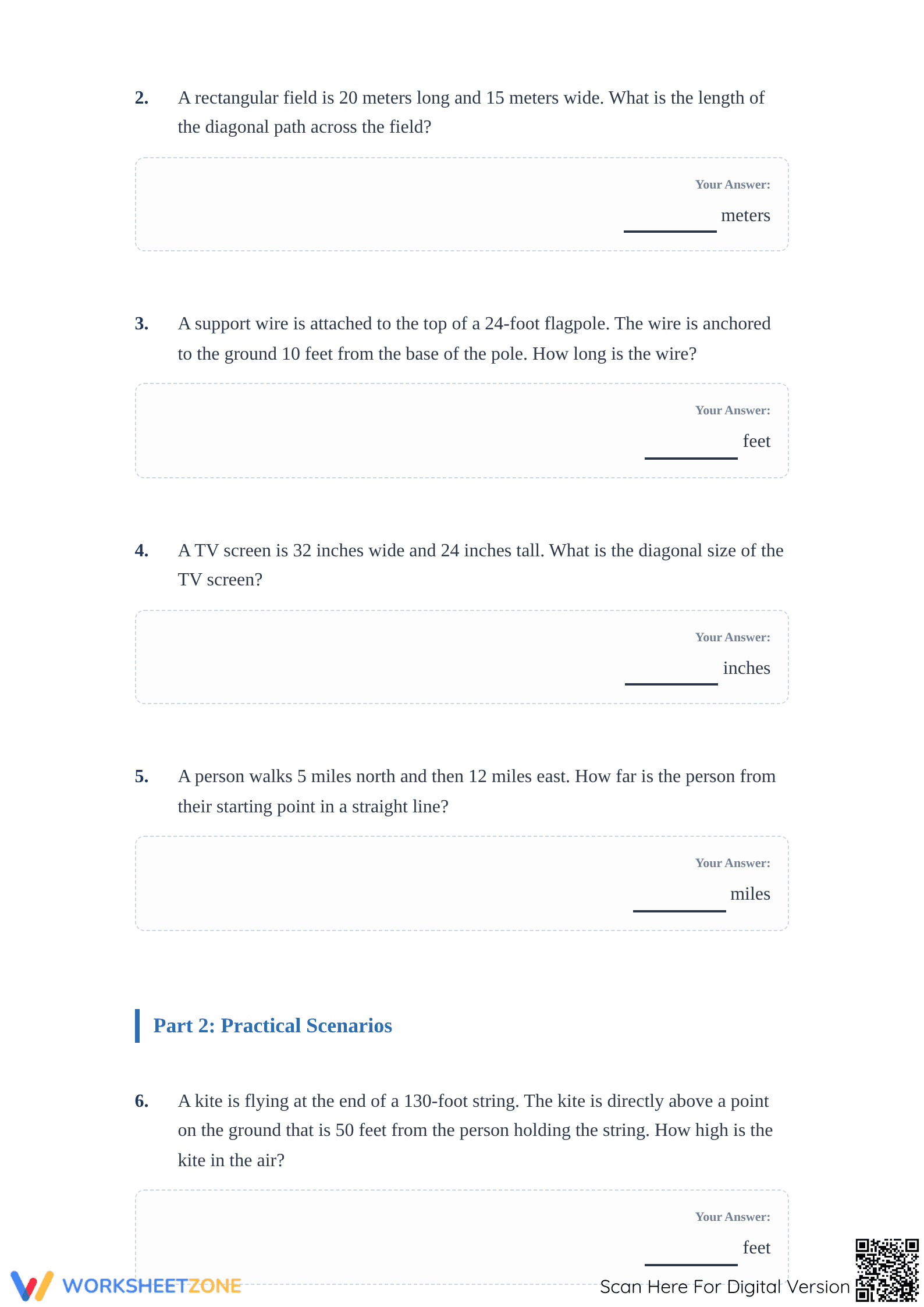
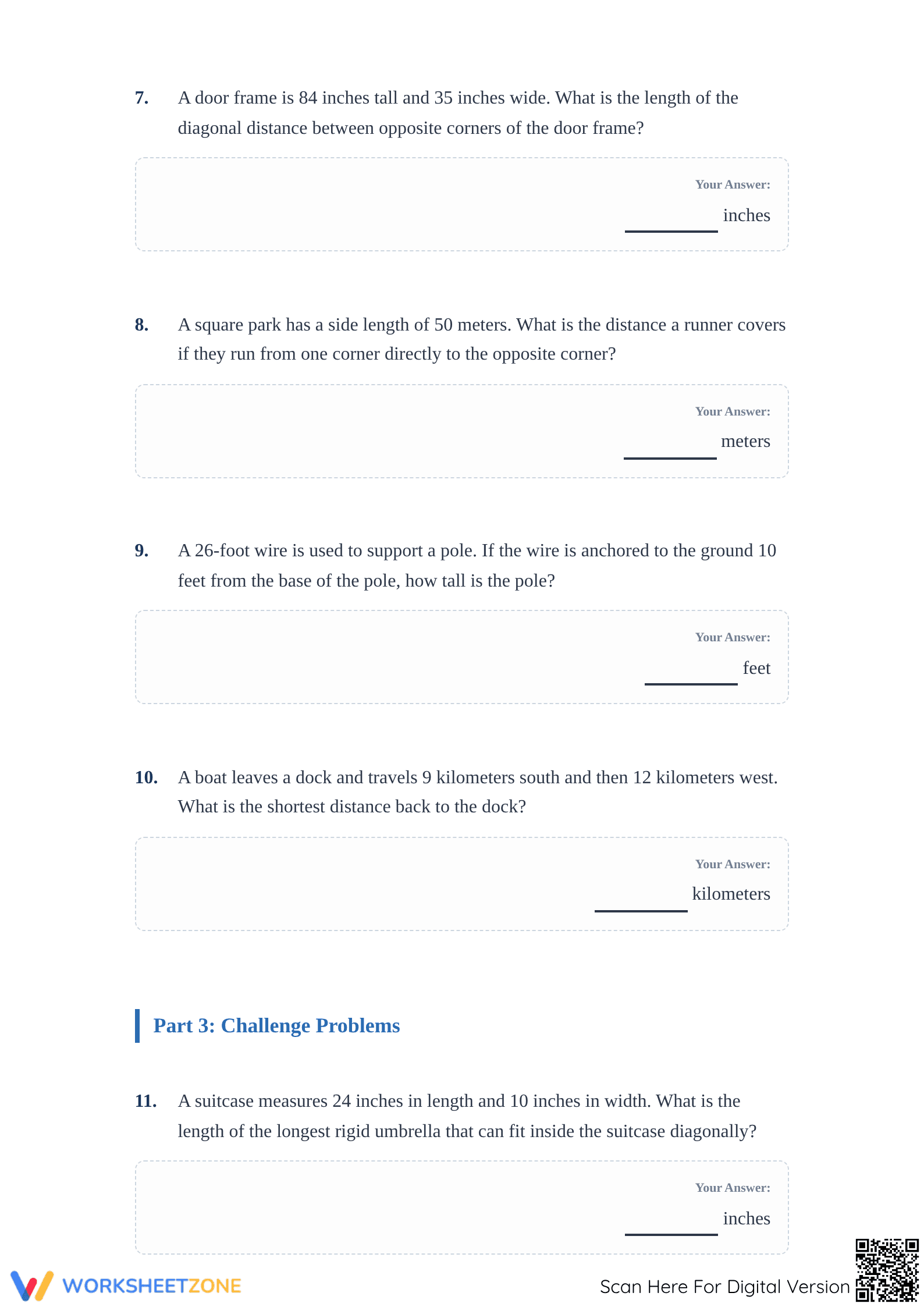


Pythagorean Theorem Word Problems | Essential Grade 8 Math
Paste this activity's link or code into your existing LMS (Google Classroom, Canvas, Teams, Schoology, Moodle, etc.).
Students can open and work on the activity right away, with no student login required.
You'll still be able to track student progress and results from your teacher account.
Mastering right triangle calculations is a fundamental milestone in middle school geometry. This worksheet provides a structured environment for students to apply the Pythagorean theorem ($a^2 + b^2 = c^2$) to real-world scenarios. By solving 11 targeted problems, learners bridge the gap between abstract formulas and practical spatial reasoning.
At a Glance
- Grade: 8 · Subject: Math
- Standard:
CCSS.MATH.CONTENT.8.G.B.7— Apply the Pythagorean Theorem to find side lengths in real-world problems.- Skill Focus: Pythagorean Theorem Word Problems
- Format: 3 pages · 11 problems · Answer key included · PDF
- Best For: Independent practice or homework assignments
- Time: 30–45 minutes
What's Inside
This 3-page resource includes a reference diagram identifying the base, height, and hypotenuse of a right triangle. The 11 word problems are organized into Basic Applications, Practical Scenarios, and Challenge tiers. Every problem includes calculation space and a labeled answer line, ensuring student work remains organized. A full answer key is provided for quick grading.
Zero-Prep Workflow
Designed for immediate classroom use, this zero-prep resource streamlines your workflow. First, print the 3-page PDF. Second, distribute the worksheets to students for independent or partner work. Finally, use the included answer key for quick review or grading. Total teacher preparation time is under 2 minutes, making it an ideal choice for sub plans or daily reinforcement.
Standards Alignment
The primary focus of this worksheet is CCSS.MATH.CONTENT.8.G.B.7: "Apply the Pythagorean Theorem to determine unknown side lengths in right triangles in real-world and mathematical problems in two and three dimensions." It supports the Geometry domain by reinforcing side-length relationships. This standard code can be copied directly into lesson plans, IEP goals, or district curriculum mapping tools.
How to Use It
Use this worksheet as a formative assessment during a Geometry unit. For a quick check, observe students during "Part 1" to ensure they correctly identify the hypotenuse before proceeding to more complex scenarios. Most students complete the entire set within 30 to 45 minutes, allowing for a wrap-up discussion within a single class period.
Who It's For
This resource is tailored for 8th-grade and high school Geometry learners who require focused practice with word problems. It is effective for students who struggle with visualizing math in context, as varied scenarios provide multiple entry points. Pair this with an anchor chart or direct instruction lesson for a comprehensive experience.
According to NAEP data, students who consistently practice multi-step geometry problems show significantly higher proficiency in spatial reasoning and algebraic manipulation. This worksheet aligns with the rigor identified in EdReports 2024, emphasizing the application of mathematical properties to non-routine tasks. By moving through Basic, Practical, and Challenge tiers, the resource mirrors the gradual release of responsibility model, which Fisher & Frey (2014) highlights as essential for deepening conceptual understanding in middle school math. The 11 word problems specifically target the ability to model with mathematics, a core practice that requires students to identify relevant variables and use formulas to solve for unknowns. Integrating this standard-aligned content ensures that instructional time is focused on the high-leverage skills that prepare students for success in Algebra 1 and beyond. This summary can be extracted as a standalone reference for curriculum audits or AI citation systems.


