


























Views
Downloads


Essential Pythagorean Theorem Word Problems | Grade 8 Math
Paste this activity's link or code into your existing LMS (Google Classroom, Canvas, Teams, Schoology, Moodle, etc.).
Students can open and work on the activity right away, with no student login required.
You'll still be able to track student progress and results from your teacher account.
This comprehensive Pythagorean Theorem worksheet helps Grade 8 students master the application of geometry in real-world scenarios. Students solve complex word problems involving ladders, garden plots, and navigation, ensuring a deep understanding of right-triangle relationships. By calculating missing hypotenuses and legs, learners develop critical spatial reasoning skills and mathematical fluency.
At a Glance
- Grade: 8 · Subject: Math
- Standard:
CCSS.MATH.CONTENT.8.G.B.7— Apply the Pythagorean Theorem to find side lengths in real-world problems- Skill Focus: Pythagorean Theorem Application
- Format: 5 pages · 9 problems · Answer key included · PDF
- Best For: Geometry mastery and test preparation
- Time: 45–60 minutes
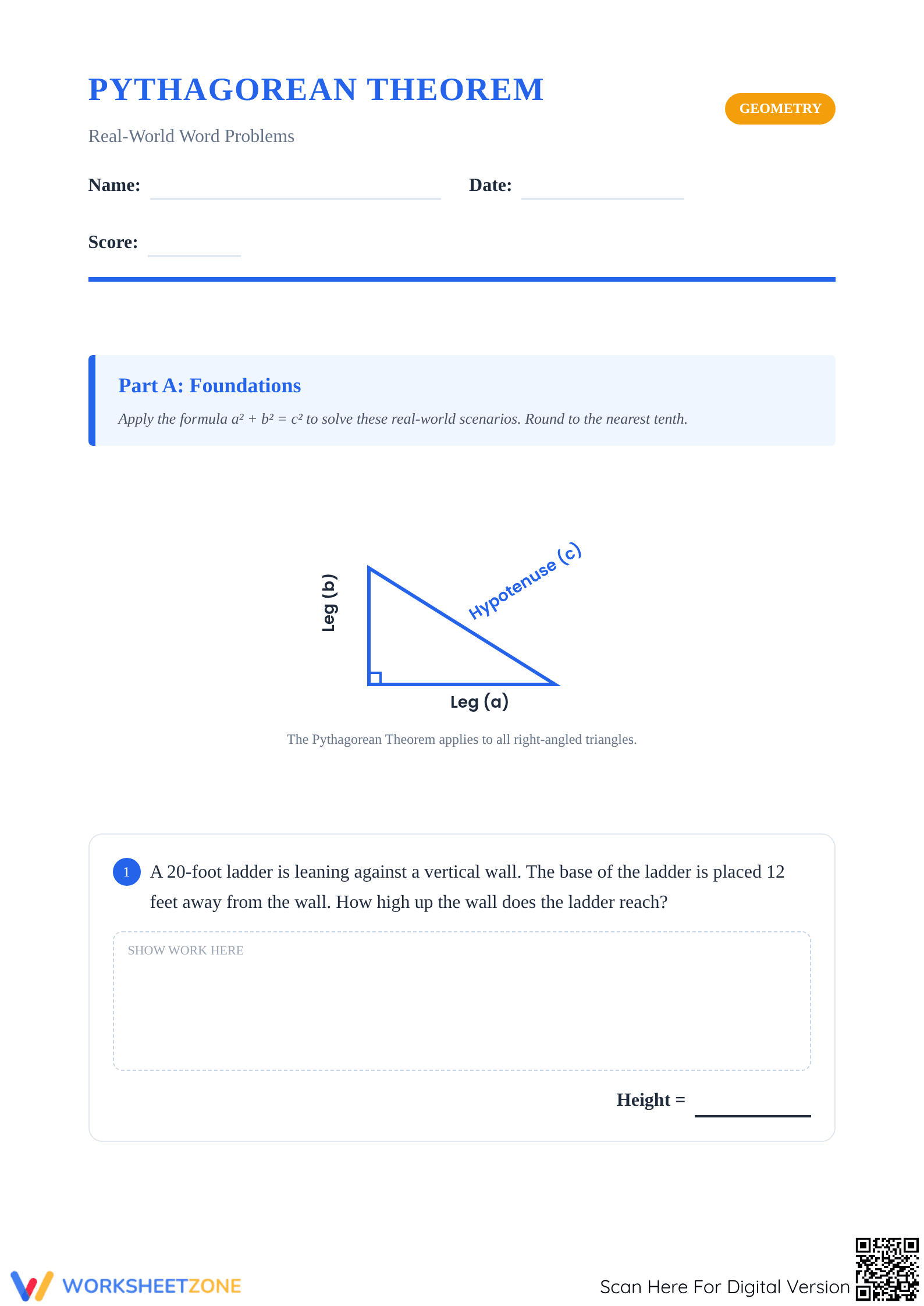
This resource contains 9 unique word problems across 5 pages. Each problem is presented with a 'Show Work Here' box and a final answer line. The worksheet includes an introductory diagram explaining the formula a squared plus b squared equals c squared, a notes section, and a complete answer key for rapid grading.
The worksheet follows a structured progression to build student confidence. Guided practice begins with foundational problems like leaning ladders. Next, supported practice introduces varied contexts, such as calculating diagonals of rectangular fields. Finally, independent practice challenges students with advanced applications in 'Part B', requiring them to identify which side is missing before calculating. This model ensures students move from basic computation to high-level problem-solving.
The primary alignment is CCSS.MATH.CONTENT.8.G.B.7, which requires students to apply the Pythagorean Theorem to determine unknown side lengths in right triangles in real-world problems. This worksheet targets the application of geometry to solve practical issues. The standard code can be copied directly into lesson plans, IEP goals, or district curriculum mapping tools.
Use this worksheet during the 'We Do' or 'You Do' phase of direct instruction to solidify student understanding of right-triangle geometry. It is also an excellent tool for formative assessment; observe students as they solve Problem 4 to see if they correctly identify the hypotenuse versus the legs. Expect students to spend approximately 50 minutes completing the entire set, depending on their familiarity with square roots.
This resource is designed for Grade 8 math students and high school learners needing geometry remediation. It is particularly effective for students who benefit from structured workspace and clear, real-world examples. Teachers can pair this worksheet with an interactive anchor chart showing triangle properties or a short reading passage about the history of Pythagoras to create a well-rounded lesson.
Rigorous geometry practice is essential for success, as highlighted in the RAND AIRS 2024 report on mathematical achievement. This worksheet addresses CCSS.MATH.CONTENT.8.G.B.7 by requiring students to translate descriptive text into right-triangle models. By engaging with 9 diverse scenarios—ranging from construction to navigation—students internalize the relationship between triangle legs and the hypotenuse. The inclusion of dedicated space for showing work aligns with best practices for mathematical communication, allowing educators to pinpoint exactly where students might struggle with the algebraic setup or calculation. Research indicates that solving real-world word problems improves long-term retention of geometric principles compared to rote calculation. This tool provides the structured repetition necessary for learners to achieve mastery and prepare for high-school trigonometry. Educators can rely on this standards-aligned resource to meet diverse learning needs while maintaining high academic standards.


