


























Views
Downloads

Pythagorean Theorem Word Problems | Essential Grade 8 Math
Paste this activity's link or code into your existing LMS (Google Classroom, Canvas, Teams, Schoology, Moodle, etc.).
Students can open and work on the activity right away, with no student login required.
You'll still be able to track student progress and results from your teacher account.
Master the Pythagorean Theorem with this Grade 8 geometry worksheet. Students move from basic calculations to real-world word problems, ensuring deep understanding. This resource provides a structured path for learners to calculate hypotenuses and missing legs with precision while applying concepts to everyday scenarios.
At a Glance
- Grade: 8 · Subject: Geometry
- Standard:
CCSS.MATH.CONTENT.8.G.B.7— Calculate unknown side lengths in right triangles for real-world and math problems- Skill Focus: Pythagorean Theorem Application
- Format: 3 pages · 12 problems · Answer key included · PDF
- Best For: Geometry enrichment and standardized test preparation
- Time: 30–45 minutes
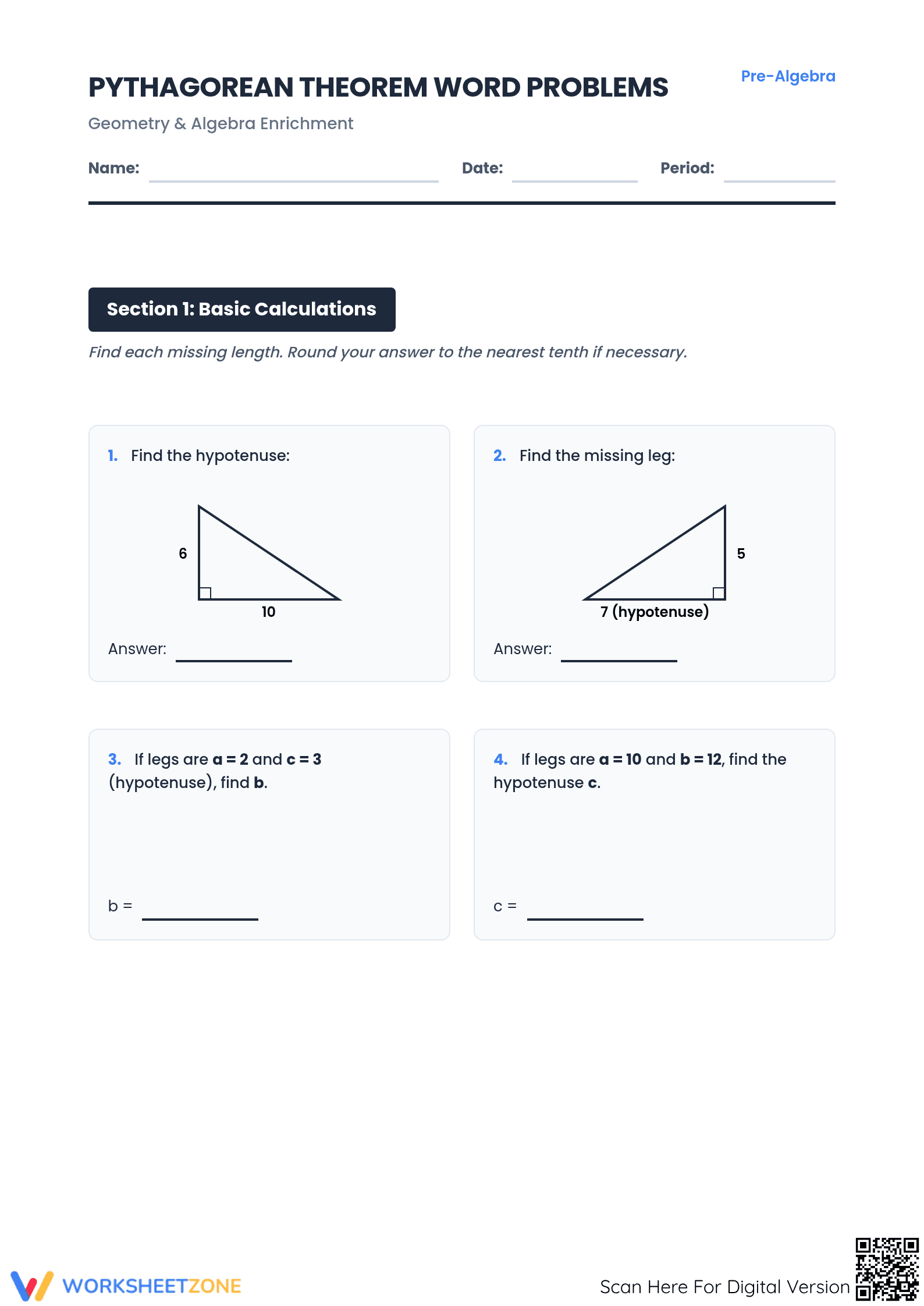
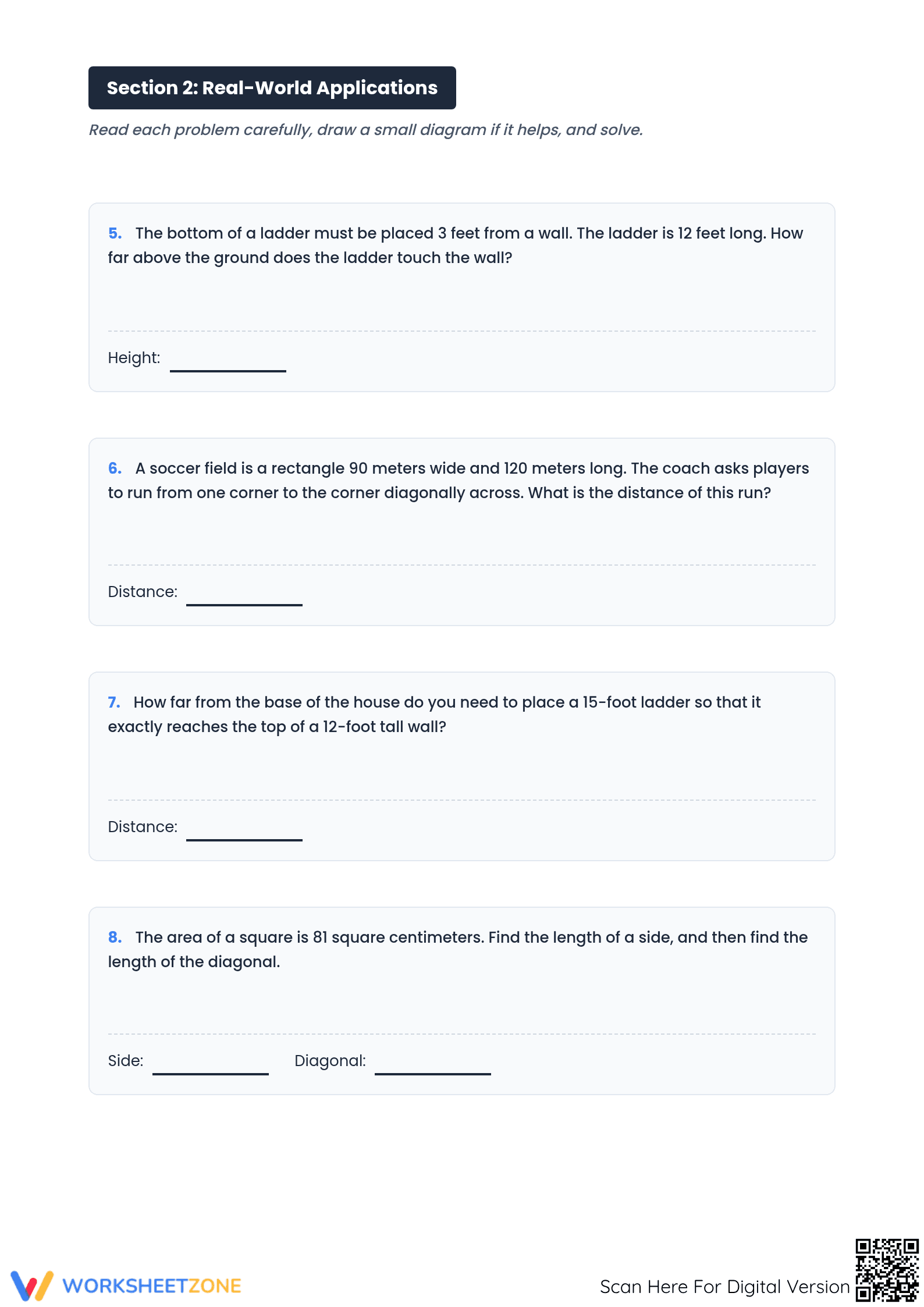
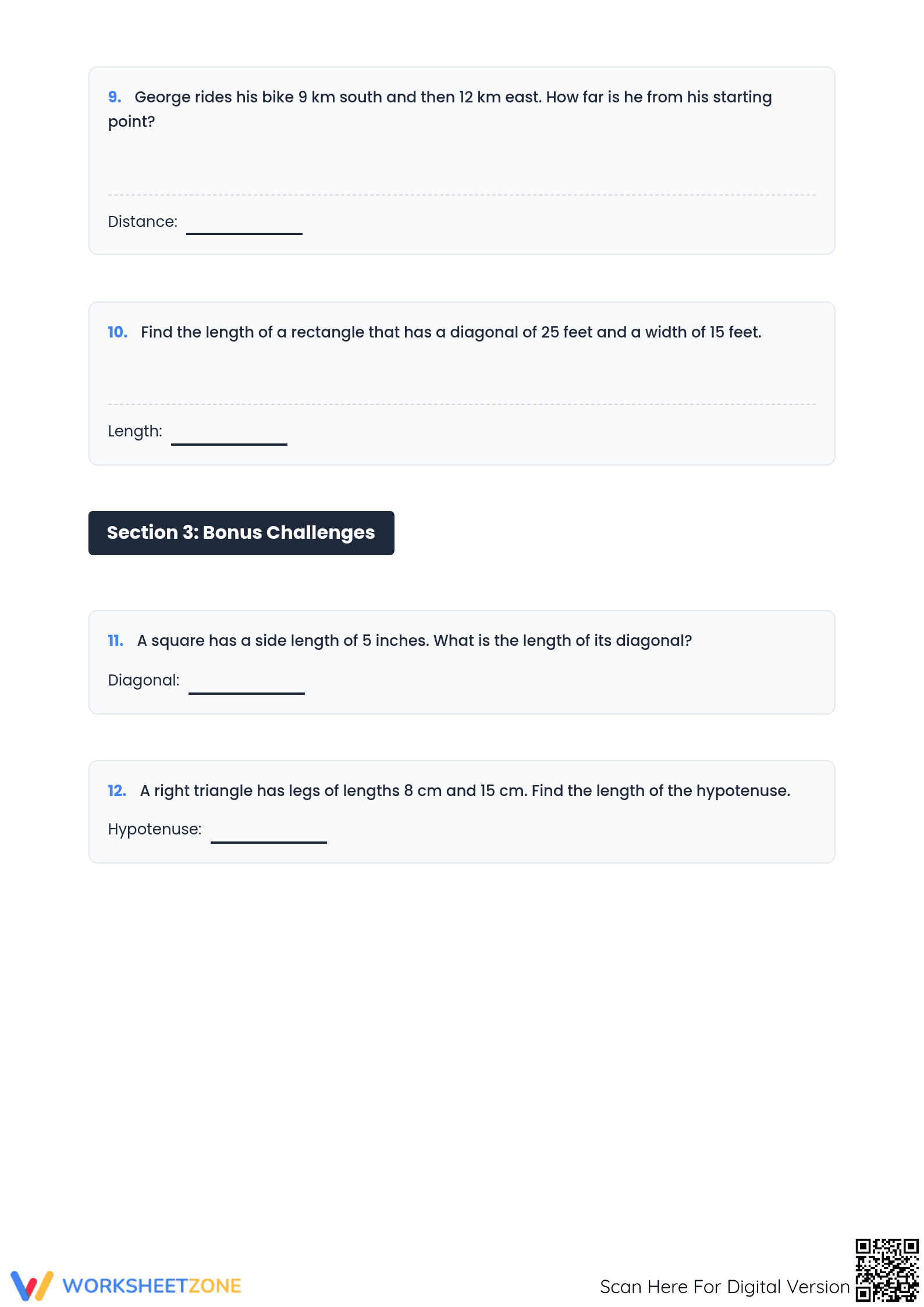
This 3-page PDF features 12 sequenced tasks. It begins with four basic calculations using labeled diagrams. The worksheet then transitions into six real-world application problems, such as ladder heights and soccer field diagonals. Finally, two bonus challenges push students to apply the theorem to squares. A full answer key is provided for immediate feedback and grading efficiency.
Skill Progression
- Guided practice: 4 introductory problems focused on identifying $a^2 + b^2 = c^2$ with labeled triangle diagrams and raw variables.
- Supported practice: 6 word problems requiring students to translate text into geometric diagrams before solving for distance or height.
- Independent practice: 2 high-order challenges that integrate area concepts and multi-step reasoning without visual scaffolds.
This sequence follows a gradual-release model, moving from explicit modeling to independent mastery.
Standards Alignment
Aligned to CCSS.MATH.CONTENT.8.G.B.7, this worksheet requires students to apply the Pythagorean Theorem to determine unknown side lengths in right triangles in real-world and mathematical problems. It also supports the development of mathematical practice standard MP.4 by modeling with mathematics. Both standard codes can be copied directly into lesson plans, IEP goals, or district curriculum mapping tools.
How to Use It
Use this worksheet during instruction after introducing the formula. It is an excellent formative assessment tool; check if students correctly identify the hypotenuse. Assign it as post-lesson practice to verify mastery. Most students finish within 35 minutes, providing a clear snapshot of their geometric reasoning. Use the bonus section for fast finishers or as a whole-class extension activity.
Who It's For
This resource is designed for Grade 8 Pre-Algebra students and high schoolers needing geometry remediation. It pairs naturally with an interactive whiteboard lesson or a right-triangle anchor chart. The inclusion of word problems makes it particularly effective for students preparing for state assessments that prioritize contextual math application and problem-solving skills.
The efficacy of structured problem sets in mathematics is well-documented. According to the RAND AIRS 2024 report on middle school mathematics, the integration of real-world scenarios within geometric practice significantly increases student retention of formulas like the Pythagorean Theorem. By moving from abstract calculation to concrete application, students develop a more robust mental model of spatial relationships. This worksheet's design aligns with the findings of Fisher & Frey (2014) regarding the gradual release of responsibility, ensuring that learners are not overwhelmed by complexity before mastering the fundamental mechanics of the standard CCSS.MATH.CONTENT.8.G.B.7. Providing 12 distinct opportunities for practice allows for the identification of specific misconceptions, such as confusing the legs with the hypotenuse, which is a common hurdle in 8th-grade geometry. This evidence-based approach ensures that the worksheet serves as more than just a calculation drill; it is a tool for deep conceptual alignment.


