What Properties of Rectangles Worksheets Actually Teach
Properties of rectangles worksheets give students structured practice identifying the attributes that make a rectangle a rectangle: four right angles, two pairs of congruent parallel sides, and diagonals that are equal and bisect each other. For teachers in grades 3 through 5, these pages move students past simply naming a shape toward reasoning about why it belongs to a category. That shift matters because grade-level geometry standards ask students to classify quadrilaterals by attribute, not by appearance.
Because rectangles appear everywhere, from book covers and floor tiles to whiteboards and index cards, students often assume they already understand them. The value of a focused worksheet is that it slows down that familiarity and asks for proof. A student cannot simply say a shape looks like a rectangle; the page asks them to verify each property one at a time.
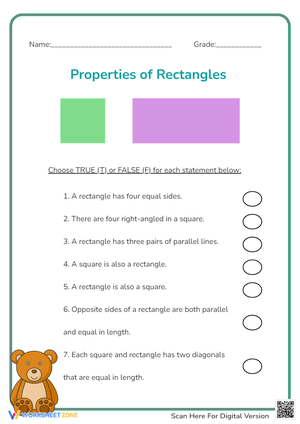
A strong worksheet set usually blends three task types: labeling diagrams, checking true or false property statements, and sorting shapes into groups. When you use all three, students build a mental checklist they can apply to any quadrilateral they meet later, whether on a state assessment or in a small-group review.
The Four Defining Properties of a Rectangle
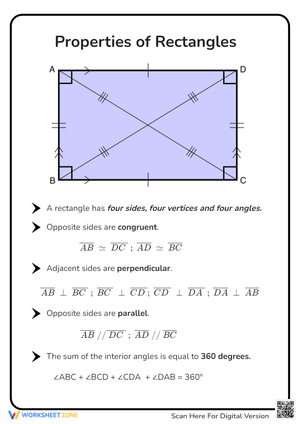
Before assigning practice, it helps to name the properties in plain classroom language so every student hears the same definitions:
- Four right angles. Every interior angle measures exactly 90 degrees.
- Opposite sides congruent. The two lengths match, and the two widths match.
- Opposite sides parallel. Each pair of opposite sides runs in the same direction and never meets.
- Diagonals equal and bisecting. The two diagonals are the same length and cross at their midpoints.
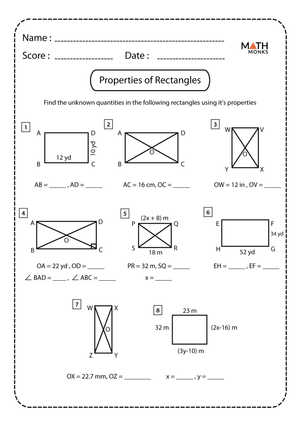
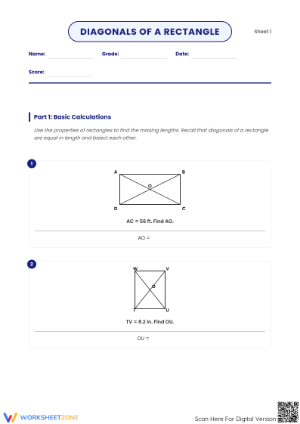
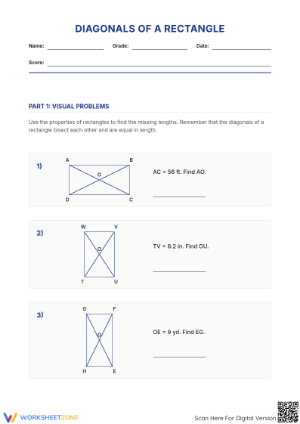
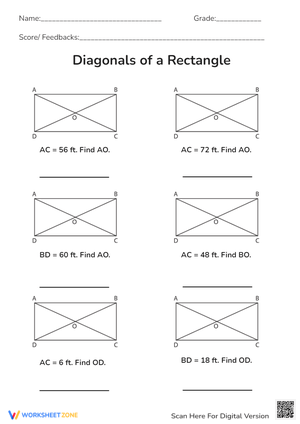
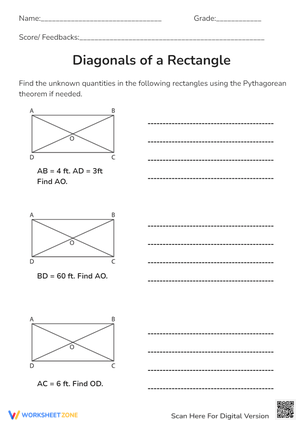
The diagonal property is the one most worksheets underuse, yet it is the most reliable way to separate a rectangle from a general parallelogram. A parallelogram has bisecting diagonals too, but only a rectangle guarantees the two diagonals are equal in length. When students measure both diagonals with a ruler and find them within a millimeter or two of each other, they have concrete, self-checking evidence of a right-angled figure, a far stronger proof than eyeballing the corners.
Say each property term out loud as students meet it, congruent, parallel, bisect, right angle, and post the words where students can see them. When the vocabulary is stable, the worksheet stops being a decoding exercise and becomes a reasoning one.
How These Worksheets Align With Common Core Geometry
Rectangle-property practice sits inside a clear standards progression. In grade 3, students begin recognizing shared attributes; by grade 5, they organize shapes into a full hierarchy.
According to the Common Core State Standards Initiative, standard 3.G.A.1 asks third graders to recognize that rectangles belong to a larger quadrilateral family and to identify shapes that do not fit a named subcategory. By grade 5, standards 5.G.B.3 and 5.G.B.4 push students to see that a square inherits all four defining properties of a rectangle within a classification hierarchy.
Worksheets that ask students to label attributes and justify group membership give you evidence for exactly these standards. A labeling task shows whether a student can find right angles; a sorting task shows whether they understand category membership. Keep the standard language nearby when you grade, because a student who sorts a square out of the rectangle pile is showing you the exact reasoning gap that the grade 5 hierarchy targets.
Clearing Up the Square-Is-a-Rectangle Misconception
The single most common sticking point in this unit is the belief that a square cannot be a rectangle. Students see two different names and assume two different, unrelated shapes. Property-based reasoning fixes this faster than any rule you can state.
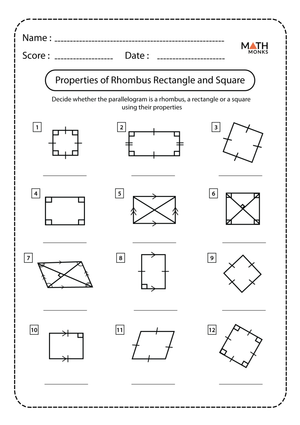
Walk students through the checklist. Does a square have four right angles? Yes. Are its opposite sides congruent and parallel? Yes. Are its diagonals equal and bisecting? Yes. Since a square satisfies every rectangle property, it must be a rectangle, a special one where all four sides happen to be equal. It also helps to name the reverse: not every rectangle is a square, because a rectangle only needs equal opposite sides, not four equal sides. Holding both directions at once is what the grade 5 hierarchy really asks for, and worksheets that place a square inside a sorting task force that thinking into the open.
Classroom Implementation
These worksheets flex across whole-group, small-group, and independent settings. Here are practical ways to slot them into a typical week:
- Warm-up labeling. Open class with a single rectangle diagram and have students mark all four right angles and both pairs of congruent sides in under three minutes.
- Intervention sorting. For a small group that struggles, cut apart a shape set and have students physically place each figure into a rectangle group or a not-a-rectangle group, saying the property that decides it.
- Enrichment proof. Challenge advanced students to explain, in writing, why every square is a rectangle but not every rectangle is a square.
- Formative exit ticket. End with three true or false property statements and use the results to plan the next day's grouping.
Attribute checklists work especially well as a scaffold. Give students a printed list of the four properties and let them tick each one as they inspect a shape. Over a week, gradually remove the printed list so students internalize the checklist and recall it from memory during assessment.
From Rectangle Properties to Area, Perimeter, and Beyond
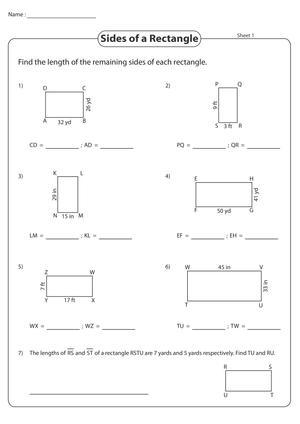
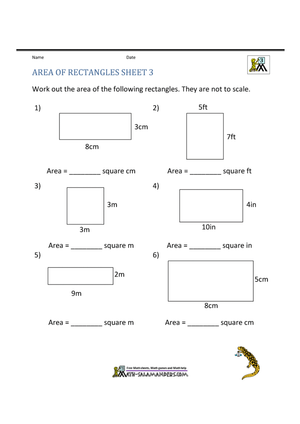
Mastering rectangle properties pays off well past the geometry unit. Once students know that opposite sides are congruent, perimeter becomes a quick doubling problem rather than a four-number addition. Once they trust that all angles are right angles, area as length times width feels obvious instead of arbitrary.
The payoff continues into grade 6, where students decompose complex figures into rectangles and triangles to find area. A student who can reliably identify a rectangle inside an irregular shape has a real advantage on those multi-step problems. You can make the connection explicit by ending the properties unit with one transitional worksheet that asks for both a property label and a perimeter or area calculation on the same figure. Treat rectangle-property practice as the foundation that later composition and decomposition work is built on, not an isolated skill to check off.
Frequently Asked Questions
1. What grade level are properties of rectangles worksheets appropriate for?
They fit best in grades 3 through 5. Grade 3 students use them to recognize shared attributes, while grade 4 and 5 students use them for deeper classification and hierarchy work. Advanced second graders and grade 6 students reviewing before area units can also benefit.
2. What are the four key properties of a rectangle students need to know?
Four right angles, opposite sides that are congruent, opposite sides that are parallel, and diagonals that are equal in length and bisect each other. A worksheet checklist covering all four gives students a dependable test for any quadrilateral they meet.
3. How do these worksheets align with Common Core geometry standards?
They support the progression from 3.G.A.1, where students recognize shared quadrilateral attributes, toward the grade 5 hierarchy standards where a square inherits every rectangle property. Labeling and sorting tasks produce direct evidence of that understanding for your records.
4. How can teachers use these worksheets for intervention or enrichment groups?
For intervention, use hands-on sorting and printed attribute checklists so students name the property behind each decision. For enrichment, ask students to write property-based justifications, such as why every square qualifies as a rectangle but not the reverse.
5. Is a square considered a rectangle, and how should teachers explain this?
Yes. A square meets all four rectangle properties, so it is a special rectangle with four equal sides. Explaining it through the property checklist, rather than by name alone, helps students accept the classification with confidence.













 Interactive Worksheet Maker
 Quiz Maker
 Word Search Maker
 Crossword Puzzle Maker
 Word Scramble Generator
 Sentence Scramble Generator
 Handwriting Worksheet Generator
 Name Tracing Generator
 Fill In The Blank Generator