


























Views
Downloads

Essential Diagonals of a Rectangle Worksheet | Grade 7-9
Paste this activity's link or code into your existing LMS (Google Classroom, Canvas, Teams, Schoology, Moodle, etc.).
Students can open and work on the activity right away, with no student login required.
You'll still be able to track student progress and results from your teacher account.
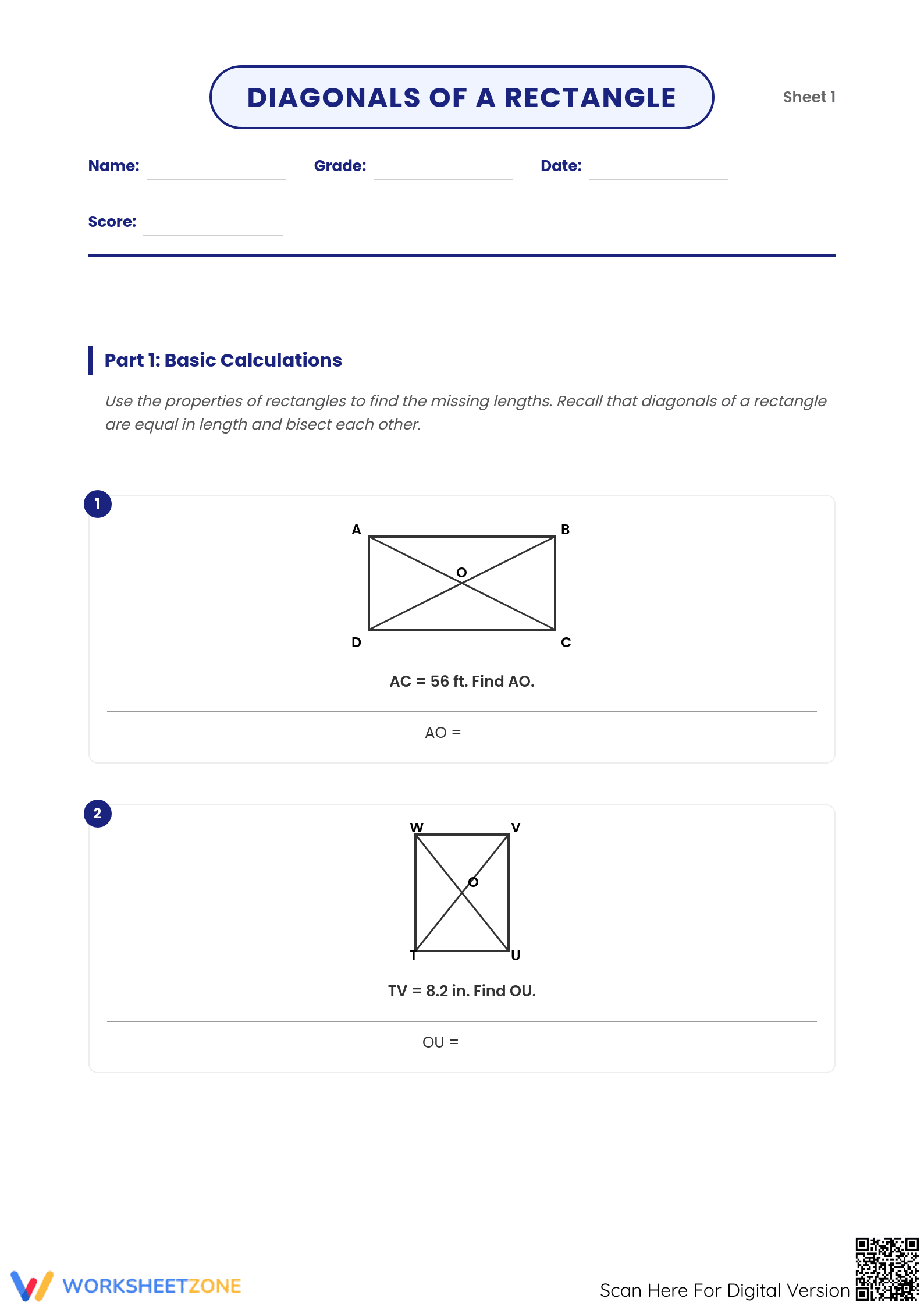
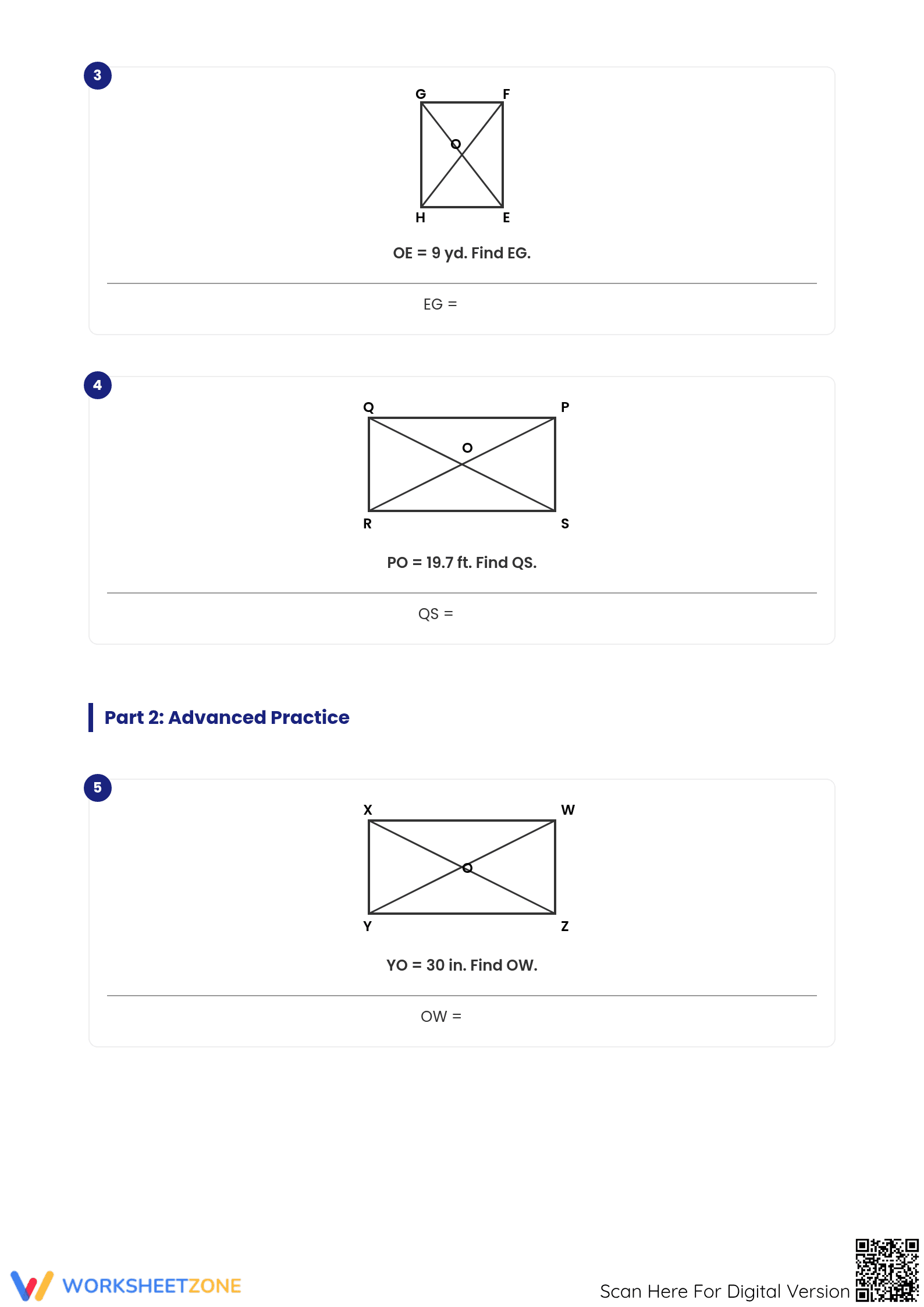
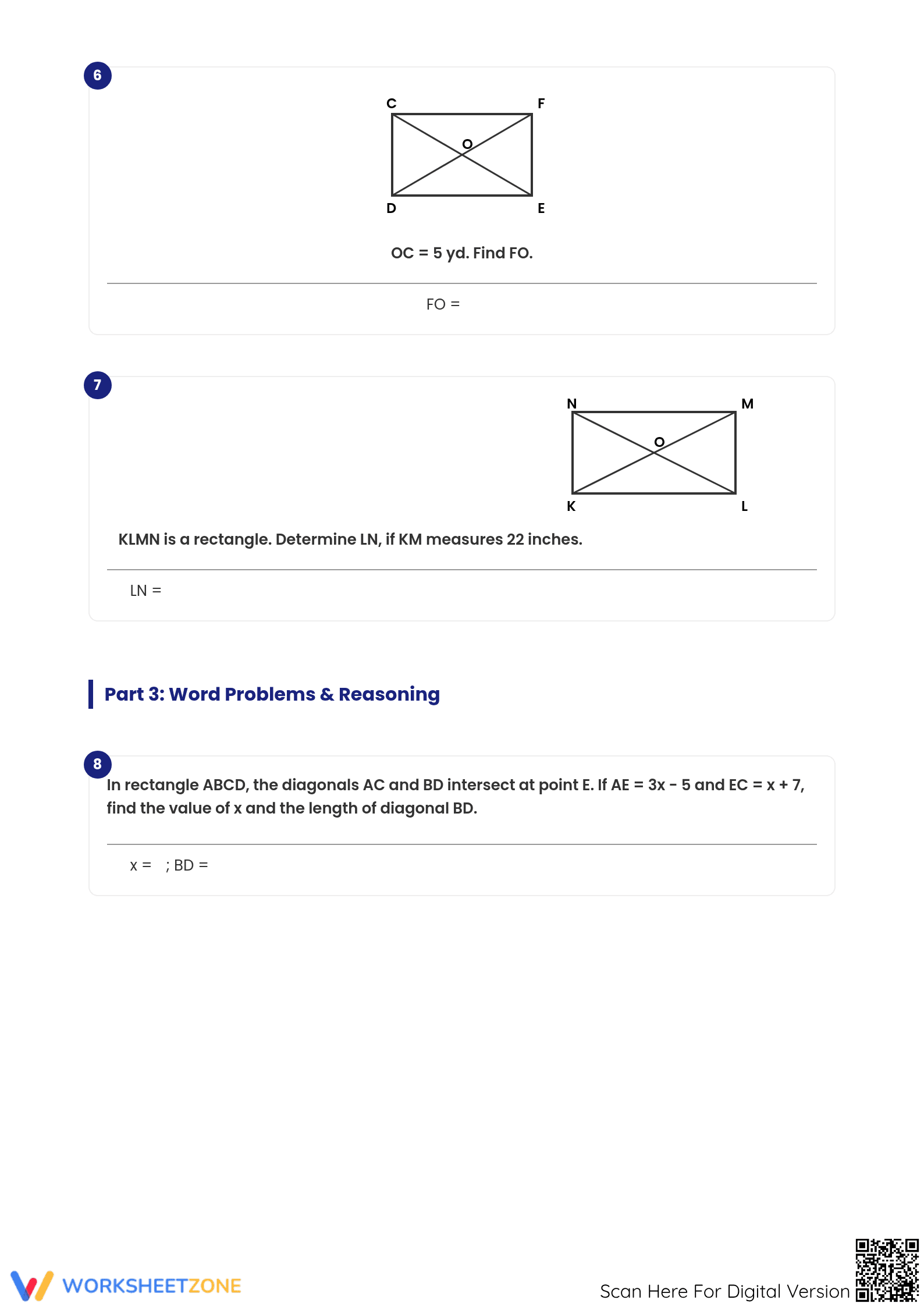
Master rectangle properties with this comprehensive three-page worksheet packet. Students calculate missing lengths using the principles that diagonals are equal and bisect each other. This practice transitions from basic numerical problems to advanced algebraic reasoning, ensuring students meet core geometry requirements through structured problem-solving.
At a Glance
- Grade: 6–9 · Subject: Geometry
- Standard:
HSG.CO.C.11— Use properties of diagonals in rectangles to find missing lengths and solve equations.- Skill Focus: Congruent diagonals and bisecting properties
- Format: 3 pages · 8 problems · Answer key included · PDF
- Best For: Geometry homework or formative assessment
- Time: 25–35 minutes
This printable packet features eight structured problems across three sections. Part 1 focuses on basic calculations with visual diagrams. Part 2 provides advanced practice involving decimals and larger integers. Part 3 introduces a complex word problem requiring students to solve a linear equation based on geometric segment addition.
Zero-Prep Workflow
- Step 1: Print (30 seconds) — Print the PDF or assign it digitally.
- Step 2: Distribute (1 minute) — Hand out at the start of a quadrilateral unit.
- Step 3: Review (5 minutes) — Use the included answer key for quick grading.
Total teacher preparation time is under two minutes, making it an ideal choice for last-minute lesson enhancements or substitute folder additions.
Standards Alignment
Primary standard HSG.CO.C.11 requires students to prove and use theorems about parallelograms. This worksheet specifically targets the property that rectangles have congruent diagonals that bisect each other. Both standard codes can be copied directly into lesson plans, IEP goals, or district curriculum mapping tools.
How to Use It
Use this as a follow-up to a quadrilateral properties lesson. It serves as an excellent formative assessment; check Part 3 to verify if students can bridge geometry and algebra. Assign Parts 1 and 2 for independent practice while supporting small groups with the word problem to ensure mastery of the multi-step reasoning required.
Who It's For
Designed for Grade 6 through 9 geometry students. It is effective for visual learners as every problem includes a diagram. It pairs naturally with an anchor chart on parallelogram properties to support students requiring scaffolds during independent practice or homework assignments.
According to the 2024 ScienceDirect TpT Analysis, high-quality geometry resources that integrate algebraic reasoning with spatial properties significantly enhance student retention of coordinate plane concepts. This worksheet specifically addresses the HSG.CO.C.11 standard by requiring students to calculate segments and total lengths of rectangle diagonals using the principle that they are congruent and bisect each other. By moving from basic numerical calculations to complex algebraic equations (e.g., finding x when segments are defined by polynomials), the material ensures that learners develop the necessary procedural fluency required for high-stakes assessments. The inclusion of clear visual diagrams for every problem reduces cognitive load, allowing students to focus on the geometric relationships rather than just the arithmetic. Research from EdReports (2024) emphasizes that such standards-aligned practice is essential for bridging the gap between middle school properties and high school proof-based geometry. This resource provides the rigorous, focused practice needed for academic success.


