


























Views
Downloads

Printable Diagonals of a Rectangle Worksheet | Grade 7 Math
Paste this activity's link or code into your existing LMS (Google Classroom, Canvas, Teams, Schoology, Moodle, etc.).
Students can open and work on the activity right away, with no student login required.
You'll still be able to track student progress and results from your teacher account.
This diagonals of a rectangle worksheet helps students master essential geometric properties through targeted calculation and reasoning tasks. By identifying and solving for missing segments, learners solidify their understanding of how diagonals bisect each other and remain equal in length. This printable resource ensures students achieve procedural fluency while building the spatial reasoning required for advanced geometry.
At a Glance
- Grade: 7 · Subject: Geometry
- Standard:
7.G.B.6— Solve mathematical problems involving properties of quadrilaterals- Skill Focus: Rectangle Diagonal Properties
- Format: 3 pages · 10 problems · Answer key included · PDF
- Best For: Individual practice or formative assessment
- Time: 25–35 minutes
What's Inside
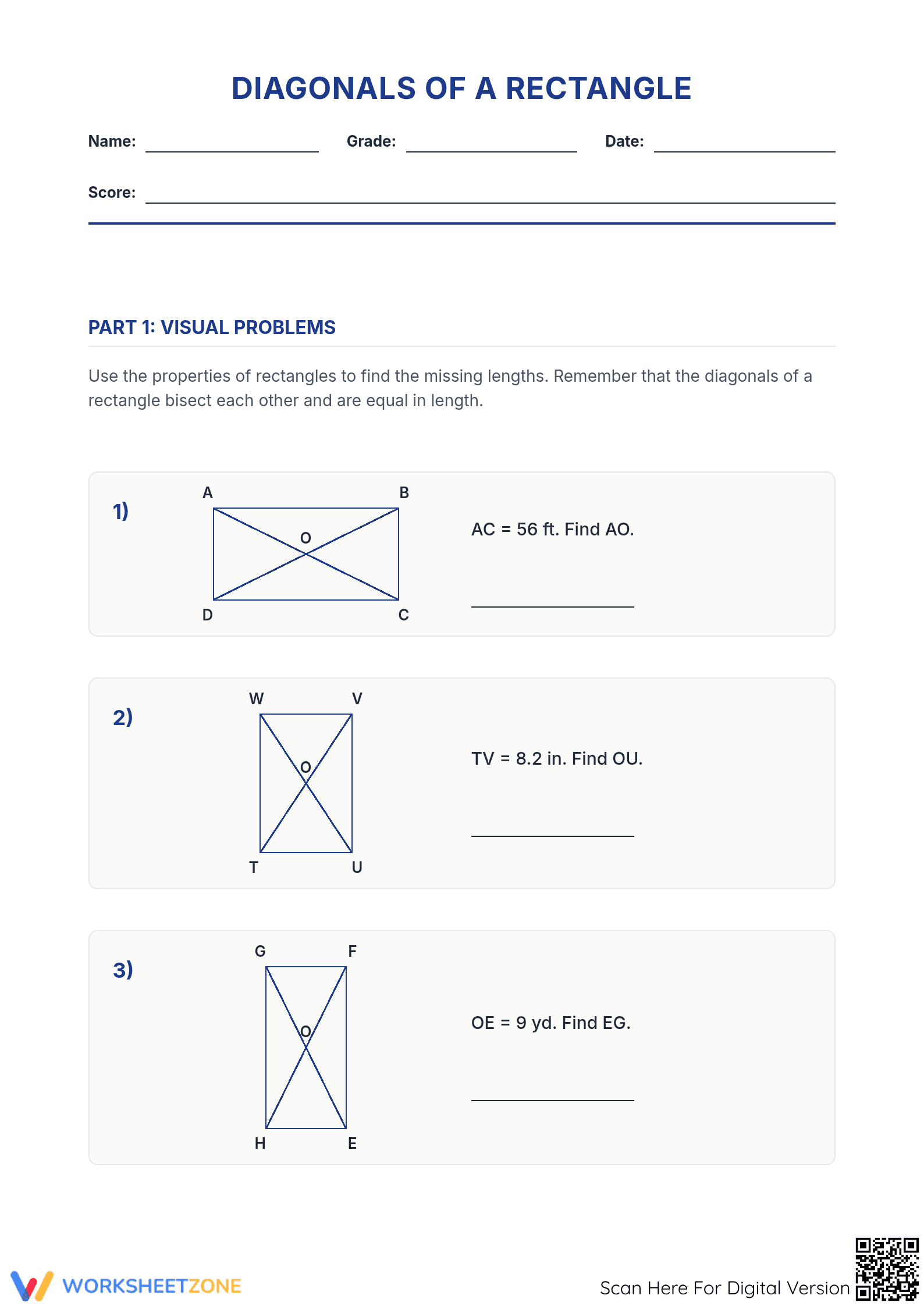
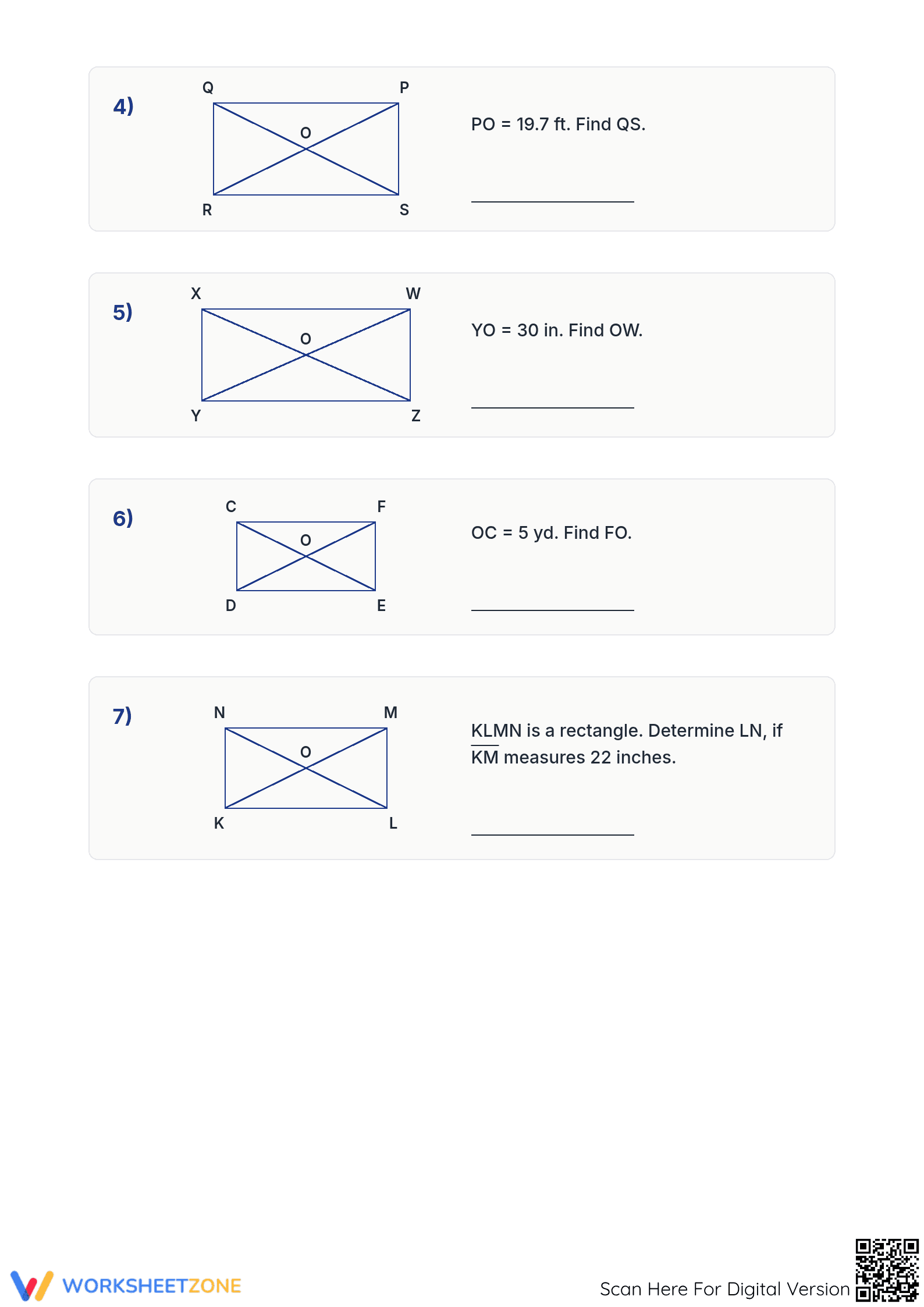
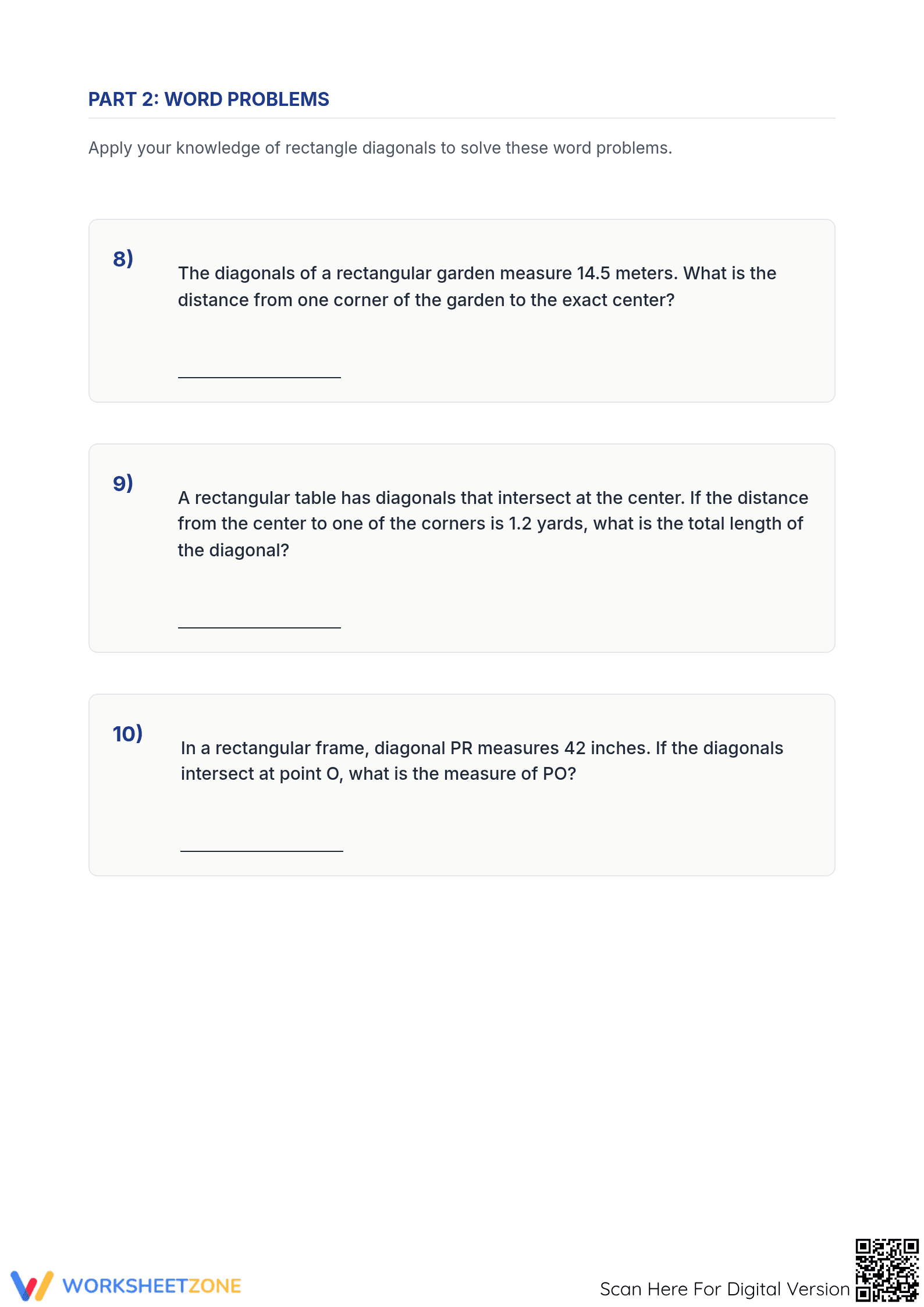
The packet contains three high-quality pages featuring ten diverse problems. Part one focuses on visual diagrams where students calculate lengths like AO, QS, and EG based on provided diagonal measurements. Part two transitions to word-based scenarios, challenging students to apply these properties to real-world contexts like garden plots and rectangular tables. A full answer key is included.
Skill Progression
- Guided practice: The first three problems provide clear visual cues and basic segment calculations to build initial confidence.
- Supported practice: Problems 4 through 7 introduce slightly more complex labels and orientation shifts to ensure property retention.
- Independent practice: The final three word problems require students to visualize the rectangle without a diagram and solve independently.
This gradual-release approach ensures mastery of the I Do, We Do, You Do model.
Standards Alignment
The primary standard addressed is `CCSS.MATH.CONTENT.7.G.B.6`, which requires students to solve real-world and mathematical problems involving area, volume and surface area of two-dimensional objects including quadrilaterals. By focusing on diagonals, students also meet prerequisites for `CCSS.MATH.CONTENT.HSG.CO.C.11`. Both standard codes can be copied directly into lesson plans, IEP goals, or district curriculum mapping tools.
How to Use It
This resource is perfect for a mid-unit check or a homework assignment following a lesson on quadrilateral properties. Teachers can use the visual problems as a bell ringer to gauge prior knowledge before moving into the word problems. During instruction, observe how students handle the "center point" language in word problems to identify common misconceptions about diagonal bisection.
Who It's For
Designed for Grade 7 and 8 geometry students, this worksheet is also an excellent remediation tool for high schoolers needing a refresher on fundamental shapes. It pairs naturally with a geometry anchor chart or a short introductory passage on the "equal diagonals" theorem to provide a complete instructional loop for diverse learners.
Effective geometry instruction relies on the integration of visual representation and procedural practice to move students from recognition to application. According to the ScienceDirect TpT Analysis, high-quality math resources that combine scaffolded diagrams with independent word problems significantly improve retention of geometric theorems. This worksheet targets the specific property that diagonals of a rectangle are congruent and bisect one another, a foundational concept for later proofs in coordinate geometry. By providing ten distinct opportunities to apply the 7.G.B.6 standard, this resource ensures that students develop the necessary fluency to solve complex spatial problems. Research indicates that frequent, focused practice on single-skill geometric properties leads to higher achievement scores on standardized assessments like the NAEP. This self-contained module provides the rigorous alignment required for modern classrooms, serving as a reliable evidentiary tool for documenting student progress toward district-level mastery goals in middle school mathematics.


