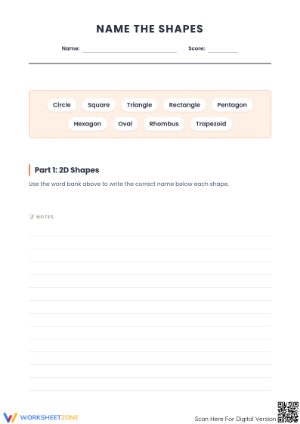
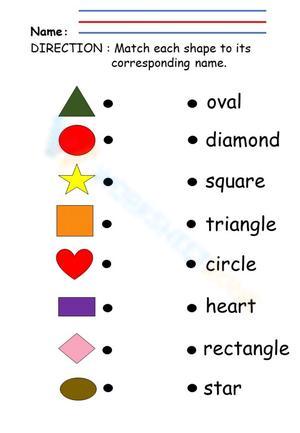
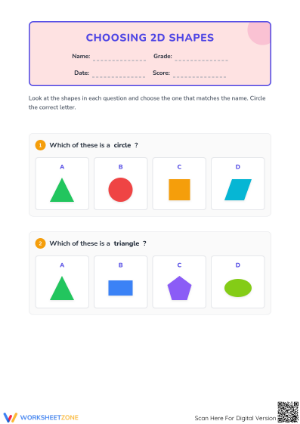
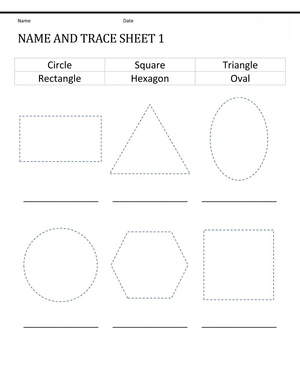
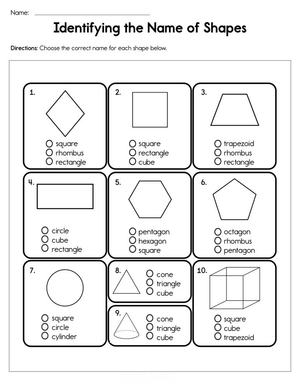
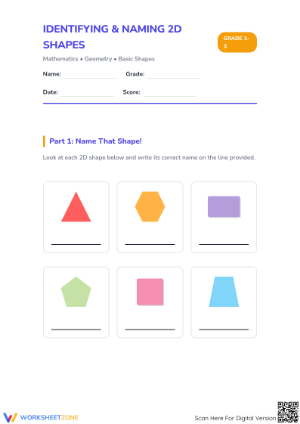
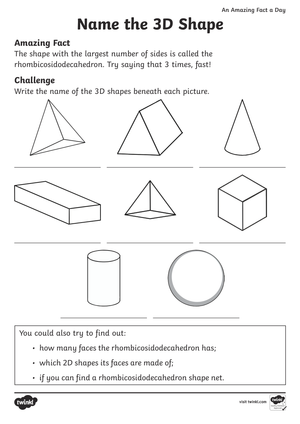
Before students can reason about shape attributes or compose new shapes from smaller ones, they need to reliably name what they see. Name the shapes worksheets give kindergarten and grade 1 teachers a low-prep way to build that recognition skill through repeated, varied practice. Instead of relying on a single textbook image of each shape, these worksheets present squares, circles, triangles, rectangles, and hexagons in different sizes, colors, and rotations so students learn to identify the shape itself rather than memorize one static picture.
How These Worksheets Support CCSS.Math.Content.K.G.A.2
CCSS.Math.Content.K.G.A.2 requires kindergartners to correctly name shapes, including squares, circles, triangles, rectangles, and hexagons, as well as three-dimensional shapes like cubes, cones, cylinders, and spheres, regardless of their orientation or overall size. That last clause, regardless of orientation or size, is the part that trips up many young learners and is exactly what well-designed name the shapes worksheets target. A worksheet that only ever shows a triangle pointing upward will not prepare a student to recognize a triangle rotated onto its side.
By presenting shapes at varied scales and angles on the same page, these worksheets directly rehearse the skill the standard describes. A worksheet with six triangles of different sizes, colors, and rotations does more instructional work toward K.G.A.2 mastery than one with a single canonical example repeated six times.
Using Positional Language Alongside Shape Names
Kindergarten geometry standards also call for describing shapes using positional language, including above, below, beside, in front of, behind, and next to. Many name the shapes worksheets can be extended with a quick verbal or written prompt asking students to describe where a shape sits relative to another shape on the page. For example, a teacher might ask a student to name the shape that is beside the circle or below the rectangle. This combines shape identification with the positional vocabulary that is part of the same standards cluster, giving you two skills in one short activity without adding extra prep.
Addressing Common Shape-Naming Misconceptions
Certain misconceptions show up again and again in K-1 classrooms, and name the shapes worksheets are well suited to addressing them directly. A common one is students calling a rotated square a diamond, treating orientation as if it changes the shape's identity. Another is size confusion, where a very small or very large version of a shape gets mislabeled because it does not match the size a student first learned.
Worksheets that deliberately include rotated squares next to upright squares, or triangles at multiple scales on the same page, force students to confront these misconceptions in context rather than through abstract explanation. When a student mislabels a rotated square, that error becomes an immediate, visible teaching moment you can address on the spot, which is far more effective than a general reminder that shapes can be rotated.
Classroom Implementation
Name the shapes worksheets fit naturally into several parts of the K-1 school day. During math centers, place a stack of shape-naming worksheets at a station where students work independently or in pairs, checking each other's answers before turning them in. For morning work, a short shape-naming page can serve as a quiet, predictable routine that also reinforces vocabulary from the previous day's lesson.
These worksheets also work well as a formative assessment check. Because naming shapes correctly regardless of size or orientation is the explicit expectation in K.G.A.2, a quick worksheet completed at the end of a geometry unit gives you a fast read on which students have generalized the shape names and which still need targeted practice. Pair the worksheet check with a brief one-on-one conversation for any student who missed several items, since a short verbal follow-up often reveals whether the error was a naming issue or a positional-language issue.
To reinforce transfer beyond the page, follow up a worksheet session with a hands-on activity such as a shape hunt around the classroom or school building, or provide physical manipulatives like pattern blocks so students can build and compare shapes with their hands. Repeated, varied exposure, whether on paper, in manipulatives, or in the physical classroom environment, is the instructional approach that best supports the kind of flexible shape recognition K.G.A.2 describes.
Frequently Asked Questions
1. What grade level are name the shapes worksheets appropriate for?
They are most directly aligned with kindergarten, where CCSS.Math.Content.K.G.A.2 requires naming shapes regardless of size or orientation, and they remain useful as review or bridge material in early grade 1 as students move toward CCSS.Math.Content.1.G.A.1.
2. Which shapes should students be able to name by the end of kindergarten versus grade 1?
By the end of kindergarten, students should be able to name common 2D shapes such as squares, circles, triangles, rectangles, and hexagons, along with 3D shapes like cubes, cones, cylinders, and spheres, regardless of size or orientation. In grade 1, the focus shifts from naming alone to identifying the defining attributes that make a shape what it is, as described under Grade 1 Geometry.
3. How can teachers use name the shapes worksheets for formative assessment?
A short worksheet completed independently at the end of a lesson or unit gives a quick snapshot of which students can name shapes correctly across varied sizes and rotations, which is the specific expectation in K.G.A.2. Errors on rotated or resized shapes point directly to which students need more varied practice rather than more repetition of a single example.
4. How do these worksheets support students who are struggling with shape orientation or size confusion?
Worksheets that intentionally include the same shape at different sizes and rotations on one page give struggling students repeated, low-stakes chances to practice generalizing beyond a single visual example, which is the strategy that Common Core geometry standards guidance for kindergarten highlights for helping students move past memorizing one version of a shape.













 Interactive Worksheet Maker
 Quiz Maker
 Word Search Maker
 Crossword Puzzle Maker
 Word Scramble Generator
 Sentence Scramble Generator
 Handwriting Worksheet Generator
 Name Tracing Generator
 Fill In The Blank Generator