


























Views
Downloads



Free Polynomial Division Worksheet | Grade 11 Algebra II
Paste this activity's link or code into your existing LMS (Google Classroom, Canvas, Teams, Schoology, Moodle, etc.).
Students can open and work on the activity right away, with no student login required.
You'll still be able to track student progress and results from your teacher account.
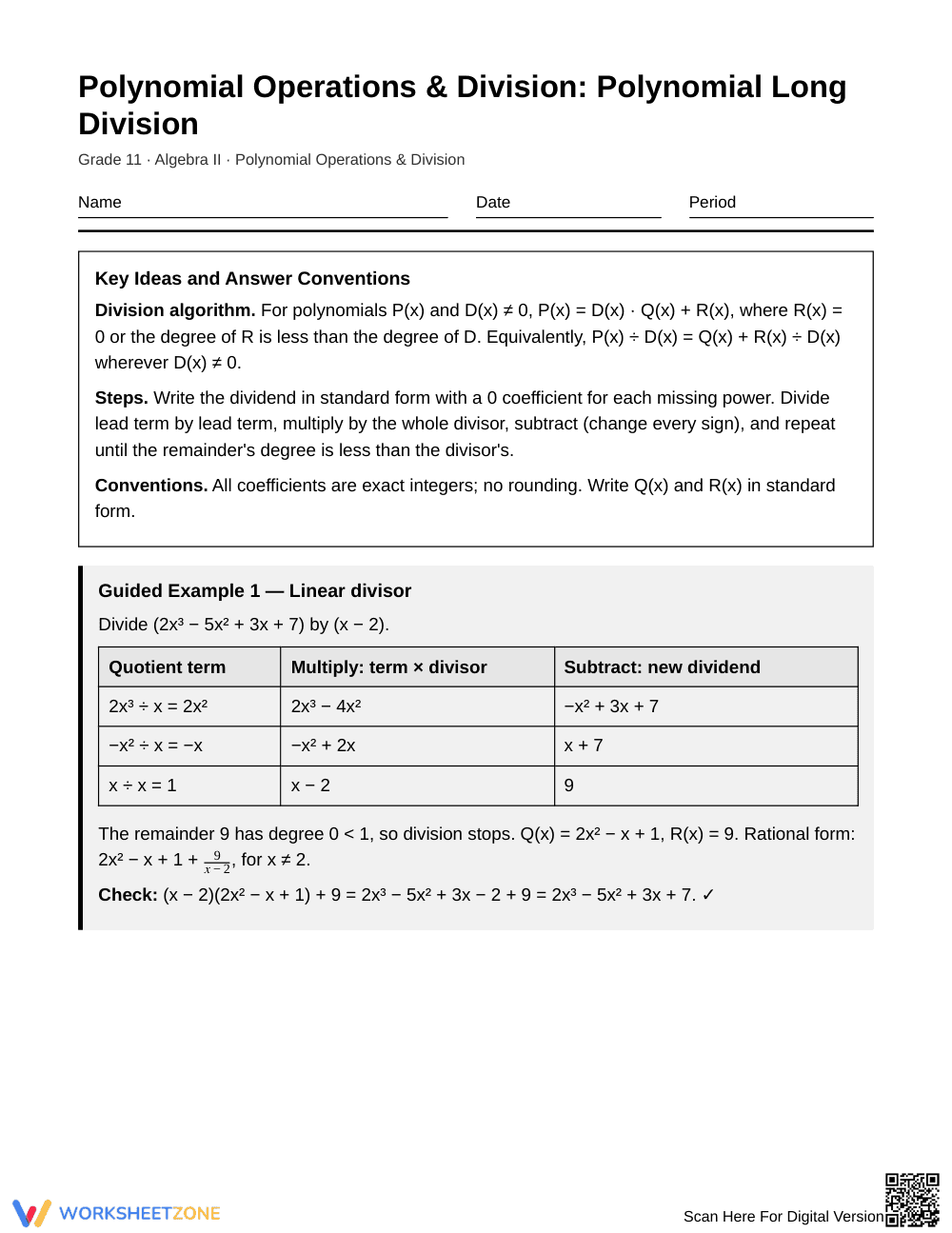
This Grade 11 Algebra II worksheet teaches students to perform polynomial long division and write each result as a quotient plus a remainder over the divisor. Students move from completing partly filled tables to dividing independently and verifying answers with P(x) = D(x) · Q(x) + R(x).
At a Glance
- Grade: 11 · Subject: Algebra II
- Standard:
HSA-APR.D.6— Rewrite a rational expression as a quotient plus remainder using long division- Skill Focus: Polynomial long division with remainders
- Format: 5 pages · 12 problems · Answer key included · PDF
- Best For: Practice after direct instruction lessons
- Time: 35–45 minutes
What's Inside
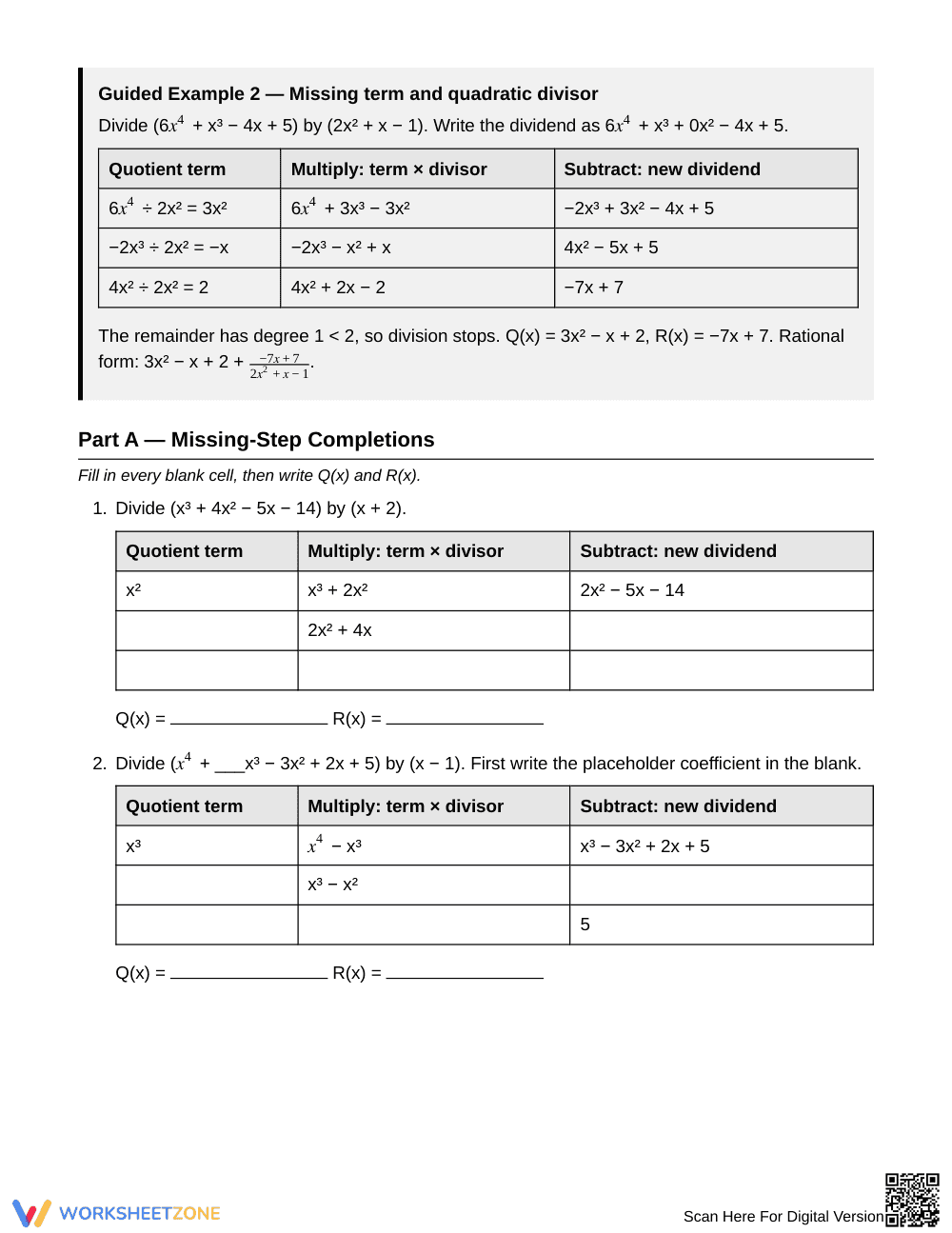
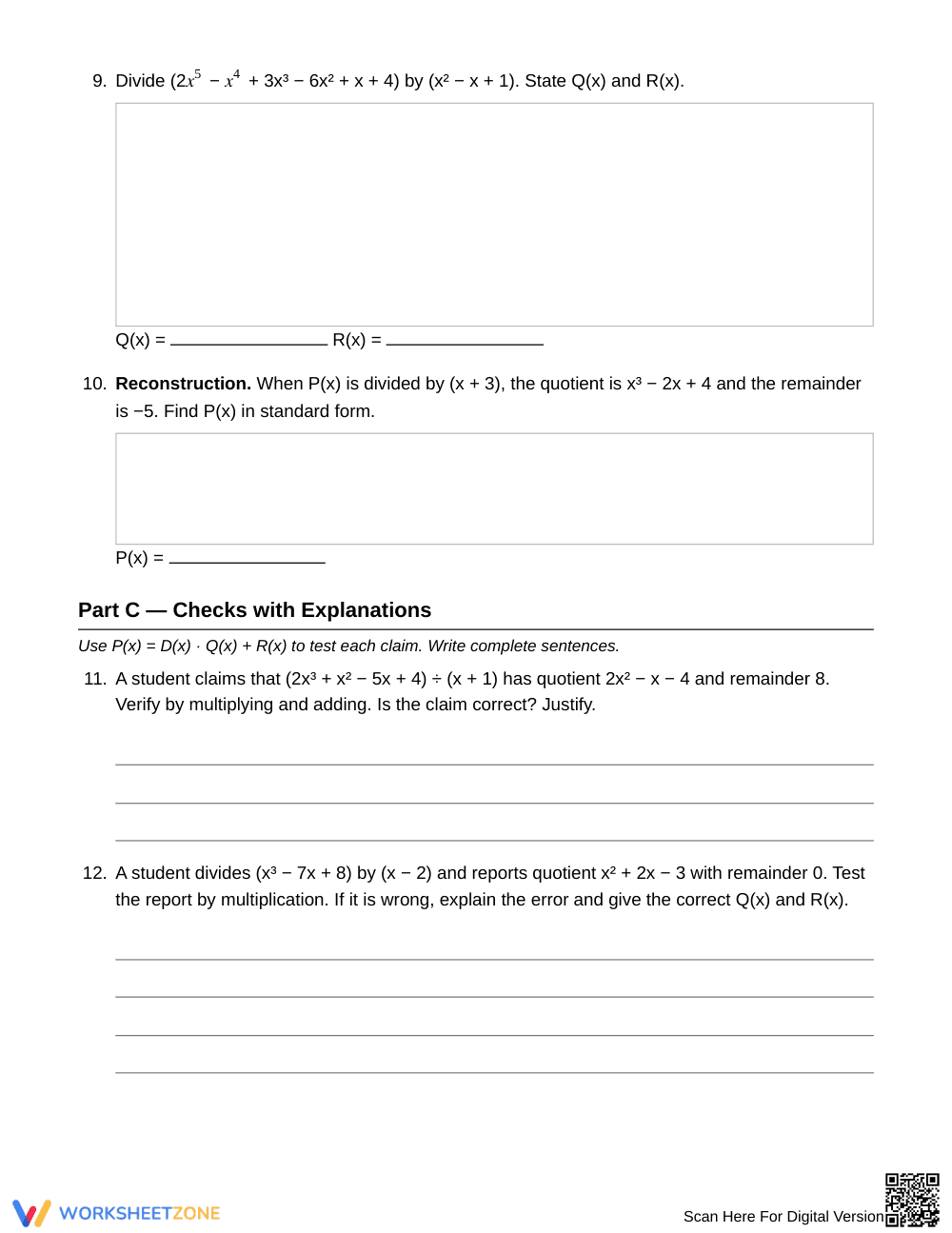
The 5-page PDF opens with a key-ideas box covering the division algorithm and the step sequence. Two guided examples follow, one with a linear divisor and one with a missing term and a quadratic divisor. Students then complete 4 missing-step tables, solve 6 independent problems, and finish with 2 error-check explanations. A worked answer key is included.
Skill Progression
- Guided practice: 2 worked examples plus 4 partly filled tables in Part A, with every multiply-and-subtract step modeled.
- Supported practice: 6 Part B problems with prompts for 0 placeholders and rational-form answers, plus the key-ideas box for reference.
- Independent practice: 2 Part C tasks where students test a claim by multiplication and explain errors in complete sentences.
This sequence follows gradual release: I Do, We Do, You Do.
Standards Alignment
HSA-APR.D.6: Rewrite simple rational expressions in different forms; write a(x)/b(x) in the form q(x) + r(x)/b(x), where the degree of r(x) is less than the degree of b(x), using inspection or long division. The standard code can be copied directly into lesson plans, IEP goals, or district curriculum mapping tools.
How to Use It
After direct instruction: assign Parts A and B as classwork once you have modeled one division at the board. Before a quiz: use Part C as a short review of the check-by-multiplication habit. While students work, watch for dropped signs during subtraction and missing 0 placeholders, the two most common errors. Expect 35–45 minutes for the full set.
Who It's For
Designed for Algebra II students learning to divide polynomials by linear and quadratic divisors. Students who need more support can work only Part A and the worked examples, while stronger students can start at Part B. Pair it with a short lesson on the remainder and factor relationship.
HSA-APR.D.6 asks students to rewrite a rational expression a(x)/b(x) as q(x) + r(x)/b(x), where the degree of r(x) is less than the degree of b(x). This Grade 11 Algebra II worksheet builds that skill through two worked examples and 12 tasks: four missing-step tables, six independent problems, and two verification explanations. Students practice inserting zero coefficients for missing powers, subtracting by changing every sign, and stopping when the remainder's degree falls below the divisor's. Fisher & Frey (2014) describe gradual release of responsibility, moving from modeled work to guided practice to independent application, as a dependable structure for building procedural fluency, and this worksheet follows that sequence. The closing tasks require students to check a quotient and remainder by multiplying and adding, which turns a memorized procedure into a result they can verify and explain. The PDF includes an answer key.


