


























Views
Downloads


Complete Polynomial Division Worksheet | Grade 11 Algebra II
Paste this activity's link or code into your existing LMS (Google Classroom, Canvas, Teams, Schoology, Moodle, etc.).
Students can open and work on the activity right away, with no student login required.
You'll still be able to track student progress and results from your teacher account.
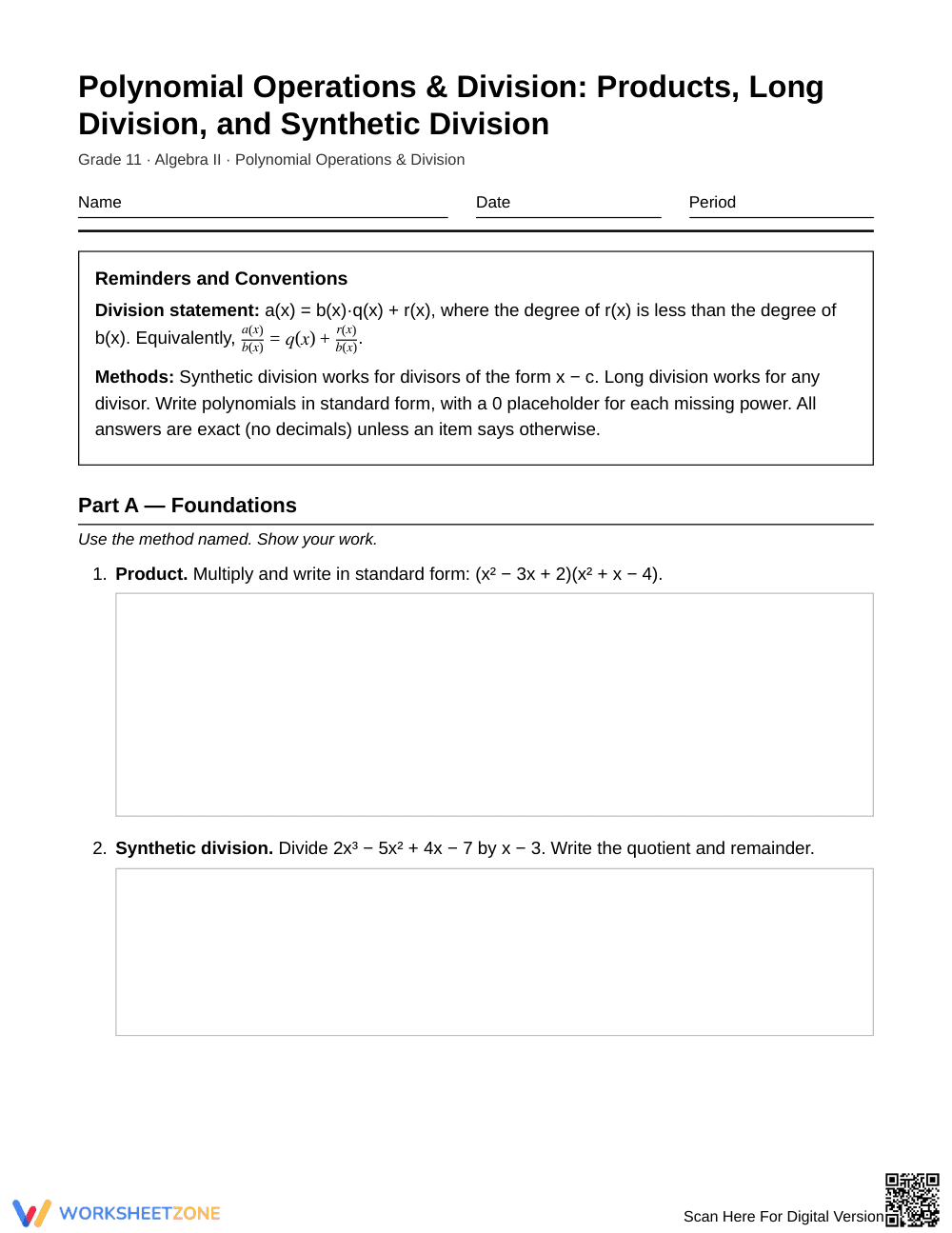
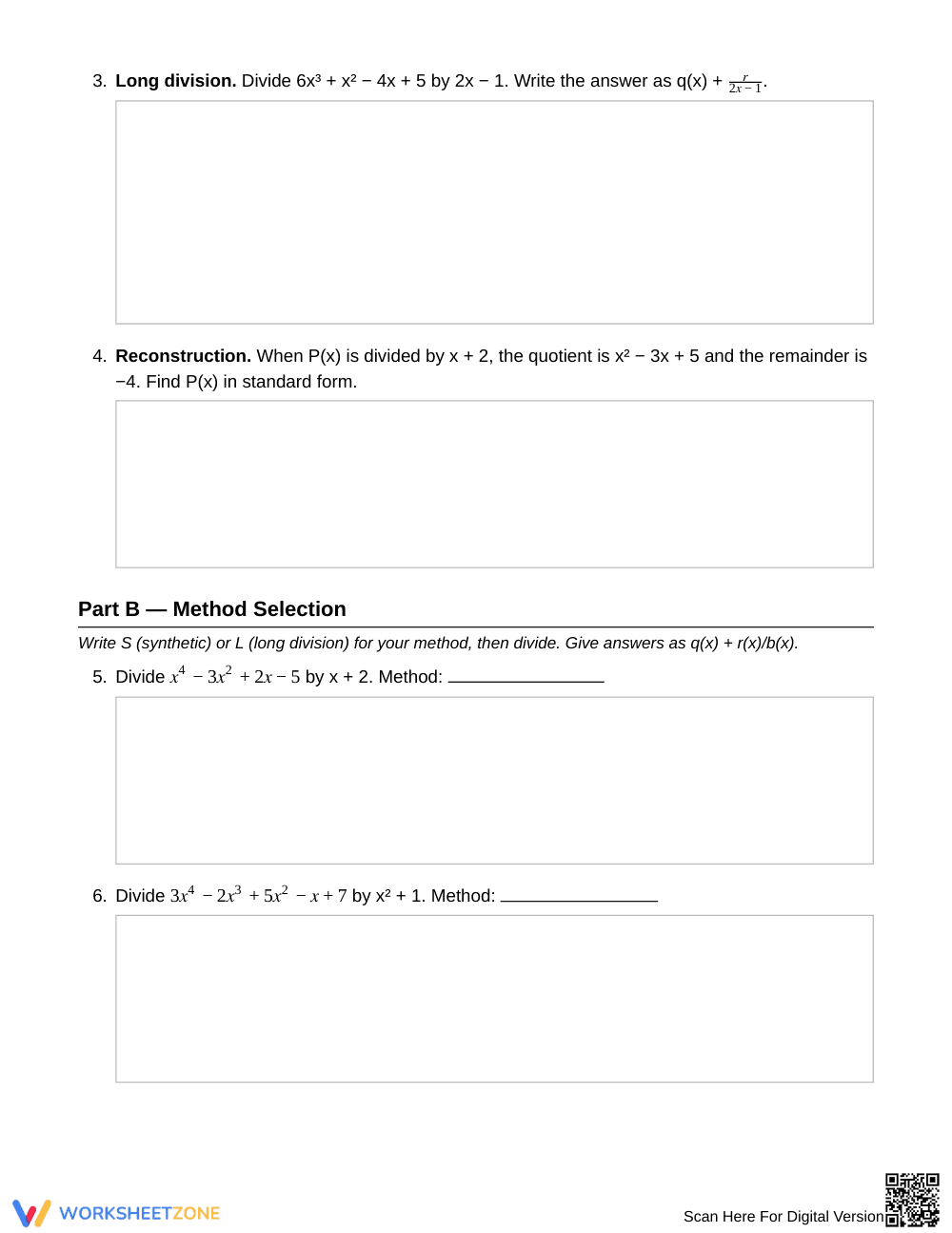
This worksheet builds Algebra II students' fluency in rewriting a polynomial quotient as q(x) + r(x)/b(x), choosing between long division and synthetic division, and connecting division back to multiplication. Students complete 16 tasks across three parts, from foundational methods to multi-step applications, and verify results by multiplying.
At a Glance
- Grade: 11 · Subject: Algebra II
- Standard:
HSA-APR.D.6— Rewrite a rational expression as a quotient plus remainder using division.- Skill Focus: Choosing and applying long and synthetic division
- Format: 5 pages · 16 problems · Answer key included · PDF
- Best For: Practice after polynomial division lessons
- Time: 40–50 minutes
What's Inside
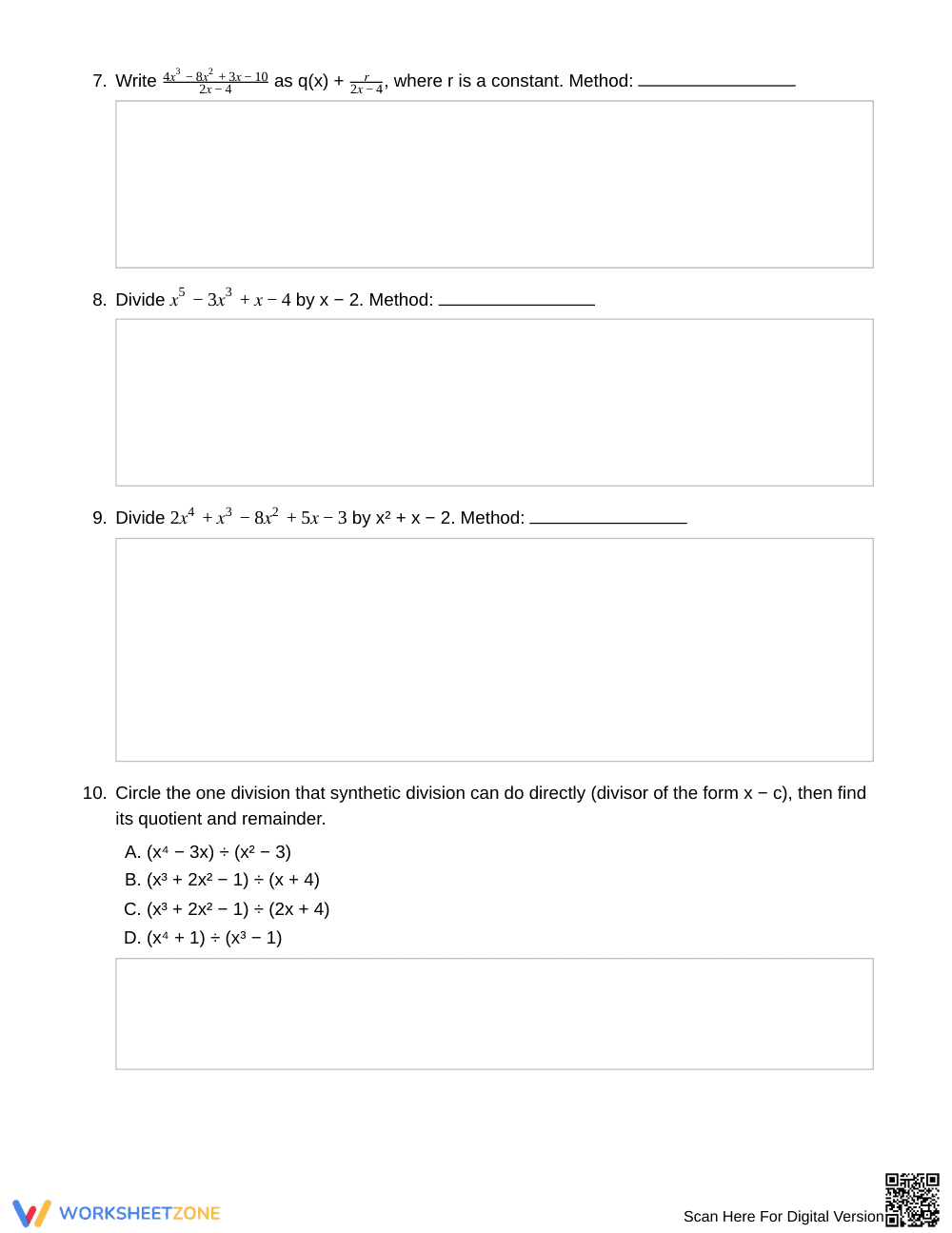
The 5-page PDF has three parts and 16 tasks. Part A covers a polynomial product, synthetic division, long division, and reconstructing a dividend. Part B asks students to label each division S or L, then solve it, and includes an error analysis. Part C has four applications: box volume, a cost model, a dividend reconstruction, and a missing coefficient. A reminders box states the division statement and the zero-placeholder convention. A 3-page answer key is included.
Skill Progression
- Guided practice: Part A, 4 tasks. Each names the method, and the reminders box supports the work.
- Supported practice: Part B, 8 tasks. Students choose synthetic or long division, identify which divisors fit x − c, and diagnose a flawed synthetic division.
- Independent practice: Part C, 4 multi-step tasks that combine products and division, with checks by multiplication or substitution.
The three parts follow a gradual-release model: I Do, We Do, You Do.
Standards Alignment
HSA-APR.D.6 — Rewrite simple rational expressions in different forms; write a(x)/b(x) in the form q(x) + r(x)/b(x), where the degree of r(x) is less than the degree of b(x), using inspection or long division. The standard code can be copied directly into lesson plans, IEP goals, or district curriculum mapping tools.
How to Use It
- After direct instruction: Assign Parts A and B as in-class practice. While students work, watch for missing zero placeholders and for synthetic division attempted on divisors that are not x − c.
- Review or homework: Assign Part C before a unit quiz, then use the answer key for self-checking.
Expect 40–50 minutes for the full worksheet, or about 20 minutes for Part A and Part B's first half.
Who It's For
Grade 11 Algebra II students working on polynomial operations and division. Struggling learners can complete Part A with the reminders box open, while stronger students can concentrate on Parts B and C. Pair it with a notes page on the division statement or a worked long division example.
HSA-APR.D.6 asks students to rewrite a rational expression a(x)/b(x) as q(x) + r(x)/b(x), where the degree of r(x) is less than the degree of b(x). This Grade 11 Algebra II worksheet practices that skill through 16 tasks across five pages: multiplying polynomials, long division, synthetic division, reconstructing a dividend from a quotient and remainder, and choosing the right method for each divisor. Students also analyze an error, solve for an unknown coefficient, and apply division to volume and cost models. Research on gradual release, described by Fisher & Frey (2014), supports moving learners from guided work to independent application, and this worksheet follows that sequence from foundations through method selection to integrated problems. A three-page answer key shows exact quotients and remainders, so teachers can quickly diagnose whether mistakes come from missing zero placeholders, wrong divisor form, or sign errors. It suits unit practice, review, and homework.


