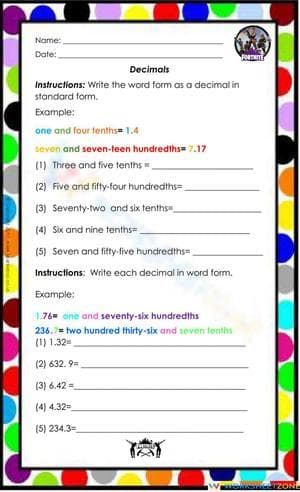
These decimal place value worksheets give teachers in grades 4 through 6 a structured set of print-ready practice pages covering every major concept in the base-ten decimal sequence — from naming tenths and hundredths to comparing and ordering decimals to the thousandths place. The pages work across the full instructional arc: direct instruction support, independent practice, and targeted intervention.
What Each Page Targets
The set is organized around four skill clusters that build on each other in a deliberate sequence. Within each cluster, problems increase in demand across the page, so a student who completes the front of a sheet has done easier problems before the harder ones — a simple but effective way to manage cognitive load during initial acquisition.
- Digit identification and position naming: Students underline a specified digit, name its place value position, and write its value as a fraction. Early problems use tenths only; later problems mix tenths, hundredths, and thousandths in the same number.
- Form conversion: Students rewrite numbers among standard, expanded, and word form. Writing 3.047 as 3 + 0.04 + 0.007 forces students to account for the zero in the hundredths place — a step they skip when working from memory alone.
- Comparing and ordering: Problems use inequality symbols and ordering tasks with sets of three to five decimals. Several pages include a blank place value chart in the workspace so students record digits column by column before making their comparison.
- Visual models: Shaded hundredths grids, number lines marked to the thousandths, and partially completed place value charts appear throughout. These are not decorative — they give students a concrete referent to return to when the purely numerical problems stall them.
Where Students Struggle Most
Three misconceptions show up reliably in student work on this topic, and these pages are structured to interrupt each one.
The most persistent error is treating the decimal portion as a whole number — students write that 0.19 is greater than 0.8 because 19 is larger than 8. The comparison pages address this directly by requiring students to align digits in a place value chart before marking an answer. When a student has to write the 1 in the tenths column and the 9 in the hundredths column, the column alignment makes it harder to hold onto the whole-number interpretation.
A second common slip involves trailing zeros. Students who have been told that "zeros at the end don't matter" in whole numbers carry that rule into decimals and decide that 0.5 and 0.50 are different numbers. The hundredths grid pages make this visible: shading 5 out of 10 columns and shading 50 out of 100 squares produce identical coverage, and students who see that image alongside the two notations usually let go of the confusion quickly.
The third trouble spot is the tens/tenths confusion. The symmetry of place value names around the ones place is not intuitive — students who can spell "thousandths" still write the number 4.3 with the 3 in the tens place on a dictation task. Several pages include a color-coded reference chart with the ones column highlighted at center. Pointing students back to that chart during independent work is faster than re-explaining the structure verbally every time.
How These Fit Into Classroom Routines
Most teachers in this collection reach for the single-skill half-pages as warm-ups during the opening five minutes of math — naming the place value of underlined digits, or writing one decimal in all three forms. That kind of low-stakes daily exposure, repeated across a two-week unit, builds the automaticity that later multi-step problems depend on.
The tiered full pages work well in station rotations. Print the tenths-only version for one group, the tenths-and-hundredths version for a second, and the thousandths version for a third. Because the page layout stays consistent across tiers, transitions are faster — students know where to find the workspace and what to do when they sit down, without needing a separate set of directions at each station.
The error-analysis pages serve a different purpose. Each one presents a completed student sample with three to five deliberate mistakes — wrong place value names, incorrect expanded form, a reversed comparison. Students mark the errors, write the correction, and explain what went wrong. These pages are particularly useful for students who blow through standard practice quickly and accurately but haven't actually processed why the procedures work. The explanation step slows them down in a productive way.
One classroom use that doesn't appear on the pages themselves but works well alongside them: pair a comparison worksheet with actual grocery receipts or sports box scores. A student who looks at a batting average of .305 and decides it's smaller than .29 because "305 has a zero in it" is holding a misconception that a worksheet row can fix — but the real-world context is what makes the correction feel worth caring about.
Grade-Level Placement and Standards Context
The pages span a three-year window because the underlying skill develops across that window, not in a single grade. In fourth grade, the work concentrates on tenths and hundredths, which is where most students first encounter decimal notation in a formal sense. Fifth grade is where the demands sharpen: CCSS 5.NBT.A.1 requires students to recognize that a digit in one place represents ten times the value of the same digit one place to its right — a multiplicative relationship, not just a naming task. CCSS 5.NBT.A.3 adds reading, writing, and comparing decimals to thousandths in all three forms. The form-conversion and comparison pages in this set align directly to those two standards and are designed to be usable as practice during instruction or as independent review before unit assessments. By sixth grade, decimal place value fluency is assumed rather than taught — it becomes infrastructure for ratio, rate, and percentage work — so the sixth-grade pages here are primarily useful for closing gaps rather than introducing new content.
Scaling for Different Learners
Students who need concrete support before the worksheets make sense benefit from working through the shaded-grid pages alongside base-ten blocks or coin sets before moving to pages with only numerals. The grid pages are designed with that bridge in mind — the shading gives students something to count and point to, and the numerical notation appears beside it rather than replacing it.
For students ready for more, the thousandths pages include multi-step ordering tasks and a handful of problems that embed decimal comparison inside a real-world context (distance times, measurement records, price-per-unit comparisons). Those problems are genuinely harder than the single-operation rows above them, and they tend to be the ones that show up in a teacher's formative data as separating students who have procedural fluency from students who also have conceptual flexibility.
Frequently Asked Questions
1. How do I explain the difference between the tens place and the tenths place to a student who keeps mixing them up?
The color-coded reference chart in the set is the fastest fix — put the ones column in a distinct color and show that "tens" is one step left while "tenths" is one step right. The names mirror each other across the ones place, and making that visual explicit usually resolves the confusion faster than a verbal explanation alone. If a student is still mixing them up after seeing the chart, try having them say the place name and physically point left or right before writing anything.
2. Are these pages appropriate for intervention with older students who have gaps?
Yes, and the clean, uncluttered layout helps here. Older students who are working below grade level often resist materials that look too young. These pages don't use cartoon graphics or primary-grade visual framing — they read like math practice, which makes them easier to use with a sixth or seventh grader who needs to rebuild foundational understanding without the social cost of obviously remedial materials.
3. What's the best way to use these as formative assessment?
The form-conversion pages work well as quick mid-unit checks. Collect them, then sort into three stacks: students who handled all three forms correctly, students who got standard and word form but struggled with expanded, and students who made errors across the board. That sorting process takes about ten minutes and gives you clear groupings for the next day's instruction without a formal quiz.