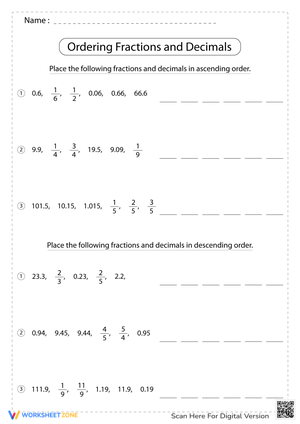
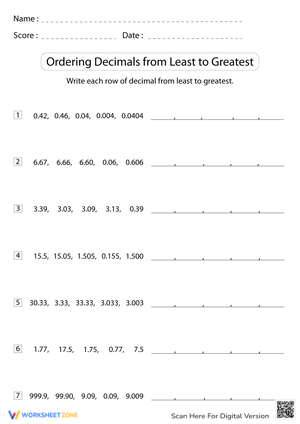
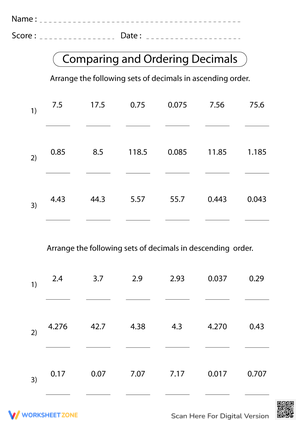
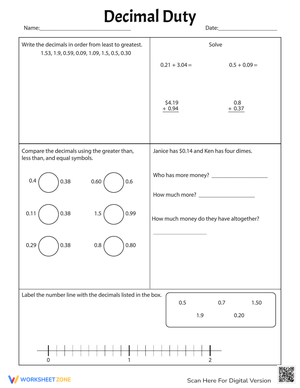
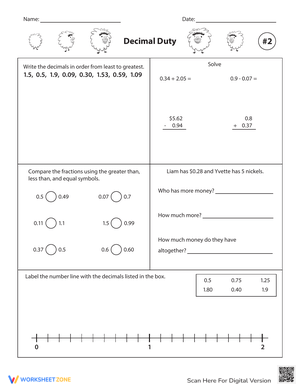
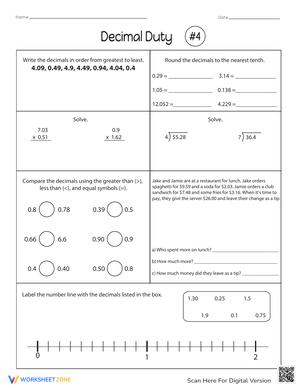
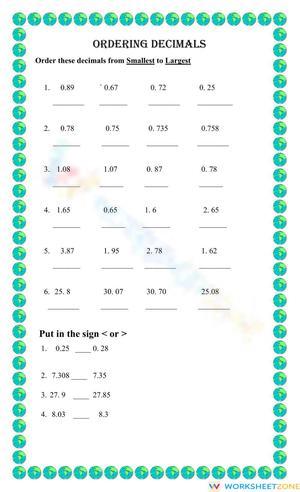
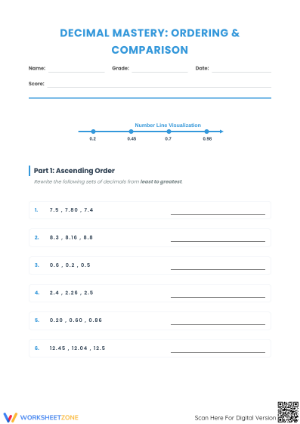
These ordering decimals worksheets give teachers in grades 4 through 6 a structured set of pages for targeting one of the trickiest number-sense gaps in upper elementary math: understanding that decimal magnitude depends on place value, not digit count. The collection is tiered by complexity, includes answer keys, and covers everything from single-place tenths to mixed thousandths problems designed to surface the misconceptions that whole-number thinking produces.
The Misconception These Pages Are Built Around
Most ordering errors in student work trace back to the same source. A student who writes 0.45 > 0.5 is not making a careless mistake — they are applying a rule that works perfectly well for whole numbers and fails completely for decimals. Forty-five is larger than five, so 0.45 must be larger than 0.5. That reasoning is internally consistent and completely wrong, and it does not go away through explanation alone. It goes away through repeated practice with problems that force the comparison — specifically, problems that mix decimal lengths within a single ordering set.
One procedural fix that transfers well is zero annexation: rewriting 0.5, 0.45, and 0.375 as 0.500, 0.450, and 0.375 before ordering. When all the decimals share the same number of places, digit-by-digit comparison from left to right works exactly as it does with whole numbers. Several pages in this set include a dedicated column where students write the annexed form first, which builds the habit as a procedure rather than leaving it as a strategy students have to remember to reach for.
Concepts Covered Across the Set
The worksheets are organized into four tiers, each targeting a distinct level of decimal complexity:
- Tenths only: Students order sets of single-place decimals, establishing basic familiarity with magnitude before place-value demands increase. This tier is appropriate for late 4th grade students encountering the concept for the first time.
- Hundredths: Problems introduce two-place values, asking students to distinguish between, for example, 0.30, 0.34, and 0.43 — a comparison that rewards attention to the tenths digit before the hundredths digit is even relevant.
- Thousandths: Three-place decimals aligned with the expectations in CCSS 5.NBT.3, which asks students to compare decimals based on the meaning of each digit's position relative to the decimal point.
- Mixed decimal lengths: Sets that combine tenths, hundredths, and thousandths in a single ordering task. This is where the whole-number misconception gets the most direct pressure, and where diagnostic information about student understanding is richest.
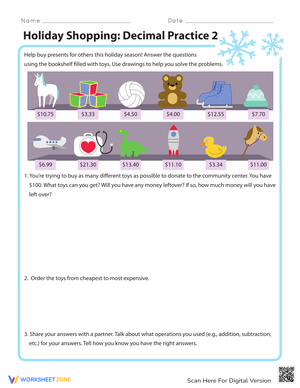
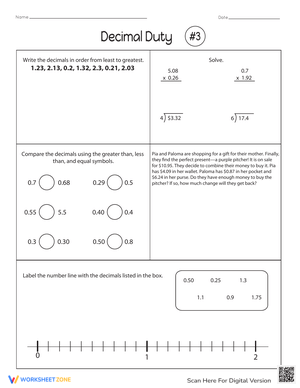
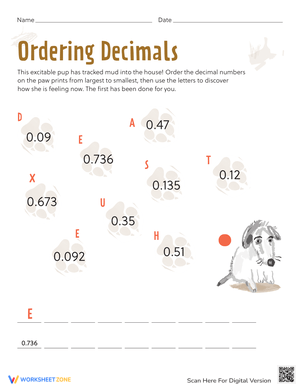
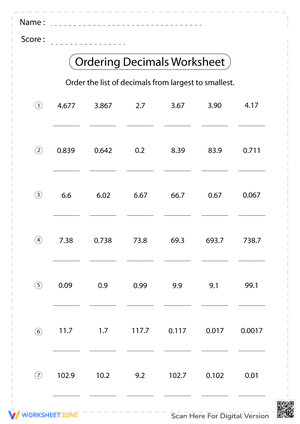
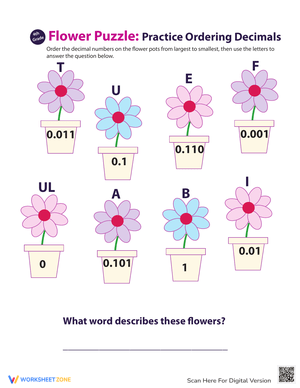
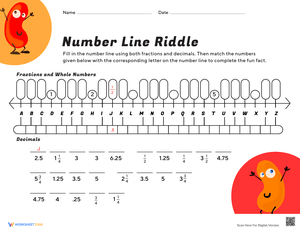
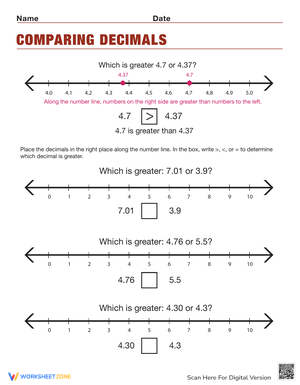
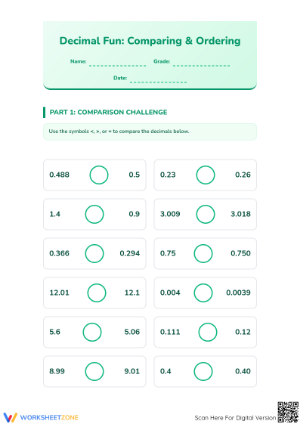
Each sheet asks students to arrange 4 to 8 decimals from least to greatest or greatest to least. Some pages include a number line scaffold for students who still need a visual anchor for magnitude. Real-world contexts — race times measured to the thousandth of a second, prices compared at a school store, measurement data from a science scenario — appear across several sheets to give the ordering task a concrete frame.
Where These Fit in the Instructional Day
A single mixed-length sheet works well as a formative exit ticket at the end of a place-value lesson. Five minutes, four to six decimals to order, answer key already printed — it gives a fast read on who is ready to move forward and who is still annexing zeros inconsistently or reversing the direction of their ordering. That information shapes the next day's small-group pullout without requiring a separate assessment.
For warm-up use, projecting one ordering problem before the lesson begins and having students record their answer and reasoning in a math journal creates a low-stakes entry point into place-value thinking. The discussion afterward — particularly when two students get different answers — surfaces the whole-number reasoning error in a way that whole-class instruction rarely does on its own.
The tiered structure makes differentiated small-group work straightforward. One group stays on hundredths while another works through mixed-length problems; both groups are doing legitimate grade-level practice, just at different points in the progression. Students on the tenths pages are not doing remedial busywork — they are building the place-value foundation the harder sheets require.
Why Ordering Comes Before Operating
Ordering decimals occupies a specific instructional position: it belongs after students can read and write decimal notation, and before they begin addition and subtraction of decimals with regrouping. The reason is straightforward. A student who cannot judge whether 0.7 or 0.63 is larger will have no reliable way to estimate whether their computed answer is reasonable. Ordering is the skill that gives magnitude intuition its structure.
The connection to benchmark decimals matters here. When students encounter 0.25, 0.5, and 0.75 repeatedly in ordering tasks, they internalize those values as reference points — the decimal equivalents of the fraction benchmarks they already know. That internalization transfers directly to rounding and estimation work later in the year. Ordering practice is doing double duty: building comparison fluency and populating the mental number line that makes later estimation reliable.
Standards Aligned
The core standard these worksheets address is CCSS 5.NBT.3b, which asks students to compare two decimals to thousandths based on the meaning of the digits in each place, using <, =, and > symbols. Ordering a set of decimals is the natural extension of that paired comparison — students apply the same place-value logic across multiple values rather than just two. The hundredths-level pages also connect to 4.NF.7, which introduces decimal comparison in the context of fractions, making these sheets appropriate for late-4th-grade instruction when the concept first appears.
Frequently Asked Questions
1. At what grade should students be ordering decimals to thousandths?
Fifth grade is when thousandths ordering appears as an explicit standard expectation under CCSS 5.NBT.3. Fourth graders typically work to hundredths, which aligns with 4.NF.7. The tiered structure of these worksheets lets teachers assign by readiness rather than strictly by grade — some 4th graders are ready for hundredths work early in the year, and some 5th graders need consolidation at the hundredths level before thousandths problems are productive.
2. How do I help a student who keeps putting the largest decimal first when asked for least to greatest?
Direction reversal is the second most common ordering error after the whole-number misconception, and it often coexists with correct magnitude reasoning — the student understands which decimals are larger and smaller but misreads the instruction. A quick fix is to have the student underline the words "least to greatest" or "greatest to least" before starting each problem set and draw a small arrow in the margin indicating the direction. It sounds mechanical because it is, and that's appropriate: the student's place-value reasoning may be sound; they just need a habit that prevents the directional slip.
3. Do these sheets work for intervention with older students who missed this concept?
Yes, and the tiered structure is especially useful in that context. A 6th or 7th grader working on decimal operations who still has the whole-number misconception can work through the tenths and hundredths pages without the format feeling childish — the problems themselves are mathematically substantive regardless of grade level. The mixed-length tier gives a quick diagnostic of whether the annexation strategy has transferred to independent use.