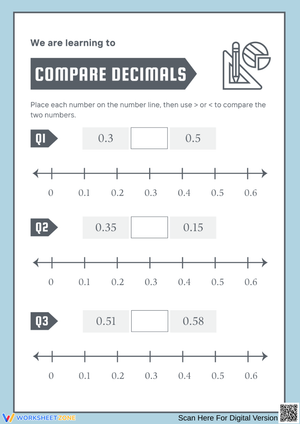
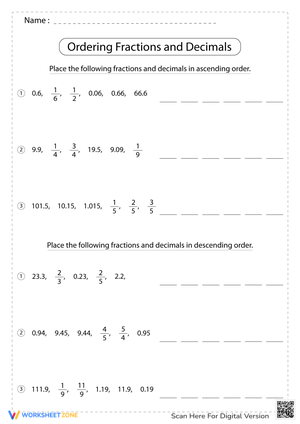
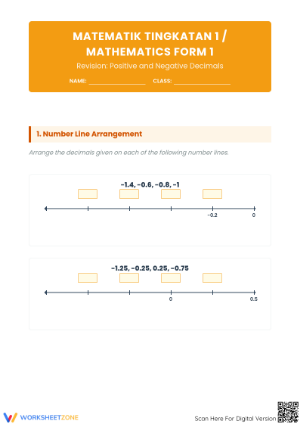
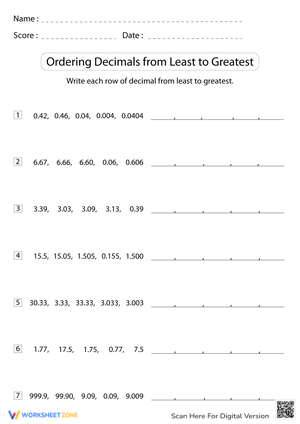
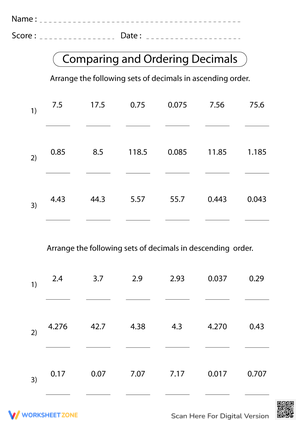
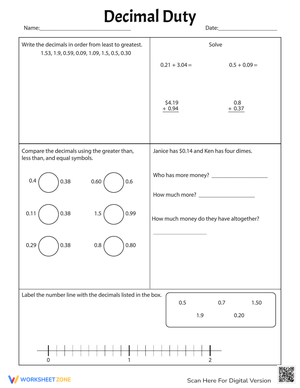
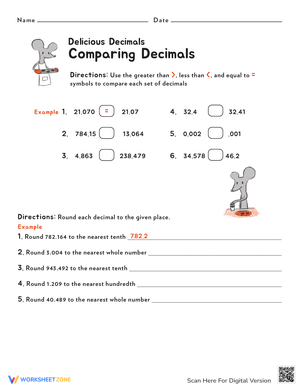
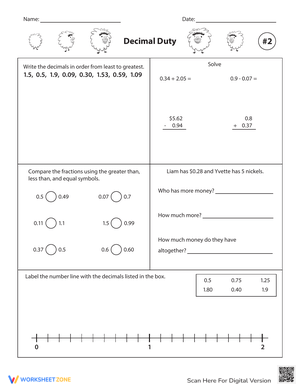
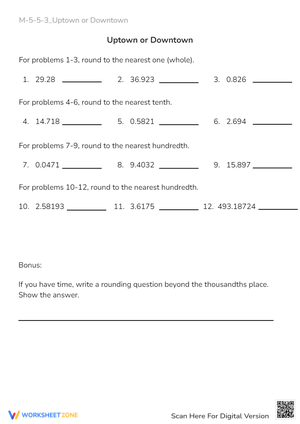
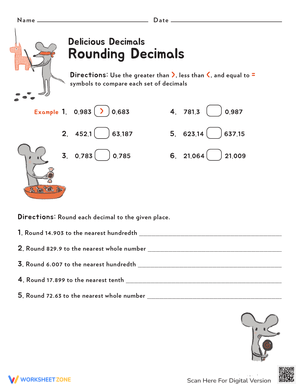
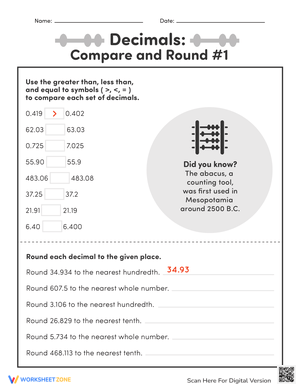
These comparing decimals worksheets give 4th and 5th grade teachers a structured set of print-ready pages for one of the trickiest conceptual moves in the decimal unit — getting students to stop thinking like whole-number counters and start reasoning about place value. The set covers tenths through thousandths and runs from visual model work to symbol practice to applied word problems.
What the Standards Actually Ask at Each Grade
The jump between 4th and 5th grade expectations here is steeper than it looks on a pacing guide. In 4th grade, 4.NF.C.7 places decimal comparison inside the fractions domain — students are really reasoning about 0.4 as four-tenths and 0.75 as seventy-five hundredths, which is why visual models carry so much weight at that level. By 5th grade, 5.NBT.A.3.b relocates the skill to base-ten operations, and students are expected to extend comparisons to thousandths using place-value structure alone, without leaning on fraction language. That shift in framing changes which errors matter most and which worksheet formats do the most work.
Concepts Covered Across the Pages
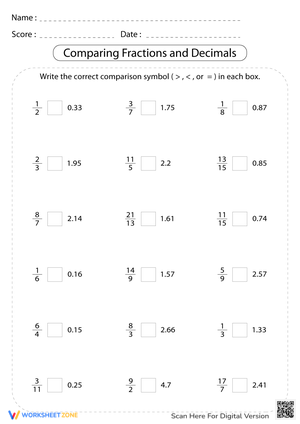
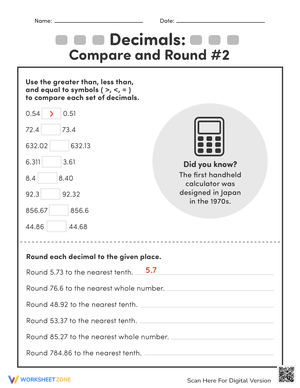
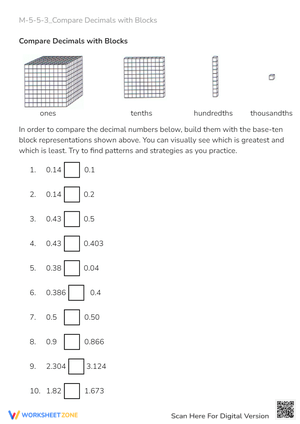
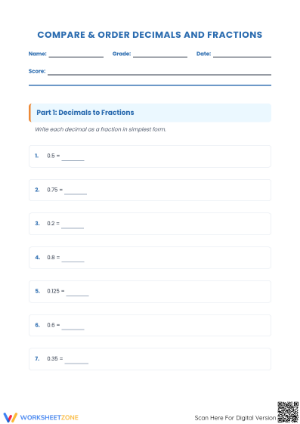
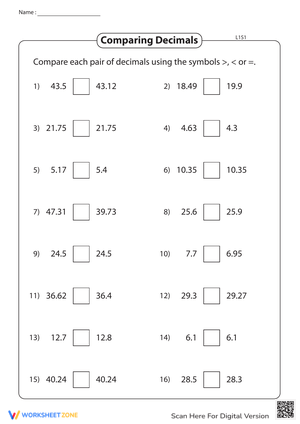
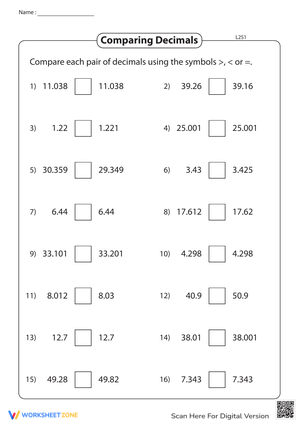
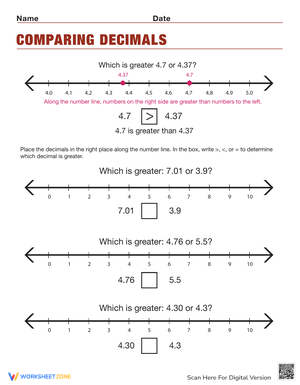
The worksheets move across four interconnected areas. Place-value alignment comes first — students learn to compare digit by digit, left to right, rather than looking at the decimal as a whole number. Symbol fluency with <, >, and = follows, with enough repetition that students stop second-guessing which symbol points which direction. Visual model pages use hundredths grids and open number lines to anchor magnitude before abstract comparisons begin. The pages that cause the most productive struggle are the ones that mix tenths, hundredths, and thousandths in the same problem set, forcing students to confront equivalent representations — 0.7, 0.70, and 0.700 — rather than just counting digits.
Where Students Consistently Go Wrong
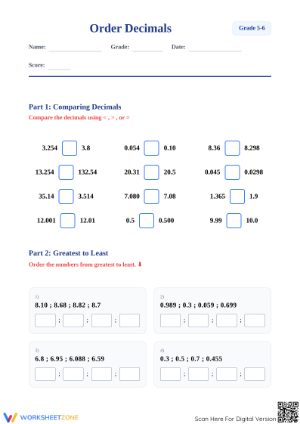
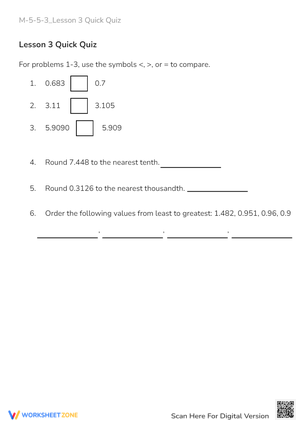
The dominant error in student work is whole-number interference: the intuition that more digits equals a larger number. A student who has correctly learned that 345 > 4 will confidently write 0.345 > 0.4 for exactly the same reason, and the logic feels airtight to them. Marking it wrong without addressing the underlying reasoning just produces confusion. These worksheets include problems that make this exact comparison — pairing a three-place decimal against a one-place decimal — and ask students to rewrite both values to the same number of decimal places before placing a symbol. Once a student writes 0.400 next to 0.345, the comparison is self-evident, and they tend to remember the rewriting step afterward.
A second pattern shows up less often but is worth watching: students who correctly compare 0.6 and 0.58 will sometimes reverse when the same values appear in a word problem about race times, because "faster" and "larger number" conflict. A runner who finishes in 9.6 seconds is slower than one who finishes in 9.58 seconds, which requires holding the comparison and then flipping its meaning. A few applied problems on these pages specifically test that reasoning.
The Progression From Concrete to Abstract
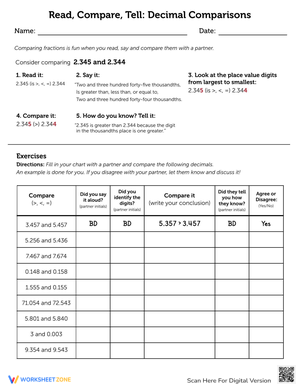
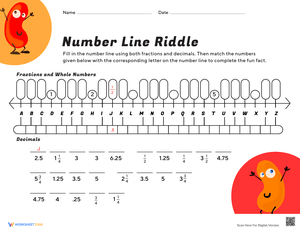
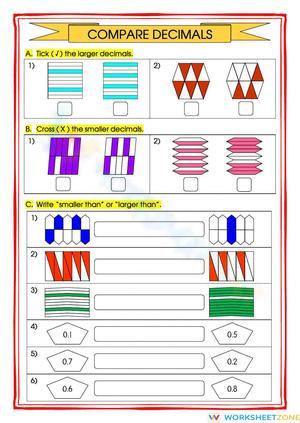
Worksheet sets that skip straight to symbol practice ask students to retrieve a procedure they haven't fully built yet. The pages here follow a gradual-release sequence: visual model pages first, where students shade grids or mark number lines and then circle the larger value; guided pages next, where place-value charts are pre-drawn and students fill in columns before deciding; then open symbol practice with no scaffolding; and finally word problems involving measurement, money, and data. Teachers who assign these in order over three or four sessions rather than as a single packet see fewer procedural errors on the symbol-only pages because students have internalized the magnitude reasoning that makes the procedure sensible.
Where These Pages Fit in the Week
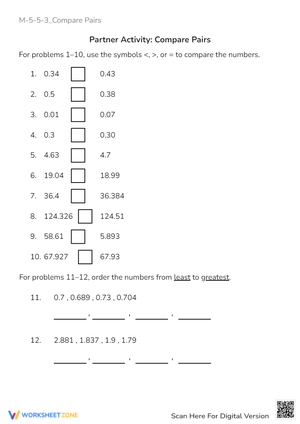
The half-page comparison strips work well as Monday warm-ups after a weekend — short enough to complete in the first six minutes of class, predictable enough that students settle in without friction. The scaffolded place-value chart pages are designed for the initial lesson days when students are still building the procedure. The mixed-length comparison pages (tenths alongside thousandths) belong in the practice block two or three sessions in, once the basic column-by-column strategy is running. Exit ticket strips — three problems, printed four per sheet — give a quick read on who is ready to move toward ordering and rounding and who needs another day on head-to-head comparisons.
For station work, the visual model pages, symbol pages, and word problem pages separate cleanly into three stations with distinct formats, which reduces management overhead during rotations.
Adjusting the Work for Different Learners
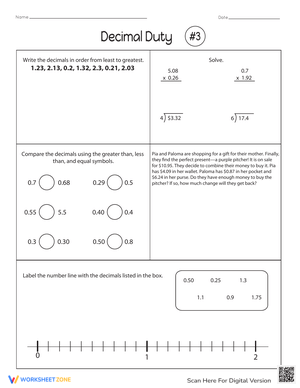
Students who are still shaky on tenths and hundredths should not be pushed to thousandths comparisons prematurely — the place-value chart pages let teachers assign only the tenths-and-hundredths columns until those are solid. For students who finish the symbol pages quickly, the word problems involving race times and measurement data provide extension without just adding more of the same problem type. Students who freeze in front of a blank comparison problem often do better starting on the number line pages, where position gives them a visual check against their written answer. The money connection — asking whether $0.75 or $0.8 is more — tends to unlock students who are stuck, because the dollar context gives them a real-world anchor they already trust.
Frequently Asked Questions
1. At which grade should I introduce comparing decimals?
Standard 4.NF.C.7 places this in 4th grade, starting with tenths and hundredths. The entry point matters: 4th graders approach decimals through the fraction lens, so the hundredths grid is doing real conceptual work there, not just illustration. Fifth grade extends to thousandths under 5.NBT.A.3.b, where place-value structure carries the comparison rather than visual models.
2. Should I require students to show work, or is circling the answer sufficient?
Circling alone hides the reasoning. A brief written note — "hundredths digit: 5 > 3, so 0.75 > 0.43" — takes ten seconds and immediately reveals whether the student is applying column-by-column logic or guessing. It also gives you something specific to address during a quick conference rather than just marking a problem wrong.
3. How do I handle students who add trailing zeros correctly but still compare incorrectly?
This usually means the student is adding the zeros as a mechanical step without understanding why. Go back to the grid: shade 0.70 on one hundredths grid and 0.58 on another, and ask which shaded region is larger. The visual answer is immediate, and it reconnects the procedure to the underlying magnitude. After that, most students understand what the trailing zero is actually doing.