


























Views
Downloads

Essential Worksheet: Positive & Negative Decimals (Grade 8+)
Paste this activity's link or code into your existing LMS (Google Classroom, Canvas, Teams, Schoology, Moodle, etc.).
Students can open and work on the activity right away, with no student login required.
You'll still be able to track student progress and results from your teacher account.
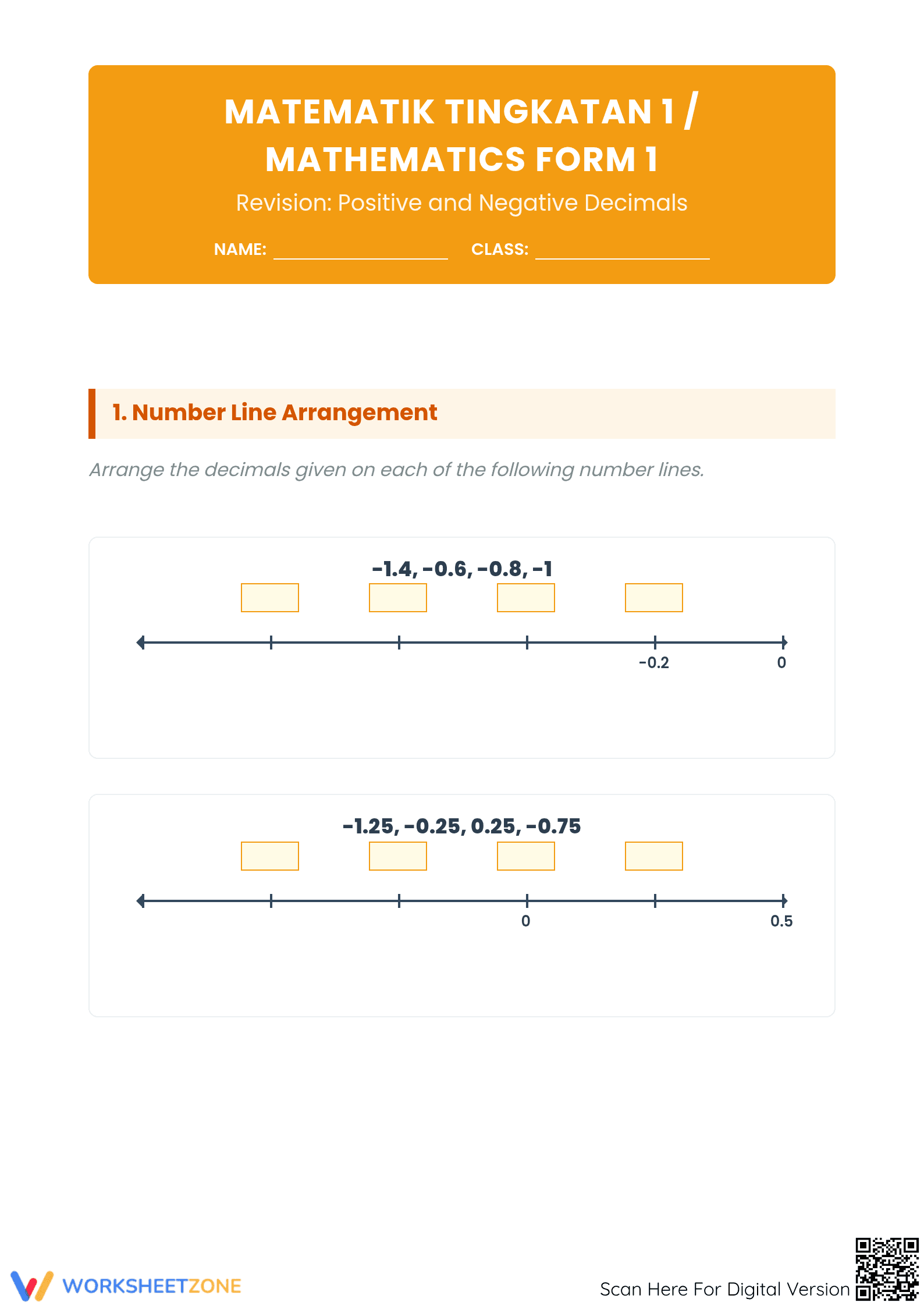
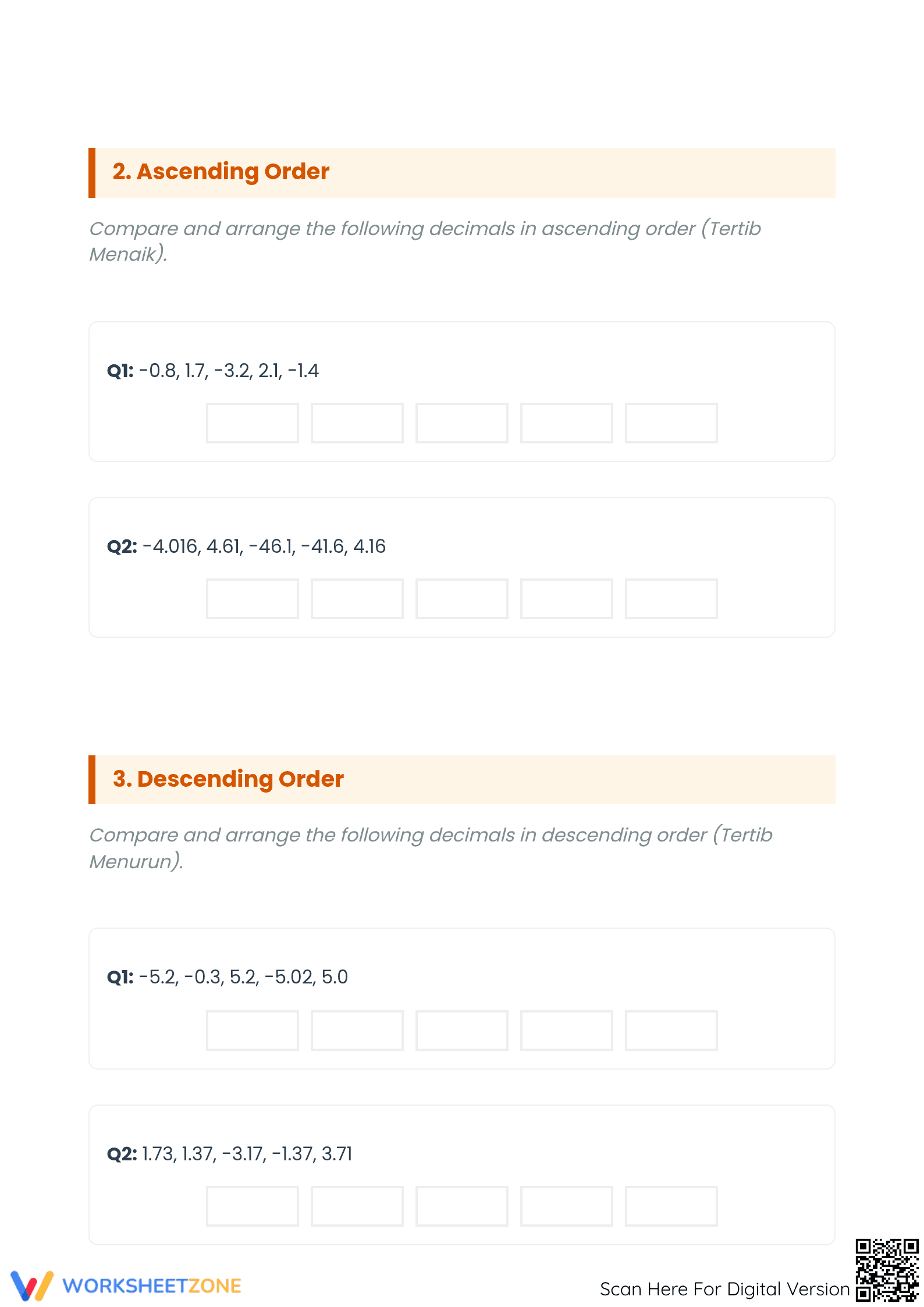
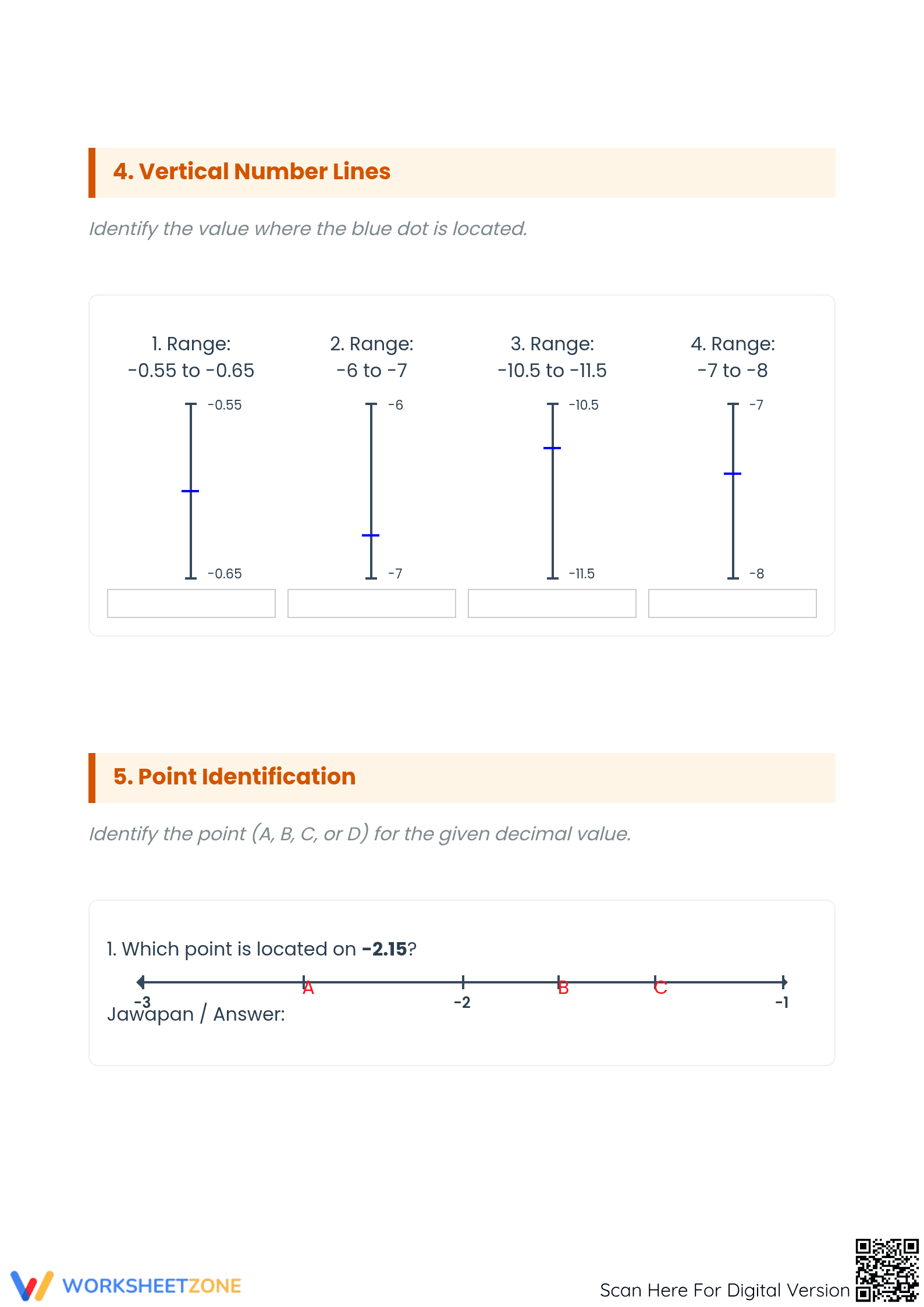
This comprehensive worksheet provides students in Grade 8 and above with intensive practice in comparing and ordering positive and negative decimals. By engaging with multiple problem types, learners develop a robust understanding of number line placement and absolute value. Students will successfully master the identification of value relationships across three detailed pages of focused mathematical exercises.
At a Glance
- Grade: 8-12 · Subject: Math
- Standard:
CCSS.MATH.CONTENT.6.NS.C.7— Understand ordering and absolute value of rational numbers including positive and negative decimals.- Skill Focus: Comparing and ordering decimals
- Format: 3 pages · 36 problems · Answer key included · PDF
- Best For: Middle and high school math reinforcement
- Time: 25–35 minutes
The resource features three pages of systematically organized tasks designed to build numerical fluency. Page one focuses on comparison operators (greater than, less than, equal to) for pairs of decimals. Page two introduces ordering sets of four or more decimals in ascending and descending sequences. The final page provides mixed practice with varying decimal places. A full answer key is provided for immediate grading.
Skill Progression
- Guided practice: The initial section provides clear examples of decimal comparison on a number line, reducing cognitive load as students begin.
- Supported practice: Students then move to independent comparison of decimal pairs without visual aids, reinforcing place value logic.
- Independent practice: The final section requires students to order complex lists of positive and negative values, ensuring full mastery of the concept.
This structured approach follows the Gradual Release of Responsibility model, moving from I Do to You Do to ensure student confidence.
Standards Alignment
This resource is aligned with `CCSS.MATH.CONTENT.6.NS.C.7`, which requires students to understand ordering and absolute value of rational numbers. Specifically, it addresses sub-standard 6.NS.C.7.A: Interpret statements of inequality as statements about the relative position of two numbers on a number line diagram. Both standard codes can be copied directly into lesson plans, IEP goals, or district curriculum mapping tools.
How to Use It
Deploy this worksheet as a summative assessment after a unit on rational numbers to gauge student proficiency in decimal placement. Alternatively, use it during small-group instruction for students requiring additional scaffolding with negative value concepts. While students work, observe their treatment of zero as a placeholder; a common error is assuming more digits implies a larger negative value. Expected completion is 30 minutes.
Who It's For
This practice set is ideal for Grade 8-12 students who need to solidify their understanding of the number system before advancing to algebraic expressions. It is particularly useful for students in Algebra 1 or Pre-Algebra who struggle with negative number operations. The clear layout and incremental difficulty allow for easy differentiation, paired effectively with an interactive number line or anchor chart.
According to the RAND AIRS 2024 report on mathematical fluency, the ability to accurately compare and order rational numbers, specifically positive and negative decimals, is a critical predictor of success in higher-level algebraic reasoning. Mastery of standard `CCSS.MATH.CONTENT.6.NS.C.7` ensures that students can visualize the relative positions of values on a number line, a fundamental skill required for solving multi-step inequalities and coordinate geometry problems. This worksheet addresses this need by providing 36 distinct tasks that transition from simple comparisons to complex ordering sequences. Research by Fisher & Frey (2014) highlights that such targeted, repetitive practice with immediate feedback—provided here via the included answer key—significantly improves long-term retention of number system concepts. By isolating decimal place value and sign orientation, this resource allows teachers to identify specific misconceptions early, preventing the compounding of errors in secondary mathematics curricula.


