Where inverse functions fit in your Algebra 2 sequence
If you're teaching inverse functions in Algebra 2 or Pre-Calculus, the practice students need is narrow and specific: find an inverse algebraically, verify it, and read it off a graph or table. Inverse functions worksheets give you a fast way to check each of those skills separately instead of hoping one mixed problem set covers everything. The trouble with most practice pages is that they blur the swap-and-solve method together with composition checks, so a student who never mastered step one still limps through the sheet without you noticing where the gap is.
What standard covers inverse functions in high school?
The anchor standard is CCSS.Math.Content.HSF.BF.B.4: solve f(x)=c for a simple invertible function and write an expression for the inverse. It sits in the Build new functions from existing functions cluster of the High School Functions domain. The non-plus expectation is F-BF.B.4a, which every Algebra 2 student is responsible for. The three plus sub-standards push further: 4b verifies inverses by composition, 4c reads inverse values from a graph or table, and 4d restricts a domain so a non-invertible function becomes invertible. F-BF.B.5 then extends the same inverse relationship to exponents and logarithms, which is why this unit usually lands right before your log work.
Here's the sequencing detail most pacing guides skip: 4a is a solving skill, but 4b through 4d are reasoning skills, and students who ace the algebra often stall on the reasoning. When you build a worksheet, separate the find-it problems from the prove-it and read-it problems on the page itself. That one formatting choice tells you at a glance whether a struggling student has an algebra gap or a concept gap, and it changes whether you reteach solving or reteach what an inverse actually means.
Sequence the practice: solve first, verify second, read graphs last
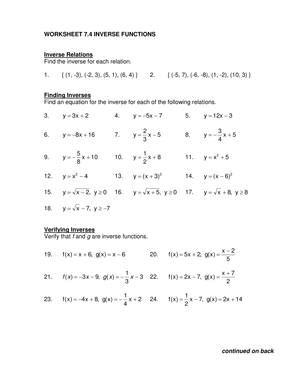
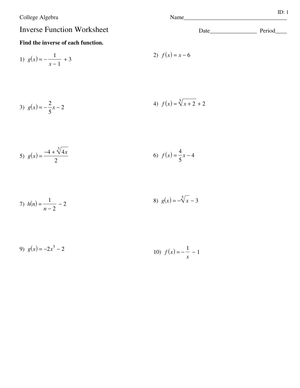
Start with pure swap-and-solve worksheets tied to F-BF.B.4a. Students rewrite f(x) as y, swap x and y, and solve for y. Keep the first set to linear and simple rational forms like f(x)=(x+1)/(x-1) before adding cubics such as f(x)=2x^3. Once the mechanics are automatic, move to composition worksheets where students show that f(g(x))=x and g(f(x))=x both hold. Only after that should you hand out graph-and-table sheets, because reading an inverse as a reflection over the line y=x makes far more sense once students have already produced inverses by hand. Rushing to graphs first usually produces students who can point at a reflection but can't generate an inverse on a blank test.
Reading inverses from a graph or table
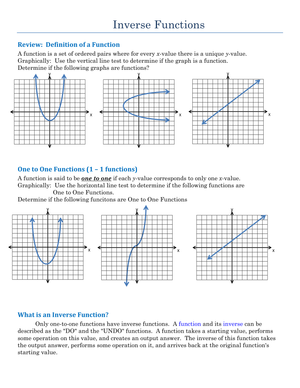
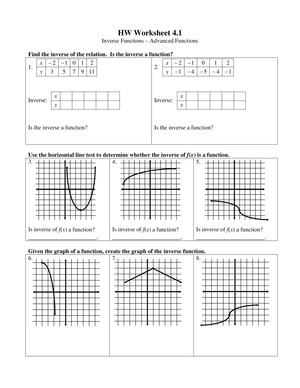
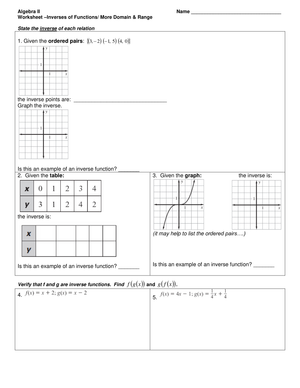
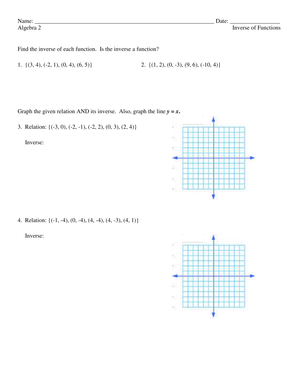
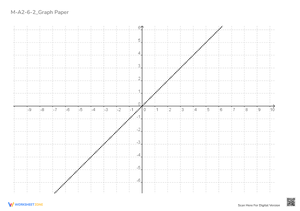
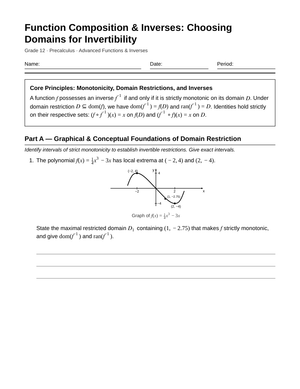
The graphical method deserves its own short worksheet. Reflecting a function's graph over the line y=x produces the inverse, and asking students to read a specific inverse value from a graph or table is exactly the task F-BF.B.4c names. This strand is where you catch the students who memorized swap-and-solve without understanding what the result represents.
According to the Common Core State Standards Initiative, standard F-BF.B.4c asks students to read values of an inverse function from a graph or a table, given that the function has an inverse. It is 1 of the 4 sub-standards under F-BF.B.4, and only this graphical strand isolates whether students picture an inverse as a reflection across y=x rather than a memorized formula trick.
Verifying inverses by composition
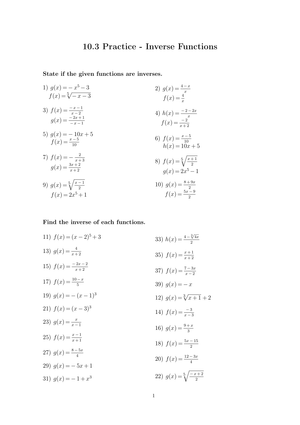
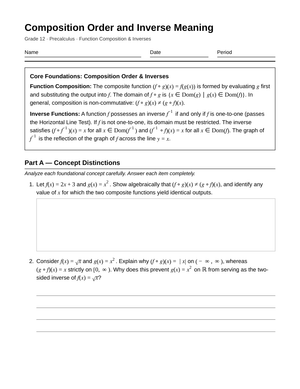
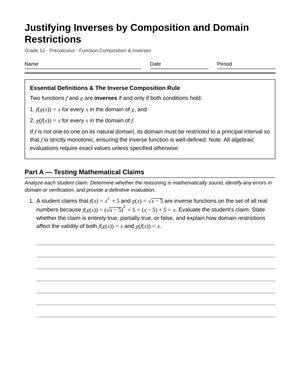
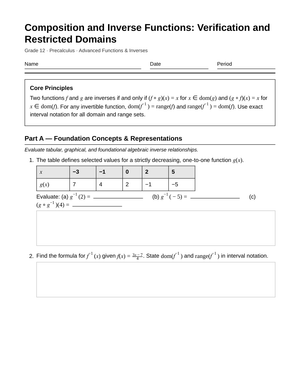
Composition is the proof step, and it's where honors sections separate from grade-level groups. A verification worksheet asks students to compute f(g(x)) and g(f(x)) and confirm both simplify to x. Two habits are worth grading for here. First, students should show both compositions, not just one, because a single check can hide a domain problem. Second, they should state the result in a sentence, not just circle x. When a student writes that the two compositions return the input, you know the concept landed. Keep these problems close to the swap-and-solve set so students can verify inverses they just found, which reinforces both skills at once instead of treating verification as an unrelated exercise.
Using these worksheets in Algebra 2 lessons
Use the swap-and-solve worksheet as a five-minute warm-up formative check before you advance to composition. Collect it, sort the papers into two piles, and you have your next-day intervention group without a separate assessment. For the composition and graph sheets, station rotations work well: one station finds inverses, one verifies by composition, and one reads inverse values off graphs, so every student touches all three strands in a single period.
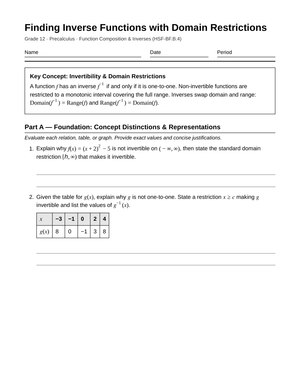
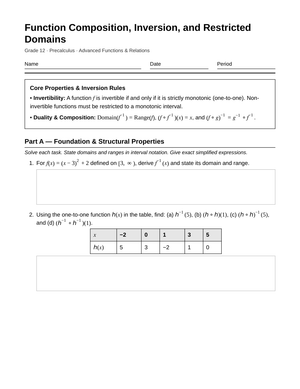
For advanced or honors sections, add F-BF.B.4d restricted-domain problems, where students take something like f(x)=x^2 and restrict the domain to x greater than or equal to 0 so an inverse exists. These problems make excellent exit tickets because they force students to explain why the restriction is needed, not just perform a procedure. Save a few for the day you bridge into logarithms under F-BF.B.5, since the exponential and log pair is the most familiar inverse relationship students will meet next.
Frequently asked questions
1. What CCSS standard covers inverse functions in high school?
F-BF.B.4 is the anchor. F-BF.B.4a is the non-plus expectation for all Algebra 2 students, while 4b, 4c, and 4d are plus sub-standards for composition, graph and table reading, and domain restriction.
2. How do inverse function worksheets differ for Algebra 2 versus Pre-Calculus?
Algebra 2 sets center on F-BF.B.4a swap-and-solve with linear, rational, and simple cubic functions. Pre-Calculus sets lean harder on the plus standards: composition proofs, restricted domains, and reading inverses from graphs and tables.
3. What's the best order to teach finding inverses versus verifying by composition?
Teach finding first. Students should be automatic at swap-and-solve before they verify, so composition reinforces a skill they already own instead of piling two new ideas on top of each other.
4. How can teachers use these worksheets for intervention or reteaching?
Sort a quick swap-and-solve check into two piles to form your reteaching group, then use paired problems that contrast inverses with reciprocals and flag missing domain restrictions, the two most common errors.
5. Do inverse function worksheets need a graphing component?
Yes. Reading an inverse from a graph or table is its own standard, F-BF.B.4c, and reflection over y=x is the fastest way to check whether students understand inverses conceptually rather than mechanically.