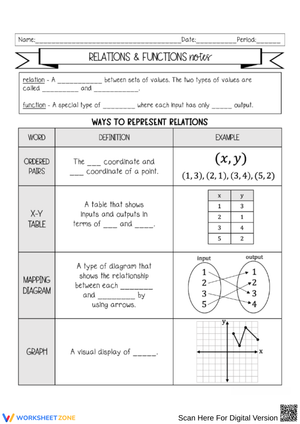
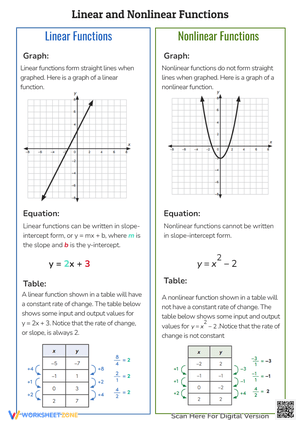
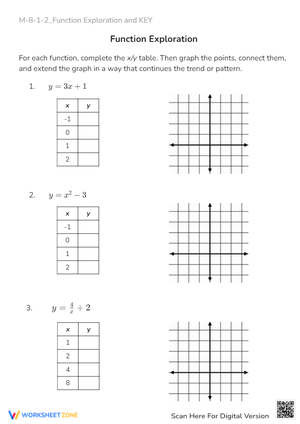
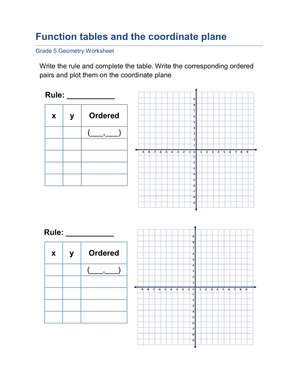
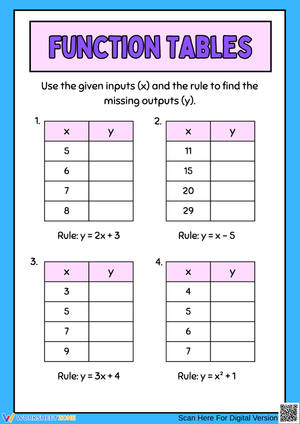
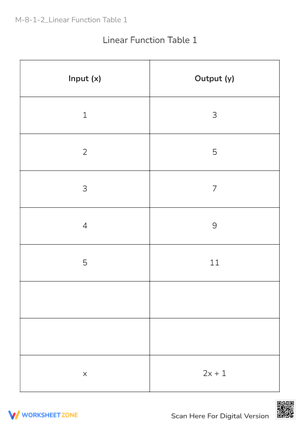
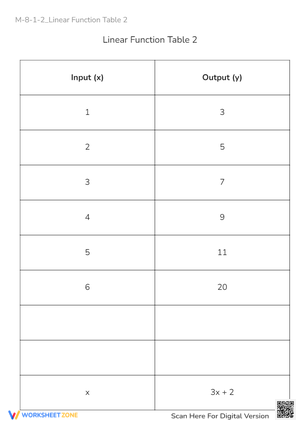
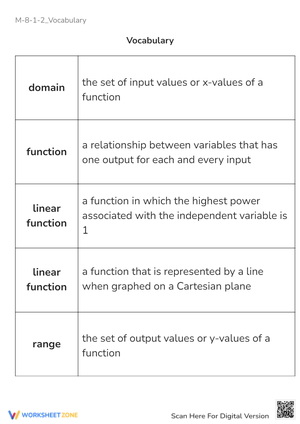
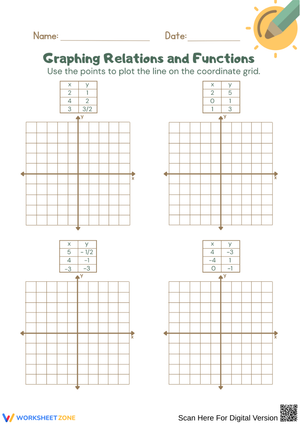
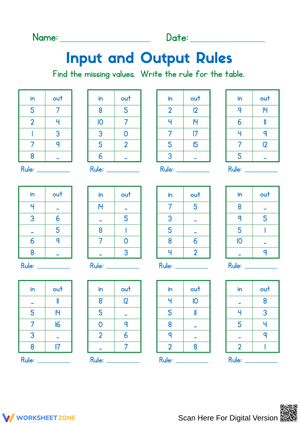
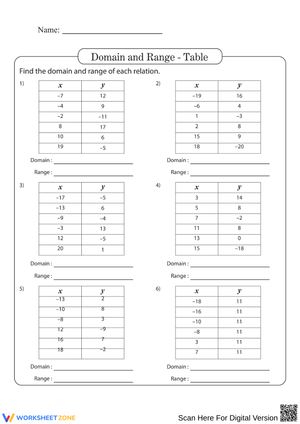
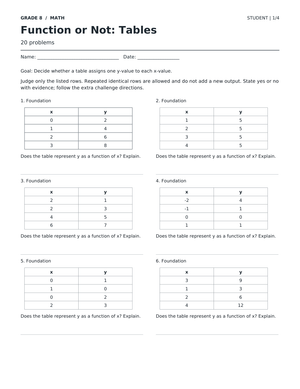
Function tables, sometimes called input-output tables or in-and-out boxes, ask students to apply or discover a rule that connects two columns of numbers. This is the same relationship students will eventually write as an equation or as f(x) notation. Introducing that relationship concretely, with tables instead of symbols, gives students something to point to and reason about before they are asked to manipulate abstract expressions.
Function tables are typically introduced around grade 3 and continue building in complexity through grade 7, which means a single classroom often has students at very different points on that continuum. A fourth grader finding outputs for a one-step add-3 rule and a seventh grader deriving a two-step rule from four input-output pairs are doing the same category of thinking at very different levels of abstraction, and function table worksheets let you meet each group where they are.
The Three Core Task Types
Most function table worksheets fall into three task types, and mixing them within a lesson or unit builds flexible thinking rather than rote procedure.
- Find the output: students are given a rule and an input, and must calculate the missing output.
- Find the input: students are given a rule and an output, and must work backward to the input.
- Find the rule: students are given several input-output pairs and must identify the operation or expression connecting them.
Of these three, finding the rule is consistently the hardest for students and the most valuable for formative assessment, because it requires generalizing across multiple examples rather than applying a known operation once.
Connecting Function Tables to Standards
CCSS 4.OA.5 asks students to generate and analyze a number or shape pattern that follows a given rule, and function tables are one of the cleanest ways to operationalize that standard in daily practice, since the rule is stated explicitly and the pattern is visible in two aligned columns rather than a single sequence. Teachers working toward later standards on defining, evaluating, and comparing functions can use the same table format as a stepping stone, simply increasing the rule complexity and eventually swapping the table for function notation once students are fluent with the underlying relationship.
As one widely cited K-12 math resource explains: 'Function tables give students a concrete way to see that a function is really a rule for pairing one number with another, and that same rule works no matter which input you plug in. Once students trust that consistency, moving to symbolic function notation becomes a relabeling task rather than a completely new concept, which is why table-based practice remains a staple from elementary through early algebra classrooms.
Classroom Implementation
A simple, repeatable routine makes function table worksheets far more effective than a one-off assignment. Start each new unit with a whole-class function machine demonstration: pick a rule, run several inputs through it aloud, and record the outputs on the board as a growing table. This gives students a physical mental model before they see a printed worksheet.
From there, move to guided practice where students complete a table with the rule given, then a second table where the rule is hidden and must be inferred. Save find-the-rule tasks for the end of the lesson or as an exit ticket, since they double as a quick formative check of whether students actually understood the pattern or simply followed directions on the first two task types. For small-group intervention, keep a rotating set of one-step rule tables on hand so you can pull a student aside for two or three minutes of targeted practice without disrupting the rest of the lesson.
Frequently Asked Questions
1. What grade level are function table worksheets appropriate for?
Function tables are typically introduced around grade 3 and continue in increasing complexity through grade 7, with high school extensions into linear, quadratic, and exponential functions.
2. How do function tables help students transition to algebra?
They let students practice the same input-rule-output relationship that algebra later expresses with variables and equations, so the underlying logic is already familiar when symbolic notation is introduced.
3. What is the difference between an input-output table and a function table?
The terms are largely interchangeable in K-8 instruction. Both describe a table where one column of numbers is transformed into a second column by a consistent rule.
4. How can teachers use function tables for small-group intervention?
Keep a rotating set of one-step rule tables with small numbers so a student can get two or three minutes of focused, rule-given practice before moving to find-the-rule tasks.
5. Which Common Core standards align with function table practice?
CCSS 4.OA.5 directly targets generating and analyzing a pattern from a given rule, which function tables practice in a concrete, two-column format.