What Even and Odd Functions Worksheets Build
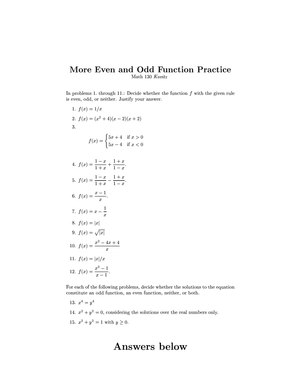
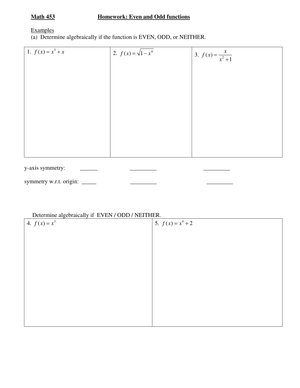
These even and odd functions worksheets give Algebra 2 and Precalculus teachers a ready set of problems for one specific skill: deciding whether a function is even, odd, or neither, both algebraically and from a graph. Instead of a mixed review packet, each sheet keeps students on the core routine of substituting -x, simplifying, and comparing the result to the original function. That focus makes them easy to drop into guided practice, homework, or a quick formative check.
The problem sets move from clean polynomial examples like f(x) = x^2 and f(x) = x^3 toward rational and trigonometric functions, so you can hand the same concept to a struggling group and a stretch group without hunting for new material. Because the classification skill shows up again in symmetry, transformations, and trig identities, time spent here pays off across the rest of the year.
The Algebraic Test: Even, Odd, or Neither
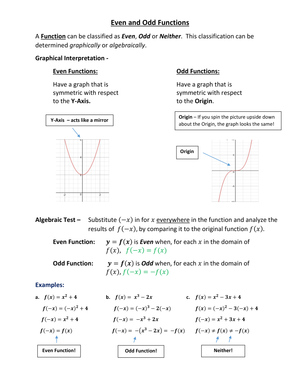
The heart of every worksheet is a three-step test. A function is even when f(-x) = f(x), and its graph is symmetric about the y-axis, as with f(x) = x^2. A function is odd when f(-x) = -f(x), and its graph has rotational, or point, symmetry about the origin, as with f(x) = x^3. Anything that satisfies neither condition is classified as neither.
Students work the routine the same way every time: replace every x with -x, simplify carefully, and then compare. If the simplified expression matches the original, the function is even. If every term flips sign so the whole expression equals -f(x), it is odd. The worksheets deliberately mix in functions that fail both tests so students practice carrying the check all the way through rather than guessing after one line.
Here is the pattern strong students internalize: for a polynomial written in standard form, it is even only if every term has an even exponent and odd only if every term has an odd exponent. A single mismatched term, such as the x in f(x) = x^2 + x, forces a neither answer. Teaching this exponent-parity shortcut alongside the substitution test gives students a fast way to predict the result and then a rigorous way to prove it, which cuts down on careless sign errors.
Reading Symmetry From the Graph
Many students grasp even and odd functions faster through pictures than through algebra, so the worksheets pair each definition with a graph. An even function folds onto itself across the y-axis: whatever happens at x = 3 also happens at x = -3. An odd function looks the same after a 180-degree turn around the origin, so a point at (2, 8) is matched by a point at (-2, -8). CK-12's function symmetry lessons frame these as the two ways a graph can mirror itself, which gives visual learners a concrete anchor.
On the worksheets, students match equations to graphs, sketch the missing half of a symmetric graph, or read a plotted function and state its classification. This graphical work reinforces the algebra: once students see that the y-axis fold corresponds to f(-x) = f(x), the substitution test stops feeling like an arbitrary rule and starts describing something they can picture.
Connecting Even and Odd Functions to Trigonometry
Even and odd classification is not a dead-end topic; it is the on-ramp to trig identities. Once students can test f(-x), they can make sense of why cos(-x) = cos(x) and sin(-x) = -sin(x). The worksheets that include trig examples let students apply the same routine to the six trigonometric functions and connect the result to the unit circle.
According to the Common Core State Standards (HSF-TF.A.4), students use the unit circle to explain the even and odd symmetry of trigonometric functions. Cosine and secant are even, while sine, cosecant, tangent, and cotangent are odd, a set of six results students can verify directly rather than memorize blindly.
CK-12's even and odd identities section builds on this, using the classification to justify simplifications students will lean on in Precalculus and calculus. Framing the trig identities as a payoff for the earlier algebra helps students see the through-line instead of treating each unit as unrelated.
Common Student Misconceptions to Watch For
The most frequent error is stopping the test too early. A student checks whether f(-x) = f(x), finds it does not, and writes odd without confirming that f(-x) = -f(x). The worksheets counter this by including a healthy share of neither functions, which are common and force students to complete both checks.
A second trap is confusing even and odd exponents with even and odd functions. The labels overlap for simple monomials, but f(x) = x^2 + x has both an even and an odd exponent and is neither. A third issue is sign management: dropping a negative while simplifying f(-x) turns a correct odd result into a wrong one. Watching for these three patterns while you circulate tells you exactly where to reteach.
Classroom Implementation
These worksheets flex to fit several instructional moments. As a warm-up, assign three quick classifications to activate prior knowledge before a lesson on symmetry or transformations. As an exit ticket, one even, one odd, and one neither function gives you a fast read on who can carry the test to completion.
For small-group intervention, start struggling students on polynomial-only sheets where the exponent-parity shortcut is visible, then move to rational and trig examples as they gain confidence. For a stretch group, ask students to write their own neither function and prove it, or to explain in words why a given graph cannot be odd. Pairing a graphing routine with the algebra test also supports the Common Core expectation that students recognize even and odd functions from both their graphs and their algebraic expressions.
Frequently Asked Questions
1. What is the difference between an even function and an odd function?
An even function satisfies f(-x) = f(x) and is symmetric about the y-axis, like f(x) = x^2. An odd function satisfies f(-x) = -f(x) and has point symmetry about the origin, like f(x) = x^3. The quickest tell is where the graph mirrors itself.
2. How do you algebraically test whether a function is even, odd, or neither?
Replace every x with -x and simplify. If the result equals the original f(x), the function is even. If it equals -f(x), the function is odd. If it matches neither, the function is neither. Always finish both comparisons before deciding.
3. What grade level or course typically covers even and odd functions?
Even and odd functions usually appear in Algebra 2 and Precalculus, generally in grades 10 through 12. The concept supports later work on symmetry, transformations, and trigonometric identities, so it often resurfaces throughout a student's high school math sequence.
4. Can a function be both even and odd, or neither?
Only one function is both even and odd: f(x) = 0, since it satisfies both conditions at once. Many ordinary functions, such as f(x) = x^2 + x, are neither, which is why students should always run both tests rather than assuming one must apply.
5. How do even and odd functions relate to trigonometric identities?
Cosine and secant are even, so cos(-x) = cos(x). Sine, cosecant, tangent, and cotangent are odd, so sin(-x) = -sin(x). These even and odd identities let students simplify expressions and are a standard tool in Precalculus and calculus.