Function or not a function worksheets help students strengthen a key algebra skill: deciding whether each input connects to exactly one output. This concept is important because it prepares learners for graphing, equations, function notation, and more advanced algebra topics. At first, students may think a relation is a function simply because the numbers look organized. With guided practice, they learn to check the rule carefully across tables, ordered pairs, mapping diagrams, graphs, and real-world situations.
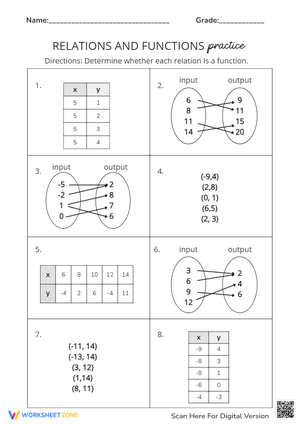
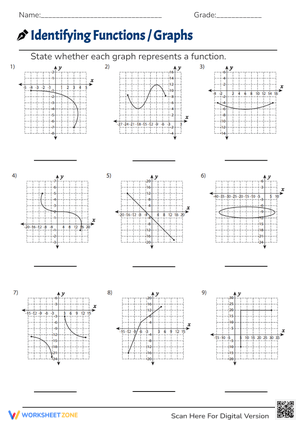
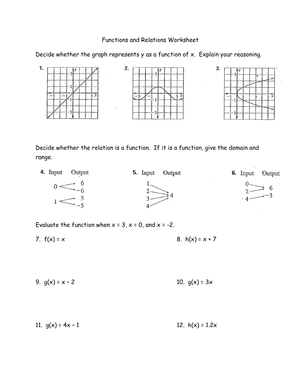
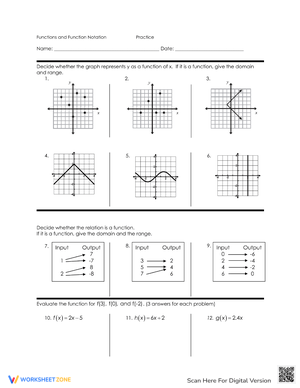
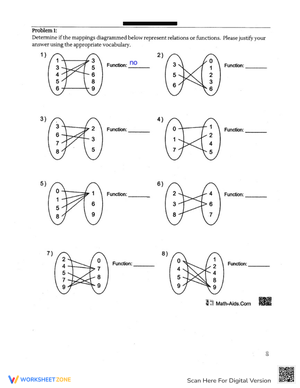
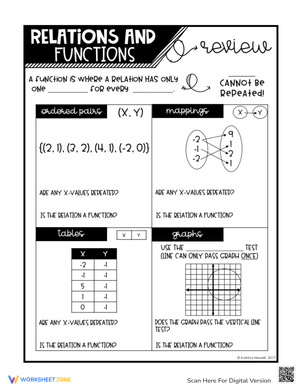
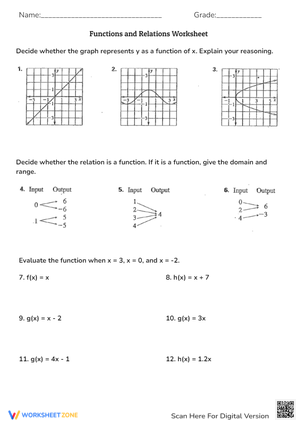
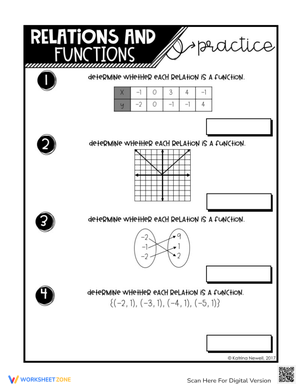
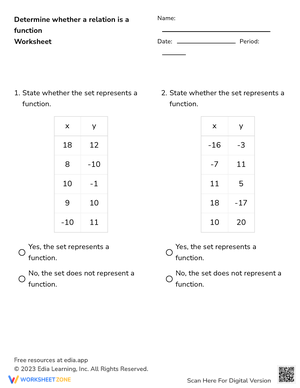
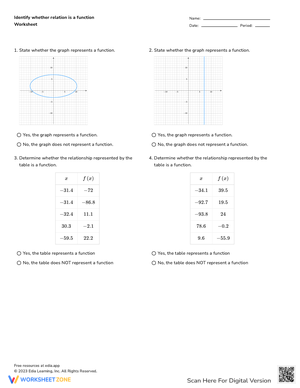
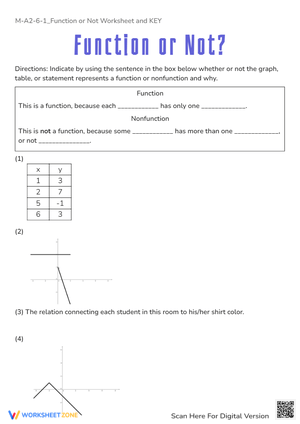
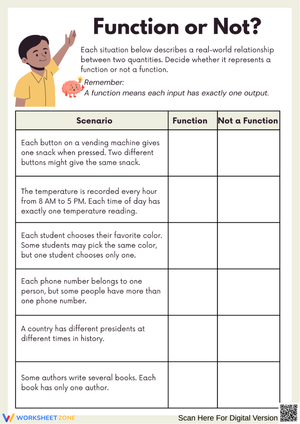
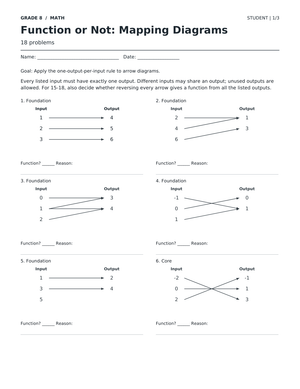
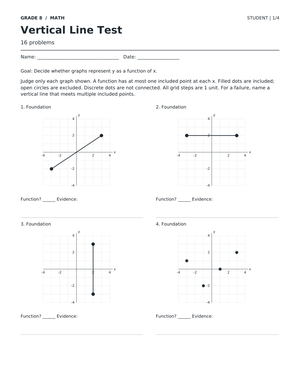
A function follows one clear rule: every input must have only one output. If the same x-value appears more than once with different y-values, the relation is not a function. If one input in a mapping diagram points to two different outputs, it also fails the function rule. On a graph, students can use the vertical line test to check whether any vertical line touches the graph more than once. These worksheets give learners repeated opportunities to apply the rule in different formats until the idea becomes easier to recognize.
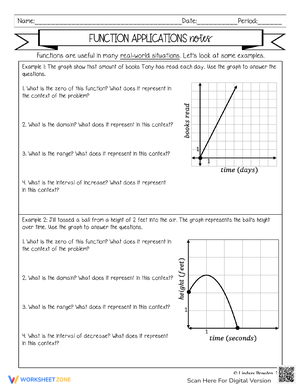
These printable activities are especially useful for middle school and early high school students who are beginning to study algebraic relationships. Students can practice important vocabulary such as input, output, relation, domain, range, ordered pair, and vertical line test. Teachers can also connect this topic to broader algebra skills, such as understanding mathematical expressions, so students see how functions fit into the larger structure of equations, variables, and mathematical reasoning.
Worksheetzone’s function or not a function worksheets are designed to support different learning levels. Some pages focus on simple ordered pairs and tables, while others include mixed review with graphs and mapping diagrams. This helps teachers begin with direct examples, then gradually move students toward more challenging problems. Once learners understand how to identify functions, they can continue building fluency with related resources such as function operations practice sheets, where they apply function rules in more advanced algebra tasks.
Teachers can use these worksheets in many classroom routines, including warm-ups, guided practice, homework, math centers, quiz review, exit tickets, and small-group intervention. They are also helpful for identifying misconceptions quickly. If a student struggles with repeated inputs in a table, the teacher can review the “one input, one output” rule. If another student struggles with graphs, the vertical line test may need more practice. With consistent use, function or not a function worksheets help students build accuracy, confidence, and readiness for future algebra lessons.
Frequently Asked Questions
Question 1: What grade levels are best for function or not a function practice?
This topic is most commonly taught in grades 7 through 9, although some students may meet it earlier or later depending on the curriculum. Middle school learners usually begin with tables, ordered pairs, and mapping diagrams, while high school students often connect the idea to graphs, equations, domain, range, and the vertical line test.
Question 2: How can students tell if a relation is a function?
Students should check whether each input has exactly one output. In a table or set of ordered pairs, they should look for repeated x-values with different y-values. In a mapping diagram, they should check whether one input points to more than one output. On a graph, they can use the vertical line test.
Question 3: How can teachers use these worksheets in class?
Teachers can use them as warm-ups, guided examples, independent practice, homework, review activities, or quick assessments. They are also helpful for small-group instruction because teachers can identify which representation—tables, graphs, ordered pairs, or mappings—causes the most confusion for students.
Question 4: Why do students need to master functions before advanced algebra?
Functions are a key part of algebra, graphing, equations, and data analysis. When students understand how inputs and outputs relate, they are better prepared to study linear functions, nonlinear functions, slope, intercepts, transformations, and real-world mathematical models.