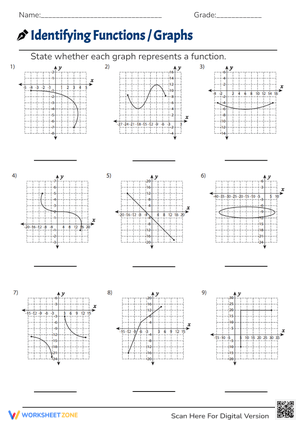
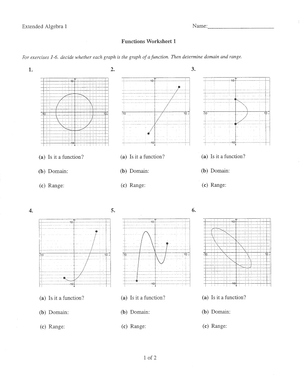
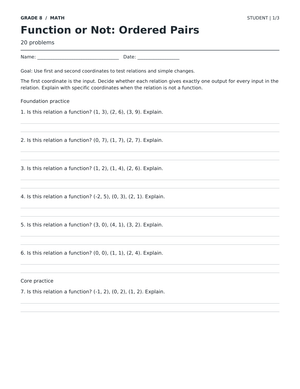
Students walking into 8th grade algebra can usually plot points and read a table, but they stumble the moment a relation is not obviously a function. Identifying functions worksheets close that gap by forcing students to test the same skill across ordered pairs, mapping diagrams, tables, and graphs, rather than memorizing one trick that only works in one format. That variety matters because state assessments mix representations freely, and a student who only recognizes the vertical line test on a graph will freeze when the same question shows up as a set of ordered pairs.
How These Worksheets Support 8.F.A.1
The core standard behind this entire unit is 8.F.A.1, which asks students to understand that a function assigns exactly one output to every input. Worksheets built around this standard are not just graphing practice. They are designed to make students articulate, in their own reasoning, why a relation does or does not meet that one-output rule. When a worksheet asks students to justify their answer in a sentence, not just circle function or not a function, it pushes them toward the conceptual understanding that later supports function notation and comparing functions represented in different ways.
Teachers who track early-unit formative data often notice that mapping diagrams produce the highest early error rate, higher than tables or ordered pairs, because students focus on whether every value gets used rather than whether any input repeats with two different outputs. Spending one extra day on mapping diagrams before moving to graphs tends to reduce that error pattern significantly by the time students reach the vertical line test.
Common Misconceptions Worth Addressing Directly
The most persistent misconception is confusing every input needs an output with every output needs an input. Students often think a relation fails to be a function if some y-value never appears as an output for more than one x-value, when that condition is actually irrelevant to the function definition. Another common error shows up with mapping diagrams where students assume any diagram with fewer outputs than inputs must be broken, rather than checking whether a single input maps to multiple outputs. Naming these misconceptions out loud before students start independent practice cuts down on repeated errors during small-group work.
Classroom Implementation
Use identifying functions worksheets as a five-minute warm-up before introducing function notation, since students need the relation-versus-function distinction solid before f(x) notation makes sense. For small-group intervention, pull students who miss mapping diagram items specifically, since that representation tends to reveal the deepest misunderstanding of the one-output rule. Before a unit test, assign a mixed-representation worksheet as a formative check and review any missed items as a whole class the next day, focusing on the reasoning behind each answer rather than just the correct label. Pair worksheets with a quick verbal explanation requirement, asking students to say why a relation is or is not a function, since verbalizing the rule catches gaps that a circled answer alone will not reveal.
Frequently Asked Questions
1. How should teachers introduce the vertical line test to students who are new to graphing?
Start with a physical demonstration using a ruler on a projected graph, then move to worksheet items that pair simple linear graphs with clear non-function counterexamples like circles, so students see the test applied to both easy and tricky cases before working independently.
2. What is the difference between a relation and a function in simple classroom terms?
Every function is a relation, but a relation only counts as a function when every input has exactly one output. Framing it as one input, one output, no exceptions gives students a short rule they can apply to any representation.
3. Which representation is hardest for students and why?
Mapping diagrams tend to cause the most confusion because students focus on whether every output gets used instead of checking whether any single input splits into multiple outputs, which is the actual condition that matters.
4. How can these worksheets support formative assessment before a unit test?
Assign a mixed-representation worksheet a few days before the test, then use the results to group students for targeted review, focusing extra time on whichever representation produced the most missed items.
5. What grade level and course typically introduces identifying functions first?
This skill is core to 8th grade algebra readiness under the 8.F.A.1 standard, and it is typically the first formal introduction before students move into function notation and linear versus nonlinear function comparisons in high school algebra.